Performance


Introduction
The pioneering lantern historian John Barnes, in the second part of the catalogue he published for the Barnes Museum of Cinematography, wrote that "The years 1659 to 1721 may be regarded as the formative period of the magic lantern when the instrument would be relatively unknown to the general public. The public debut of the magic lantern most probably took place when it passed into the hands of the itinerant showmen. These early exhibitors of the magic lantern are recorded, unnamed, in contemporary pictures and engravings or casually noted in the literature of the times."1 lt is difficult to assemble a proper history of the travelling lanternist as only a few contemporary accounts of their activities survive in printed sources, and some of those need to be assessed in terms of the writer's own self-interest or prejudices, as can be seen in the text below. At the same time some lantern historians have been seduced by the often romantic imagery of the itinerant lanternist as portrayed in many paintings, woodcuts, and engravings that are a common source of information about not only peripatetic lantern showmen but also vendors of many other goods and services, from the sale of cookwares to the cleaning of chimneys to the circulation of popular prints depicting current events.
Almost by definition, the travelling lanternist (or street musician, or peepshow exhibitor) provided entertainment or news in exhibitions given opportunistically: when invited into a private home, often by or for its servants, when twilight provided a momentary chance in a park or a dim street, when an informal or unregulated market or fair appeared. For the travelling lanternist of the 18th and 19th centuries there were no handbills, no posters, no advertising in local publications; in fact, there were no engagements planned in advance that left a later historian with records that could be assessed and deployed to produce a coherent narrative. Instead, the history of the travelling lanternist involves a careful parsing of a fragmentary record that includes a few eyewitness accounts, a few sketchy accounts of the sale and manufacture of apparatus (including slides), a few public complaints, and a very many artistic representations of the lanternist and his workplace and his family, all of which must be interpreted with an appropriate balance and perspective that might be able to strip away some of the layers of romanticism and bourgeois politeness that all too often obscure the actual experience of the travelling entertainer.
Before the lanternist appeared, the anonymous early travellers from Savoy, from Piedmont, from Auvergne, from any poor district where a hard life of a precarious existence on the road offered hope beyond the certainty of endless impoverishment, roamed across Europe in the 17th and 18th centuries as individual showmen serving up momentary glimpses of curiosities or short performances of physical skill. They exhibited coloured drawings in peep show boxes, juggled balls or fruit, sang about the foolishness of life or about the exploits of the nobility, told stories of far-away lands or nearby scandals, performed hand magic with cards or cups, and carried news of strange happenings from place to place in a settled and immobile society. To attract notice for their impromptu shows in the streets, at markets and fairs, or in the homes of the emerging middle classes, they most commonly used a small hand organ turned with a crank or travelled with a trained marmoset. Sometimes an entire family travelled together, the woman grinding away at the organ's handle while the man called an audience together and gave a simple performance, a small child perhaps adding an energetic tumbling or acrobatic routine to the overall bustle, or beating time on a small drum or triangle. With the wider availability of the magic lantern towards the end of the 17th century, this apparatus quickly became one of the many "curiosities" exhibited for the wonder of ordinary people by these travelling showmen, called Galantee showmen in England, Savoyards on the Continent, Ausrufer in Germany and Denmark. The profession was not new, only the instrument.
There is some evidence that the magic lantern had reached the hands of itinerant showmen not long after it was first noted by scientists in the decade of the 1660s. With Abraham Weber from Dresden exhibiting a magic lantern for six days at the Easter market in Leipzig in 1677,2 it is now clear that the new optical instrument had begun to occupy a public space outside of the parlours of gentlemen at a very early date. And by 1756 the Abbé Jean Antoine Nollet could say that the lantern had become "almost ridiculous.... [lt is] paraded in the streets" and used to amuse children and the common people.3 By the first half of the 18th century, well before the first prints of travelling lanternists appear, disparaging comments on the use of the lantern to frighten or divert superstitious audiences became ever more common in books of science or of literature; that is, books written in the main by persons of the educated class. There is an unexplored sociology to these written comments that have survived amid the scarce commentaries on a common phenomenon that was present across Europe, a sociology that has to do with the innate suspicion of strangers in a settled society, with snobbish attitudes of the educated towards the unlearned (and / or the unwashed), with the unfounded suspicions that always accompany the introduction of a new medium, a new entertainment, that accompanies change.
The travelling Savoyards and their culture
Amongst the fraternity of travelling showmen, the Savoyards were the earliest and most widely dispersed group of entertainers, seen and heard in every corner of Europe. Until late in the 18th century they seem to have had a virtual monopoly on the display of optical and mechanical curiosities; certainly it was the Savoyards who most clearly fired the imagination of artists, writers, and commentators in the early years and who were memorialised in numerous engravings, plays, novels and social commentaries. As optical and mechanical entertainments became more widespread throughout the 18th and 19th centuries through the activities of travellers from other sub-national groups, including Waloons from the Low Countries and Welsh from Britain, it was still the Savoyards who symbolically represented the world of the travelling showman for many writers and artists. Just how this group of hardy perambulators from a small region of southeastern France bordering on Switzerland and Italy came to flood across the European continent, and how they came to specialise in magic lantern shows, peep shows, and mechanical organs is something of a mystery to this day. One suggestion has been that it was poverty and lack of opportunity within Savoy that motivated so many of its residents to undertake the difficult and dangerous profession of travelling showman. But the unsettled nature of both politics and culture in Savoy must also have played a part in setting its residents on the long roads that led to northern Germany, Poland, Britain, France and Italy. Nestled south of Geneva along the southwestern Swiss and northwestern Italian borders in what is today southeastern France, Savoy commanded the western Alpine passes into Italy and had good access to not only neighbouring Geneva but also the southern German states as it lay across a major north-south trade route between Italy and Germany. Although ruled by one of Europe's oldest noble families, the House of Savoy established by Count Humbert I the Whitehanded in the 11th century, the largely French-speaking region was disputed territory throughout the early modern period, annexed by the French in 1536 only to be returned to the House of Savoy in 1559, with a second occupation in 1792 before being again returned in 1815. War between Savoy and Geneva broke out in 1535 when the nearest large city adopted the protestant doctrines of John Calvin. Meanwhile, the ruling House of Savoy, which had effectively stymied the local aspirations of both the French court in Paris and the Hapsburg court in Vienna by serving either or both as the need arose, began to take more and more interest in their Italian properties to the south, moving the region's capital and administration to Turin in neighbouring Piedmont in 1563 and becoming Kings of Sicily in 1714; they would become the ruling family of a united Italy from 1848 to 1946. Savoy played a significant role in the Italian Risorgimento, and Giuseppe Garibaldi took part in an abortive republican uprising in Piedmont in 1834. Against this fluctuating and unstable political and religious background, there were multiple grounds beyond simple poverty for residents to seek their fortunes, or at least their sustenance, outside their native region.
Travelling Savoyards, as well as travellers from Auvergne and Piedmont, were also widely known as chimney-sweeps across Europe, and even these cousins to the Savoyard optical entertainers had a dashing reputation. The Savoyard chimney sweep "was mostly an amusing fellow; he had a knack for humour ... and frequently thought up comic variations or even complex rhyming couplets for a song."4 That the Savoyard came to have something of a romantic, independent, and roguish reputation on the Continent in the 17th century is attested by Sir Anthony van Dyck's portrait François Langlois as a Savoyard of c. 1634-7. The Parisian bookseller and publisher, a longstanding friend of van Dyck whose career spanned work in The Netherlands, Italy, and London at the court of Charles I, is shown seated at the corner of a building in the open air dressed in a simple red robe and dramatic wide-brimmed hat, with a lively expression as he plays a Continental bagpipe, or doodlesack. It can be reasonably inferred from this portrait that the Savoyards already had appeared in parts of Europe as travelling entertainers, and were associated with romantic figures of charm and independence who held some attractions for liberal upper-class and bourgeois society. Even before this portrait was made, there is evidence that the Savoyards were involved as traders of optical devices. During the 17th century Savoyards were active in the fairs and markets of southern Germany as traders in eyeglasses, simple telescopes and enlarging lenses. The idea that the Savoyard trade in optics went beyond eyeglasses is given substance by a letter from the long-serving agent for Herzog August d. J. in Wolfenbüttel, Philip Hainhofer, who wrote to the Herzog from Augsburg in 1618 reporting that a set of "crystalline glasses... .were made in France... Of the perspectives for seeing in the distance, I have bought three different kinds from the Savoyards."5
Sources of the Savoyard lanterns and slides
At some point during the later 17th and early 18th centuries, the travelling Savoyard entertainers added the magic lantern and optical peep shows to their repertoire on the roads, probably as a result of their prior trade in optical goods and their knowledge of sources for these implements in southern Germany. At this time, Savoyards appeared at the markets in Germany, but now as buyers, not sellers: in his notes on opticians active in Augsburg made in the early 1740s, Johann Conrad Beuther recorded that the eyeglass maker Berkenstein "also puts together magic lanterns, cameras obscura and peep-shows which he sells to the Savoyards."6 Berkenstein had an established workshop for eyeglasses, but also made geometrical forms in glass and optical toys. Beuther also left a brief portrait of the work at Berkenstein's shop, where "A number of young boys, who work for a small daily wage, grind [lenses] for the whole day at a fixed counter with large iron pans filled with the yellow sand brought from the dunes, and [then] they polish on felt with the red English earth that they call `Batich".7 From this production Berkenstein then put together an entire showman's package, including hand-painted slides, which he commissioned from either Augsburg or Nürnberg painters. Beuther recorded some notes on Berkenstein's slides as well: "the pictures for the magic lantern are delivered to him by a local illustrator, each piece [slide] with five images for about 6 Batzen, which is reasonable for this money. but he also goes to Nürnberg for them, where he hopes to get them painted more beautifully and at a cheaper price, these are also much better drawn. but they don't have such lively colours, nevertheless each piece [slide] with six to eight figures comes for not over 30 Kr. for which they are very desirable."8
Evidence from illustrations of street criers
Direct representations of the travelling lanternist began to appear in etchings, woodcuts, and illustrations in the 18th century, often in series of prints depicting the professional work and appearance of various street vendors and entertainers. These artistic records of street criers date back to the 16th century and the introduction of the printing press, but a growing middle-class appetite for pictures made them particularly popular from around 1700, after which long series representing street life and itinerant professions were published across Europe,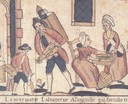
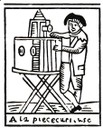
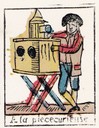
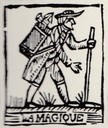
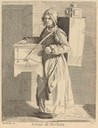
Itinerant entertainers were frequently represented, with jugglers, tightrope walkers, card players, and exhibitors of exotic animals seen in the earliest series; optical showmen began to appear in these prints around 1700, with Savoyard peep-show exhibitors seeming to be the earliest, in series of street life in Paris drawn by François Guérard and J. Maillot. The travelling magic lantern showman appeared only around the 1730s, one of the most beautiful and famous being the two representations in sculptor Edmé Bouchardon's Etudes prises dans le bas peuple ou les cris de Paris, issued in four series between 1737 and 1746.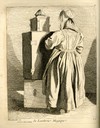
Travelling lanternists proliferate in the mid-18th century
By the 1750s, illustrations of wandering lanternists proliferate rapidly, with depictions of travellers on the road,11 shows for children,12 or performances in the homes of fashionable patrons.13 A mid-century series of forty street cries from Danzig drawn by Matthäus Deisch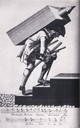
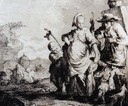
The appeal of the travelling lanternist for mid-century society is reinforced by the survival of a number of oil paintings, a vastly more expensive medium than the publication of popular prints, and one that would be affordable only by the upper bourgeois and landed gentry. Johann Konrad Seekatz (1719-1768), painted Wandemde Savoyardenknaben mit Drehleier und Latema magica in about 1760, showing a large family gathered in front of a thatched cottage. A painting attributed to Johann Georg Trautmann, one of the circle of Frankfurt-area artists associated with Goethe's father Johann von Goethe, portrayed an itinerant lanternist in a bourgeois family salon about 1765.
Perhaps the most famous of these paintings was by Jean Baptiste Maria Pierre (1714-1789), who made an intense portrait of a lanternist with two young girls about 1757, a work in which the artist took special pride, since he reacquired it from the estate of its owner, Field Marshall Conte de Vence and then kept it in his own collection until his death. The wider popularity of this work was assured by the publication of engravings of the painting by Jean Daullé in France and R. Blythe in Britain immediately upon its completion in the late 1750s.
Popular literature also took notice of the wandering showmen: "the travelling Savoyards who stroll about Europe, amusing ignorant people with the effects of a magic lanthorn", are invoked by Tobias Smollet in his The Adventures of Ferdinand Fathom published in 1753,16 when one of his characters disguises himself as a Savoyard to gain entrance to a nobleman's home. Gaetano Buganza, the abbot at Mantua, gently satirised the boastful nature of a lanternist from Trentino in his Poesie Latine of 1786, where the showman announced that his lantern "contains a new world, unknown images and the other side of men's faces."17 In his poem "Das Schattenspiel" (The Shadow Play), the literary publisher and professor of philosophy in Halle (and later Freiburg) Johann Georg Jacobi (1740- 1814) describes the show of a travelling lanternist, given one day to a young woman sitting in her garden: Jacobi's representation of the show was far different from those that the theologians and scientists so smugly derided, and included nightingales half hidden in bushes, a god with tender eyes and beautiful cheeks, and a shepherd lying in a field of flowers wakened by the goddess Diana.18
The content of the travelling lantern show
The Savoyards travelled Europe with peep show boxes, magic lanterns, street organs, and cabinets of curiosities as interchangeable attractions, sometimes in combination. It is difficult today, in a culture that is suffused with images of all kinds in books, advertising panels, public museums, and electronic media, to imagine the visual impact of a peep show view or projected magic lantern slide on a public whose only access to the representational image was to be found on the walls of churches or in the rough broadsheets sold at fairs and markets. Whether finely or crudely drawn or painted, the images presented by the wandering showman, taken in combination with his or her essential craft of storytelling and hyperbole, must have had, at the least at the beginning in the early 18th century, a startling and wondrous effect. Certainly the image of the travelling lanternist appears repeatedly in popular culture in many forms across the next hundred years, from sculpted bronze figures to decorative ceramics, to even depictions in lantern slides themselves, an early selfreferential media appearance that recalled lingering memories of the street exhibitors.
Surviving evidence of the contents of itinerant lantern shows indicates that many were a source of both narrative delight and visual information, providing a populist commentary on events of the day, representations of the life of the nobility, and illustrations of familiar stories. An early 18th century print from The Netherlands by Jan de Ridder, De Toyer Lantaren (The Magic Lantern) is one of three prints, where each shows images of three wandering lanternists and of a lantern show in a public house.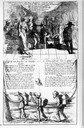

This combination of a touch of science, a touch of respectable titillation, a touch of the exotic, and a touch of the newsworthy, seems to have been typical of the range of subjects that was the ordinary repertoire of the travelling lanternist. A surviving set of lantern slides from c. 1790-1805 contains a similar range of subjects. The hand painted long slides, each 7,7 or 8 cm high and either 34,5 or 36,5 cm long are typically divided into between three and six episodes, although a slide showing the Tsarina of Russia, probably Katherine II, arriving at a palace is a single "scene", no doubt to be shown as an extended royal procession emphasizing the Tsarina's status.
Three slides represent contemporary events, including Napoleon's proclamation restoring the Mameluk nobility during his campaign in Egypt (1798) and his battle against Russian and Prussian troops at Eylau (1807). The story of Noah and the Ark is again present, along with a royal hunt. The remaining three slides, from two different painters, are of a more impertinent nature and gave the lanternist a broad potential for adopting his narrative to the age and experience of his audience. One represents six caricatures of courtly figures with grotesque features; the possible inclusion of Marie Antoinette could indicate that this was a satire on French society just before the Revolution. The second slide narrates the amorous adventures of a scoundrel who is, intriguingly, defeated by the women he attempts to conquer. The third represents a duel fought over an elegant woman and a ribald joke involving a peasant and a hoofed Devil.
This last slide may be two completely separate stories, where the lanternist could choose, depending on his audience and situation, whether or not to show his most impolite imagery. The skill of making quick and reliable judgements about strangers, which must have been a requirement for survival on the road, as well as a requirement for success, was surely a skill that was also put to use in judging just how to embroider the narrative that was woven around the single set of slides that served the travelling lanternist year in and year out for a variety of audiences.
The lantern show of Jos. Leverge and the reports of Henry Mayhew
The Biblical story of Noah and the Ark features again in another contemporary account of a travelling lantern show in Britain, when in 1818 William Hone invited a passing lanternist into his home to amuse his children during the Christmas season. Five years later Hone, a noted antiquarian, publisher of satirical pamphlets and radical social reformer,
The British journalist, reformer, and co-founder of Punch Magazine, Henry Mayhew, conducted two first-hand interviews with subjects who recalled the world of the travelling exhibitor early in the 19th century. The first report was about a lantern manufacturer, who discussed street lanternists with Mayhew in early 1850, and remembered the time around 1815 when he started out in the business, a time when lantern shows were "then no better than the common galantee shows in the street" and "There was no science and no art about it. It went on so for some time — just grotesque things for children, as 'Pull devil and pull baker." Mayhew's unidentified subject then went on to describe the repertoire of the travelling lanternists: "...Bluebeards were fashionable then — uncommon blue their beards were, to be sure; and Robin Hoods — and Robinson Crusoes with Fridays and the goats, and the parrot, and the man's footmark on the sand — and Little Red Riding Hoods, as red as the Blue Beards were blue. I don't remember Ali Babas and Forty Thieves, there were too many of the thieves for a magic lantern — too many characters; we couldn't very well have managed forty thieves — it's too many. There were things called 'comic changes' in vogue at that period. As the glasses moved backwards and forwards, fitted into a small frame like that of a boy's slate, a beggar was shown as if taking his hat off, and Jim Crow turning about and wheeling about, and a blacksmith hammering — moving his hammer. There were no theatrical scenes beyond Harlequins and Clowns."21
Mayhew's second journalistic encounter was with a street showman of long experience who began his itinerant life at the beginning of the 19th century.22 After surviving the workhouse and an unhappy apprenticeship to a chimney-sweep, the unnamed showman became assistant to an organ grinder about 1810, moving on to assist an Italian with a trained bear the next year, a position which took him across all of southern England for several years until the troupe performed an extra day after the Chester races and were arrested, the bear shot on the orders of the magistrate. The showman next took up with an exhibitor of automata, "another foreigner, named Green" sometime around 1815, who had a collection of wind-up dancing figures including "a Turk called Bluebeard, a sailor, a lady called Lady Catarina, and Neptune's car, which we called Nelson's car as well; but it was Neptune's car by rights."23 lt was with Mr. Green that the showman began his lantern exhibitions: "A month before Christmas we used to put the figures by, for the weather didn't suit; and then we went with a galantee show of a magic lantern. We showed it on a white sheet, or on the ceiling, big or little, in the houses of the gentlefolk, and in the schools where there was a breaking-up. lt was shown by way of a treat to the scholars. There was Harlequin, and Billy Button, and such-like. We had ten and sixpence and fifteen shillings for each performance, and did very well indeed. I have that galantee show now, but it brings in very little."24
Critical accounts of the travelling lantern show
During the 18th century, several commentators wrote about the poor quality exhibitions of the travelling lanternists, and to be sure there are doubts about the erudition and educational value of what was, after all, a popular entertainment given opportunistically on street corners, in pubs and taverns, and when possible, in the drawing rooms of private homes. But these critical reports also suggest an evolution in the repertoire of the travelling lanternist, for by the time direct accounts of their shows were written down early in the 19th century, the often-cited ghosts, ghouls, witches and terrifying representations of the underworld had given way to more respectable narratives and glimpses — often satirical — of the social life of the upper classes.
To some extent, these critical reports of early travelling lantern shows were also self-serving, since they tend to be found in a context where the author is principally talking about superstition and popularly held beliefs in distinction to the growing influence of rational theology and experimentally-based science. For these authors, the anonymous travelling lanternist made an easy and universally recognizable target for the writer to make a point and give his literate middle-class readership the reassurance that they were above such common pursuits. Often, the complaints are found in works defending the ongoing progress of the Enlightenment, works written by second-rank figures who were still trying to eradicate superstitions lingering on from an earlier age.
The travelling lanternist who could make "ghosts" appear became a fixture of their books, perhaps one whose prominence in the literature was not wholly deserved on the basis of actual practise. Since no accounts of the earliest travelling lantern shows survive outside this literature, the point is perhaps moot, and in any case the notoriety and rapid spread of the phantasmagoria show in the 1790s gave sufficient cause for ghostly lantern projections to come into disrepute in intellectual circles. In 1744, J. G. J. Breitkopf wrote that as the Enlightenment progressed further and further, the formerly popular ghost stories "foundered more and more because of their physical irrationality. And we would have cause to fear so many different things; since we see daily Savoyards carrying around magic lanterns for shows, who have such control over them that they have to appear at their pleasure on the wall."25
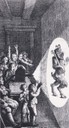
The images represented on the screen in engravings of the travelling lantern shows in the second half of the 18th century only occasionally show ghostly, devilish, or superstitious subjects, as in Johann Eleazar Schénau's La Lanteme Magique of 1765, which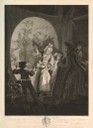
The compact, sophisticated lantern back-pack
Travelling lanternists are depicted either as a family group, often equipped to provide a number of optical and aural entertainments, or as a solitary traveller alone on the road. Their lantern is usually found as a compact instrument fitted to the top of a pack of goods, which could include a cabinet of curiosities, or a peep-show, or a mechanical organ; further accessories are normally a triangle or tambourine, and sometimes a marmoset, all of which would be used to attract attention to the main exhibitions. Marmosets, in particular, "were in general presented by Savoyards."29 The magic lantern's chimney, topped by its distinctive rosette "crinkle-top" is usually clearly visible from whatever angle the travelling showman has been depicted. By both weight and volume, the lantern was the lightest and smallest device in the travelling showman's repertoire, even if it had a substantial supply of glass slides. The solitary lantern showman is often depicted with a lightweight "all-in-one" lantern, fixed at the top of a small case with compartments underneath for the storage and protection of the valuable lens and slides, with a back panel that served as well as the carrying structure for the instrument.
One such lantern, as depicted in a print by Carle Vernet in a series of 100 street cries from around 1820, and itself dating from c. 1790-1800 has survived in a private collection, and is a remarkably sophisticated portable instrument. The overall dimensions of the wooden case are 55cm high, 24 cm deep and 43 cm wide. The lantern is 14,5 cm square and 41 cm high, including chimney, and is fixed at the left-hand side of the backboard, with two full-length compartments underneath for the storage and protection of the valuable lens and slides (the set of long slides described above was found with this lantern), lamp, and a supply of oil. The lantern body is fixed to the top of this simple box, which was a secure and instantly portable single unit, with an open tray enclosed by two pieces of board to its right. The entire unit could be removed from the lanternist's back and set on its flat base ready to project in seconds, with slides quickly produced from the storage compartment beneath. The position of the open tray next to the lantern and its lens and slide stage provided a full enclosure for the expensive hand-painted slides to one side of the lantern, so that in the case of any disruption during an impromptu exhibition the lanternist needed to protect his slides from only one side of the lantern. In calmer moments it was a simple task to remove the slides one by one from their storage compartment below and fit them ready for viewing in the lantern immediately above. A compact, well-evolved design undoubtedly based on many years' experience, the rough carpentry of the case and simple wood and tin lantern (no lens is present) belie the practical sophistication of this purpose-built and rarest of magic lanterns.
If it was not optically sophisticated as a scientific instrument, the overall design of this lantern as a working showman's tool certainly contradicts many of the critical accounts that are to be found in the semi-scientific literature of the time, for example the comments of Marc-Mitouflet Thomin in a book on optics and optical instruments published in Paris in 1749. Thomin reported that the lanterns used by travelling showmen were of poor quality and inferior effect: he complains that one of the lenses normally used "is cast in a mould of the approximate size, and as a result it cannot be well adjusted" and that the lanterns do not have a reflecting mirror at the back of the lamphouse, which greatly reduced the illumination and, consequently, the size of the projected image.30
While it is possible that Thomin may have examined such a poor quality lantern at the time, his comments are somewhat extreme since we know that a polished metal reflector, not an expensive element in lantern construction, was in use as a standard item in lanterns from the 1670s onwards, and that normal suppliers to the Savoyards in southern Germany like Berkenstein were grinding, not moulding, their lenses, although perhaps not to the highest standards demanded by quality scientific instrument makers. Perhaps Thomin undercuts his criticism of travelling lanternists by noting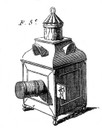
The figure of the itinerant lanternist becomes a satirical metaphor
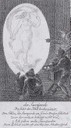
It was the travelling lanternists with their appearance across the whole of Europe who established the magic lantern as a metaphor in popular culture. In Nürnberg, the science lecturer and populariser Johann Konrad Gütle (see Chapter 2) even turned the figure of the Savoyard into an elegant toy in 1794: he produced a case with a painted representation of a lantern show using a cut-out circle where the lantern image appeared,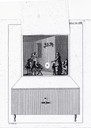
Given their ubiquitousness in the popular landscape and their reputation, deserved or not, for presenting irrespectful or socially impertinent images, it is not surprising that travelling lanternists also became figures well-known in satirical prints and political caricatures. One early Dutch print of 1720, Actieuse Nacht-Wind-Zanger, which exists in several variants,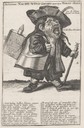
The gradual disappearance of the travelling lanternist
By the middle of the 19th century, the travelling lanternist began slowly to disappear, several decades before the street organists who were his colleagues. But by this time the pioneering travellers from Savoy, having established routes through most of the major cities in Europe, were joined by even more economic refugees leaving impoverished lands to make their way in rapidly growing urban centres. A recent study shows that by the 1850s the street entertainers and musicians who were roaming throughout Europe had been joined by migrants from the Dutchy of Parma and the Kingdom of Naples, from the province of Frosinone or the region around Lazio.34 Travellers from Savoy were still present on the road, but for the urban audiences of itinerant showmen the aura of Savoyard depictions over two hundred years now cloaked a diverse and polyglot population drawn from poorer regions in every corner of Europe, as well as from those afflicted by war. The hard life of the traveller was also beginning to appear in prints and paintings a far cry from the romanticized interpretation of Van Dyck. In a print by Valentin Foulquier of 1859 the lanternist giving a family show for some children is now depicted as an elderly man. H. G. Hines wood engraving for the Illustrated London News on Christmas Day 1858 shows a family gathered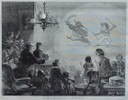
The travelling lanternists had done their job all too well, and had firmly established the magic lantern as a popular entertainment. Two harbingers of a more modern era slowly doomed their profession so that it became only a romantic memory: the growing industrialisation of magic lantern manufacture which made inexpensive models more and more commonly available in homes and to local exhibitors, and the application of the Argand lamp as a source of illumination for the magic lantern, which made possible scheduled entertainments for larger audiences.
In reality, as showmen, the travelling lanternists had not kept up with the times, notwithstanding their sometime use of contemporary events in their shows. Their profession relied both on a sense of wonder that was slowly dissipated as the magic lantern became more widely known, and on a fading attachment to a perception of adventure that went back in time to Van Dyke's 17th century portrait. As more and more sophisticated projection shows began to appear, the travelling lanternists with their simple if robust lanterns were increasingly recognized as oldfashioned and irrelevant except in the most backward and isolated parts of society. The dilemma faced by the Savoyards was presciently described by Abraham Gotthelf Kästner as early as 1749 when he commented, "Nobody takes the Savoyards with their magic lanterns for an example of an experiment-making naturalist; for their plaything is old and coarse: a portable electrical machine would give him more respect, but only for a short time."36
- ^ John Barnes, Barnes Museum of Cinematography. Catalogue of the Collection, Part 2. Optical Projection (St. Ives, Cornwall, 1970), P. 27. I am grateful to the late John Barnes for a copy of this scarce publication.
- ^ Bärbel Rudin, Hg., Lebenselixier. Theater, Budenzauber, Freilichtspektakel im Alten Reich, Bd. 1 (Reichenbach im Vogtland, 2004: Neuberin-Museum). P. 199: "Abraham Weber from near Dresden presented the Italian Shadows by means of a magic lantern in the Grimmische Alley [for] 6 days such as the 11, 12, 14-17 May, paid daily 12 gr."
- ^ Nollet, Leçons de physique expérimentale, V. 5 (1756), p. 543.
- ^ Massin, Händlerrufe aus europäischen Städten (Munchen, 1978: Heimeran), p. 126.
- ^ Inge Keil, Augustanus Opticus. Johann Wiesel (1583-1662) und 200 Jahre optisches Handwerk in Augsburg (Berlin, 2000: Akademie Verlag [= Colloquia Augustana, Bd. 12]), p. 47 & Letter of Phillipp Hainhofer to Herzog August, 11 October 1618, (Niedersachsisches Staatsarchiv Wolfenbüttel, 1 Alt 22 Nr. 172. fol. 187v-188r), cit. Keil, op. cit., p. 47n35.
- ^ Beuther's uncatalogued notes are preserved at the Staats- und Stadtbibliothek Augsburg. Here, Beuther Nachlaß, Mappe 6. I am much indebted to Inge Keil for sharing her research in these documents: letter of Inge Keil to Georg Füsslin, 26. Juli 2000, P. 2.
- ^ Keil, op. cit. (Note 5), P. 237.
- ^ Inge Keil letter of 26. Juli 2000 to Georg Füsslin, now in the author's possession, p. 2,
- ^ Massin, op. cit. (Note 4), p.31.
- ^ Johann Gottfried Mittag, Historische Abhandlung von der Erfindung, Gebrauch, Kunst und Vollkommenheit der Orgeln (Lüneburg, 1756), cit. Helmut Zeraschi, Drehorgeln (Leipzig, 1976: Koehler & Amelang), p. 84.
- ^ Francesco Magiotto, c. 1773; Michel Poisson, c. 1775; Ferdinand Kobell, c. 1780; and many anonymous prints.
- ^ Jean Baptiste Maria Pierre, 1757; John Eliazer Schänau, 1765; Thomas Rowlandson, 1799; others.
- ^ Jean-François Boisio, 1804; Gustave Moreau, 1776; several anonymous.
- ^ Karen F. Beall, Kaufrufe und Straßenhändler/ Cries and Itinerant Traders, Eine Bibliographie /A Bibliography (Hamburg, 1975: Dr. Ernest Hauswedell & Co.), P. 54.
- ^ See Stephan Oettermann, "Johann Carl Enslen (1759-1848) ...und zuletzt auch noch Photographie-Pionier", in Bodo von Dewitz und Reinhard Matz, Hgs., Silber und Salz. Zur Frühzeit der Photographie im deutschen Sprachraum 1839-1860 (Köln und Heidelberg, 1989: Edition Braus / Agfa Foto-Historama), pp. 116-141, esp. P. 120.
- ^ Tobias Smollett, The Adventures of Ferdinand Count Fathom (London, 1753), P. 343. In this proto-Gothic novel about a rogue's adventures, the character Farrel suggests dressing as a Savoyard as a ploy to gain entrance to the house and determine the true situation of a woman kept there.
- ^ Gaetano Buganza, Poesie Latine, scritte sopra argomenti di costume modemo e familiare (Firenze, 1786: Anton-Giuseppe Pagani e Comp.), P. 181.
- ^ Johann Georg Jacobi, "Das Schattenspiel", in Briefe von Henn Johann Georg Jacobi (Berlin, 1768), pp. 86-89.
- ^ London und Paris (Weimar), 1. Jg. (1798), cit. Helmut Zeraschi, Drehorgeln (Leipzig, 1976: Koehler & Amelang), pp. 75-6.
- ^ William Hone, Ancient Mysteries Described, especially the English Miracle Plays....(London, 1823: Printed for William Hone...by J. McCreery, Tooks Court), p. 231.
- ^ Henry Mayhew, "Account of magic lanterns", in: Morning Chronicle, (London), 28 February 1850. Most of the 82 lengthy interviews Mayhew conducted on the lives and professions of the poor in London for the Morning Chronicle between October 1849 and December 1850 were later compiled into the three volumes of London Labour and the London Poor published by Mayhew in 1851, but this article was not included in the book.
- ^ Henry Mayhew, London Labour and the London Poor (London, 1851: Printed for Henry Mayhew), "An Old Street Showman", Vol. III, pp. 72-74.
- ^ Mayhew, op. cit., pp. 72-3; quote p. 73.
- ^ Mayhew, op. cit., p. 73.
- ^ J. G. J. Breitkopf, "Von dem Nutzen der zeitigen Erlernung der Naturlehre wider den Aberglauben", in, Belustigungen des Verstandes und des Witzes (Leipzig, 1741-45), Bd. 6(1744), p. 242. I am indebted to Oliver Hochadel for bringing this reference to my attention.
- ^ Gustave Moreau, illustration to A propos de société, Paris, 1776.
- ^ W. Jury, engraved by P. S. Ringck, frontispiece to Johann Georg Schilling, Latema Magica. Ein satirisch moralischer Roman..., Hamburg, 1795: Gottlob Hoffmann.
- ^ Jean-François Boisio, La Lanteme Magique, 1804.
- ^ Massin, op. cit. (Note 4), p. 133.
- ^ Marc-Mitouflet Thomin, Traité d'Optique Méchanique (Paris, 1749: Chez Jean-Baptiste Coignard / Antoine Boudet), p. 183.
- ^ See Laurent Mannoni, Le grand art de la lumière et de l'ombre. archéologie du cinéma (Paris, 1994: Éditions Nathan), p. 134.
- ^ Johann Konrad Gütle, Zaubermechanik oder Beschreibung mechanischer Zauberbelustigungen (Nurnberg and Altdorf, 1794) p. 180-1.
- ^ William Hone, op. cit. [Note 20], p. 231.
- ^ John E. Zucchi, Little Slaves of the Harp: Italian Child Street Musicians in Nineteenth Century Paris, London, and New York (Kingston / Montreal, 1992: McGill/Queen's University Press), p. 18. Principally dealing with musicians rather than lanternists or optical exhibitors, this book is nonetheless of interest as a rare history based largely on 19th century reform surveys rather than romantic interpretations.
- ^ Henry Mayhew, London Labour and the London Poor (Note 22), p. 73-4.
- ^ Abraham Gotthelf Kästner, "Vorrede zur deutschen Übersetzung", Die Königlich Schwedischen Akademie der Wissenschaften (Hgs.), Abhandlungen aus der Naturlehre, Haushaltungskunst und Mechanik (Hamburg/Leipzig, 1749), Bd. 1,0. S.
ç