Performance


Lantern performances were live and therefore ‘volatile’ events: Music, singing and the lecturer’s verbal explanations accompanied the projections on the screen. These were usually part of varied programmes offering many visual and other attractions such as performances of choirs, musical bands, singers, ventriloquists, dancers, conjurors, tableaux vivants or film projections. Audiences generally participated in the events by hand-clapping, shouting, and common singing. Beyond such interactive communication forms, we still don’t know very much about audiences’ responses to lantern performances.
However, written documents offer insights in the design of such events and the possibility to conclude on intended effects of non-commercial lantern performances on audiences. An excellent starting point are reports in periodicals published by charitable organizations by the late nineteenth and early twentieth centuries: They are particularly valuable resources for studying potential audience experiences, because we know the aims of such organizations – the context of use of projection media.
Social organizations had different concerns such as temperance education, religious mission and instruction and socio-political education, but they shared one aim: They wanted to reach out to their (potential) members: the urban poor, the working classes and the rural population.
Lantern performances were considered a powerful instrument to win the interest of these target groups and, on a long scale, to extend social organizations’ activities. The Church Army was convinced: “the pictures […] bring the facts of the Gospel teaching home to the minds and hearts of the people who could hardly be affected in any other way.”1 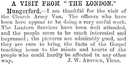
From a media-historical viewpoint, these testimonies indicate that social organizations wanted to establish strong ties with their audiences: My suggestion is that these lantern performances were designed to create powerful sensory, intimate and interactive experiences: Exhausting the potentials of performing slides, they intensified feelings of shared identity. Which practices did social organizations use to impress their (potential) members? How did they arouse their attention? Which positive, lasting impressions took audiences in? How exactly did spectators participate in the events and felt therefore bound to the organizers? In short, this article tries to find answers on the question: What was the connection between exhibition practices and their effects on audiences, social organizations attributed to their lantern performances?
Being aware that the social organizations’ reviews mainly express their intentions, my article first explores some reported effects of lantern performances on audiences. This is followed by a brief theoretical examination on how (visual) media may contribute to the building of community identities.
Reported audience reactions and ritualized performances of community identities
The social organizations’ periodicals mainly aimed at propagating their concerns. Therefore, the accounts on positive audience reactions tend to exaggerate. Regarding their language and contents, their reports are highly stereotyped. For example, social organizations very often reported on the ‘crowds’ attending their lantern performances or that interested people had to be turned away because the venues didn’t offer enough seating capacity. A typical stereotype is ‘the weather’ which (just not) prevented people from attending events with lantern exhibitions. In many cases, it was reported that lantern performances enjoyed great popularity and often provoked emotional responses.
The many statements about enthusiastic audience reactions are testimonies of the importance, social organizations themselves attributed to their lantern performances. At a SSU lantern lecture on the United States, the “interest was fully sustained throughout; there were frequent bursts of applause”.8 



Social organizations particularly emphasized that their lantern performances provoked strong emotional responses. This is especially visible from Church Army reviews. In Southowram, projections on “the life and death of our Lord were affecting in the extreme, and […] many could not refrain from tears, and more earnestly than ever before they promised to live for Him Who died and rose again for them”.13 

Whether or not lantern performances were actually experienced by audiences as described, the reported emotional responses lend support to the assumption that social organizations wanted to build and intensify feelings of shared identity. According to Max Weber, the existence of a community “is based on a subjective feeling of the parties […] that they belong together”:17 The felt (temporary) community which came into being during social organizations’ lantern performances for example by group singing was intended to be a stable community.
Media-historical studies point to the power of lantern performances to deepen such feelings of belonging. “The tradition of participation” was an integral part of English theatre culture: Various forms of “collective action” during the performances were an expression of “collective identity”.18 Music-halls and penny gaffs “were types of gatherings which directly satisfied the working-class sense of community”. Their popularity and quick expansion was a result of “particular ritualized forms” such as the common singing.19 ‘The’ early cinema programme imagined the audience as a collective body in the exhibition hall, interactively participating in, but perceiving itself as separate from the events on the screen.20
The actions during events with lantern performances resembled rituals which strengthen collective identities. They are generally based on the ludic adaptation of recurring patterns by the performers and particularly the spectators: Exclusive/inclusive mechanisms serve to confirm group identities: individual variations and creative transformations allow to deal with and to articulate differences.21 Taking place during events limited in time and space, rituals offer a scope for spontaneous and creative acting.22 Social anthropologist Stanley Tambiah exemplifies this by “the creative role of the ‘formula’”:
the oral poet, whose basic capital is a stock of memorized formulas, varies and ornaments his songs, lengthens and shortens them, according to the demands and character of the audience and other situational circumstances, […] he preserves the tradition by the constant recreation of it.23
Performed live, a lantern exhibition was always a unique experience. Like a theatre play, it proceeded according to a fixed, but variable ‘script’. The slide projections varied from event to event in their tempo and their sequence, the moment and the content of the accompanying lecture as well as music, sound effects and other auditive components. A lantern performance resembles a theatre performance: Both are volatile events where the performers’ physical presence plays an important role for the sensory experiencing by audiences. This perceiving strongly involves the single spectator who – through his reaction to other spectators – even actively contributes to the performance. The creation of the performance in its specific materiality even depends on the common acting on both sides of the footlights:
[…] the performance brings forth the spectators and actors. Through their actions and behaviour, the actors and spectators constitute elements of the feedback loop, which in turn generates the performance itself. Therefore, the performance ultimately cannot be ‘understood.’ […] it aims at the involvement of all participants, in order to create a reciprocal relationship of influence. […] Each so-called repetition deviates from the previous one […] not only as a result of the shifting conditions and humors of the actors but also due to the autopoietic feedback loop. The latter is responsible for making every performance unique and unrepeatable.24
Sensations: to attract and to impress audiences by multisensory events
Lantern performances arranged by social organizations offered their audiences powerful sensory experiences. These events were sensations in the double sense of the word: They were “very impressive or attractive” and caused “great public interest and excitement”.25 The dispositif of the historical art of projection was to arouse the attention of (potential) audiences even before the lantern exhibitions. Afterwards, this promise was kept by the creation of events which highly appealed to the spectators’ senses: Verbal, musical and other performances significantly influenced their perceiving of lantern exhibitions.
According to their reviews, social organizations aroused already much attention because they were almost unknown at many places. The Clarion reported that the Independent Labour Party, with a lantern lecture on “Slums and the Palace – a contrast” in Glasgow, succeeded to “draw in the people who knew nothing at all of Socialism”.26 
Sometimes the arrangement of the dispositif alone was an attraction for audiences. During a six weeks Church Army Van Mission among hop-pickers, the lantern services took place every night and, due to the lack of suitable, in the open-air. The screen was usually fixed on the side of barns or sheds, old chairs or empty barrels were used as hard standings for the lantern. First the children would assembly around it, “and their shouts, together with the concertina, soon made known to the older people that service was ready to begin”. The 50 to 100 adults which would arrive after that enthusiastically joined in the hymns such as All hail the power of Jesu’s name! and There is a fountain and reverently listened to the services which usually lasted for about an hour. According to the report, the entire audience called for a repetition: “When will you come again, mister?”28
With the synesthetic combination of lantern slide projections, prayers, sermons and the common singing of hymns, organizations with religious concerns intended on emphatic audience reactions in order to gain support. At a Church Army lantern exhibition of the slide set Given in Charge, or little Joy’s Mission (UK, T.J. and W.F. Piggott, n.d.) as a service of song in Bolton 1896, choruses and solos “were feelingly performed, conducted and accompanied by members of our Mission and friends”. In addition, a children’s choir “most prettily” sang a song entitled Children’s voices. The author of the review praised the excellent working of the lantern and the recitation of the “beautiful story” as “most effective”. He was convinced: “the beautiful and touching pictures, music and story will be long remembered.”29
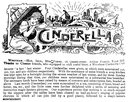
The simultaneous appeal to the senses of sight, hearing and taste was considered a particular ‘recipe’ for success. This was explicitly expressed in reports about the Cinderellas, initiated by several socialist groups to provide poor children with food and leisure time activities.30 During the winter months, they often organised lantern exhibitions: “Our experience proves that nothing is so much enjoyed by the nippers after the tables have been cleared as half-an-hour’s singing of popular choruses in which all can join (led by a good piano), followed by a magic-lantern entertainment.31
In order to offer audiences something pleasant, social organisations designed whole their events according to their tastes. Embedding lantern projections into multisensory events, they in many ways appealed to the human perception. The distribution of food and tea parties were a mode to offer audiences empirical forms of sensuousness.32 Through tactile and tasteful impressions, audiences literally grasped social organizations’ concerns.
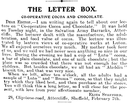
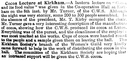
Co-operative ‘Cocoa Lectures’ which regularly took place between 1905 and 1913, were organized to persuade audiences of the ‘good taste’ of a membership. During or after the lantern slides on ‘Cocoa’, audiences received chocolate bars and free samples of cocoa or chocolate biscuits and cakes for immediate consumption. At one of these events with lantern lecture in Mossley, held by the “tea and cocoa Traveller for the C.W.S.” Mr. Turner, were not only distributed ‘Broma’ and ‘Luto’ chocolates, but also “a hot cup of cocoa brewed on the spot” – maybe even in front of the audience. According to the report, the slides intensified this ‘delightful’ experience: “Lantern views of the plantation in Trinidad, the London docks and warehouses, and Luton works considerably enhanced the enjoyment of the lecture […].”33




The persuasive power of lantern performances is especially visible from a Salvation Army feast for 1,800 poor children in London. Two services of song were embedded into a varied programme with many attractions: The event began in the afternoon with a demonstrative tea party. Afterwards, the children were separated into groups. The boys were taken to the river Thames to watch ascending balloons, the girls participated in games.
The lantern performance which was the main attraction of the programme in itself also provided variation – which was to provoke strong emotional responses: Before the first picture, a projection of the slogan “There is a better world they say”, appeared on the screen, “the excitement grew almost breathless”. At a first (unnamed) service of song which dealt with Temperance the children were “carried by the vivid pictures”. This was because verbal and musical elements were perfectly harmonised: “high above the sea of childish faces rose the ringing voices and the first picture appeared [...] Then, as the children gazed in breathless silence, from behind the screen rose a single, clear, child voice, singing.” After this service of song, the genres interchanged: A “funny little image with the enquiry, Good evening! Have you read the ‘Young Soldier’?” caused a “merry laugh.” Views of the General, Mrs Booth and the Chief-Commander (Bramwell Booth) followed, “each calling forth a burst of affectionate greeting.” Afterwards, “the first scene of the most touching story of all [Little Jamie, UK, possibly Bamforth version, 1891] riveted every eye.” In correspondence to the Little Jamie reading which advised smooth transitions between verbal and musical parts, the lantern slides, commentaries and singing were closely related: “after a few words of explanation, the chorus rose again from that little hidden voice.”
This event was not only arranged to provide poor children some seldom enjoyment, but to make membership in the Salvation Army very attractive: The service was concluded by the projection of the Band of Love Pledge which “urged” the children, “fresh from the deep impressions just made,” to join this organisation for young people.34 After the lantern exhibition and concluding the event, all children marched past the Field Commissioner who offered each one a free copy of the “beautiful” Young Soldier, the Army organ for young people.

Intimacy: the building of trust
The arousing of emotions during the Salvation Army feast certainly was partly based on the story Little Jamie which offered several possibilities for identification: Jamie is a boy who tries to get his father to give up drinking, which has plunged whole the family into poverty, and founds with other street children the Cold Water Army, a Temperance group. Poverty and broken homes would be well-known experiences for most of the young spectators. They also could take Jamie for a great example because he was an active, fighting and responsible hero. There was also a link between the story and the event: on Christmas Eve, the family father drinks away all the money saved for Christmas presents. The Salvation Army’s treat also took place at Christmas, but unlike in the story the children were presented with food, a day full of pleasure – and a free copy of the Young Soldier. A further resource of identification was the Cold Water Army, which was based on the street children’s common hardship. From the story, the children learned that personal strength is achieved by belonging to the group. These different levels of identification certainly contributed to a positive image of the Salvation Army and aroused wishes of belonging.
Whereas the heroes of fictitious slide sets not always succeeded in escaping poverty, social organizations usually offered poor people a ‘happy end’. One reason lay in the common performance of lantern exhibitions with audiences, the celebration of community: With their multisensory events, social organizations also wanted to create homely ambiances – to put forward positive family experiences to the failure of family. This was closely related to the intention of building trust: Lantern exhibitions were to create intimate experiences for audiences: to get “closely acquainted; familiar” with social organizations.35
Offering support in difficult times, the neighbourhood had always stood in the centre of working-class culture: “Investing in the community was a practical way of safeguarding against the risk of falling seriously into poverty, providing a support network […].”36 From the late seventeenth century on, numerous clubs and societies enabled town people “to build their own associational system to counteract the potential for anomie posed by urbanization”.37
Lantern performances also counteracted modern experiences of alienation. The lecturer was the central performer to establish the contact between social organizations and their audiences. Because the sometimes popular figures followed the spectators’ preferences, they launched “a comforting sense of intimacy”.38 For example, lantern exhibitions of a Church Army Captain Rowlands aroused much attention in Salford. He was a famous and obviously articulate lecturer: “no matter what class or character of audience he has, he can fit himself to the need and difficulties of all.”39 


Audiences especially appreciated lecturers who added personal experiences to their presentations. For example, a Mr. Moorhouse, having taken himself the photographs accompanying his lantern lecture on “A Co-operative Tour Round the World” 1904 in Huddersfield, “was able to speak with greater authority”. According to the report, the attendance was exceptional: Many who had been interested in the event had to be turned away “and those who were fortunate enough to get into the hall had a real treat”.43
His scientific, historic or narrative knowledge – which he sometimes only pretended to have –attributed to the lecturer a position of trust. The live performance probably also contributed to this experience: The verbal accompaniment influenced audience responses more than music or sound effects and was not necessarily predictable.44 Announcing each lantern view, the lecturer also designed the temporal course of a lantern exhibition: During whole the performance, audiences alternately looked to the stage and the screen.45 They literally looked up to the lecturer: “it was necessary that the lecturer be regarded as a trustworthy expert in a relevant field, and great care was taken to convince audiences of this.”46 Sometimes they considered him a friend and confidant even beyond the lantern exhibitions.47
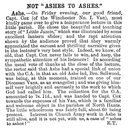
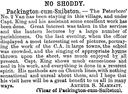
Getting in contact with village people before their lantern services, Church Army missioners were able to quickly establish intimacy. During a fortnight mission in Oakley, the crew of the Winchester No. I. Van particularly won the sympathies of young men because they organized a football match. As a result, the villagers “attended closely and in considerable numbers, the bright meetings, impressive Lantern Lectures, and solemn Services”. Captain Cox’ “pleasant and valuable knack of putting very serious and solemn matters in a very simple and homely way, without in the least sacrificing their solemnity” very much contributed to this success. He adapted his lectures to the demands of his audiences for he also held special lectures to children who were convinced: “he was just the man for them.”48

With empathy and rhetoric, the social organizations’ lecturers won the audiences’ trust. In the village of Ashe, Captain Cox, “our good friend”, was also famous for his eloquence: “Indeed, we know, of old, that Capt. Cox never fails to win, and keep the sympathetic attention of the listeners!” The narration of the slide set Little Jamie allegedly impressed the audience more than the lantern views: “the rapt attention shown by the audience proved that they warmly appreciated the earnest and thrilling narrative given in the lecturer’s very best style.”49 
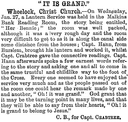
Fictitious slide sets were often used to initiate feelings of belonging: Audiences were provided with ‘real’ family experiences. 1897 in Wheelock, a lantern illustrated service of the Church Army with exhibition of the story Her Benny (UK, Bamforth, 1889) very much impressed the spectators which crowded the room: “Every one seemed to have enjoyed the service very much and as the people passed out of the room one could hear the remark made by one and another, ‘Oh! it was grand.’” A part of the audience probably met with the lecturer’s call to “come in the same trustful and childlike way to the foot of the Cross”. The author attributed to this experience the power of conversion. His words associated the participation in the lantern performance to the membership of the Christian family: “God grant that it may be the turning point in many lives, and that they will be able to say from their hearts, ‘Oh! It is grand to belong to Jesus’”.52
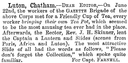
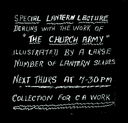
Documentary material was also deemed suitable to provide intimate experiences for audiences. From the 1870s onwards, social organizations used local views to arouse and sustain interest for their concerns. 1895 in Luton, after a “Friendly Cup of Tea”, the Church Army presented “scenes from Paris, Africa, and Luton”. “The most attractive Slide of all [...], ‘Please don’t forget the Collection,’ which spoke quite familiar” requested the audience to support its social activities by an offering.53
Film historians define the local as a genuine genre. It is characterized by “the moment of overlap between audience and the subject matter”.54 The rising production of local films was a result of the increasing competition among cinema owners: They “were exclusive, and a unique attraction in a programme that could attract large audiences interested in recognising themselves on the screen.”55 Embedding the novelty of film in the local context, programmers provided familiarity to audiences: “Local films both incorporated the attraction of news and the novelty factor of moving image, all placed in a regional and in many cases particular local setting.”56
Parallel to the boom of local films in commercial business, social organizations intensified the use of local views in their lantern performances. The Co-operative News particularly stressed the intention to strengthen feelings of shared identity: 1900 in Faversham, a lantern lecture on “Co-operators and their Manufactures” illustrated the history of the Co-operative movement. Eventually, referring to the work at the co-operative tannery at the nearby Canterbury, the lecturer reminded those present of their membership in an organization which was engaged in “the emancipation of labour”.57 “Our Own Society” was the subject of a lantern lecture covering local history in Huddersfield 1906 which also appealed to whole the community: “Those who had known the society in its youth revelled in the reminiscences, and smiled again into the faces of some whose voices had been long silent.”58
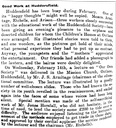
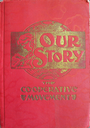
Whether social organizations presented fictitious or documentary slides, they built their lantern performances upon familiar practices to establish intimate experiences to audiences. A co-operative lantern lecture 1910 in Bradford was combined with “an excellent cinematograph exhibition” which dealt with “this branch”. The success of the event was, however, also based on the common singing of well-known songs: The “crowded audience, who showed their appreciation in an enthusiastic manner” had been presented “the usual lantern lecture on ‘Our Story’”.59 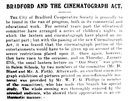
Interaction: tying audiences to the community
Social organizations hoped that the common singing would contribute to create lasting bonds with their audiences. According to their reviews, spectators enthusiastically joined in the songs which were often projected on the screen. A co-operative event in Pendleton near Manchester in 1891 was explicitly organized to recruit new members: A Women’s Guild representative held a lantern lecture on the advantages to women who would join this association. Apart from the slides, there were musical performances, among them “Co-operative choruses (in which the audience joined).”63 
Social organizations were obviously eager to get into conversation with their audiences. Meeting with the demands of their sympathizers and (potential) members in order to establish long-lasting ties, social organizations also provided them with interactive experiences.
Audiences are involved in performative acts alone by their presence, by their common reception. Annette Hill, media scientist and specialist on audience research, comments: “Live performances are powerful moments of participation. There is participation on several levels, such as sitting, standing, clapping, or going on stage. There is participation through thinking, feeling, looking, and listening.”65
In this article, interaction mainly means the mutual communication between all individuals taking part in a lantern exhibition. Being based on “interpersonal mechanisms”, the live performers on and in front of the stage offered audiences multiple opportunities for interaction and identification.66
One such opportunity were ludic forms of interaction. Co-operative lantern lectures on co-operative products including bread-baking, washing and polishing competitions are particularly characteristic. After a lantern lecture on the manufacture of soap and tobacco in Mansfield, the lecturer reminded the participants to purchase co-operative products; the organizers “appealed strongly to all present to do their duty to their own works”. After a washing competition for men, a free sample of soap made them literally grasp the high quality of co-operative products and see through the fair manufacturing of healthy products.67 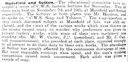

I shall, however, take up again the practice of common singing. It was a reliable means to communicate with audiences – and also a tradition of commercial entertainment, in particular the music-hall. According to film historian Frank Scheide, the “existence of the singing room reflected a need for people to celebrate life and engage in communal activity”.69
Generally intertwined with the lantern exhibition or/and other parts of the programme as well as taking place several times and at different moments of an event, it was regarded especially suitable to intensify feelings of shared identity. This is especially visible from the lantern illustrated church service. In this synesthetic composition, the common singing was part of the liturgy and the lantern exhibition. The song texts were usually projected to enable audiences to directly read from the screen. During a Church Army service in Rugby, the interactive audience experience was intensified by the interchange of slides illustrating the story of Redemption during bible passages and their commentaries, the sermons and the common singing of hymns.70 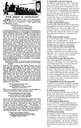
Services of song provided audiences with especially powerful interactive experiences. As for example the reading accompanying the slide set Little Jamie reveals, its exhibition was planned interactively. The spectators’ participation was explicitly desired and even expected: “The audience should be supplied with books of words; and, if thought advisable, these could be used as tickets of admission.”71 Spectators were expected to join in three of the fourteen songs, which they obviously knew from religious services and prayer meetings: Thy Faithfulness, Lord at the beginning, Blessed Words of Jesus at the end and Rescue the Perishing at one of the story’s turning points.72
By becoming thus involved in the creative act, the entire congregation experienced the confession of faith actively and even seemed to initiate it. Simultaneously, the screen was connected to life: while the story belonged to the world of imagination, it possessed a particular credibility, due to the naturalistic effect of life-model sequences.73 Equally, the programmes themselves contained elements that related to both fiction and reality. Telling a story, the slides clearly adhere to the world of fiction, but audiences perceived the shift to reality as entirely natural. However, the performative agents were the decisive go-betweens: For example, during the Salvation Army feast for 1,800 poor children in London, the acoustic accompaniment intensified the visual impressions, but the performers were physically present and therefore – at least the lecturer and the choir – perceived as participants of the community who clearly anchored the story in the here and now.74 The review attributed exactly to the hidden solo singer, who probably created a kind of illusionary effect, this role of go-between: “Here the voice of Johnnie, behind the screen sings out, ‘Kind words can never die,’ which rivets another life-lesson on the impressionable minds of the gathered children.” As a result of these performances, this auspicious community was not perceived as a distant image, but as a concrete experience. “No more entertainment to please and arouse for a while, but real life lessons,” the review ends, with the hope that the feeling of community, based on the fiction, could now be transported into reality.
The common singing could be a means for merging identities. Very often, social organizations included the singing of the national anthem into their events. Associating their own community to that of the British nation, they provided interaction to their audiences in the sense of a “reciprocal […] influence”.75
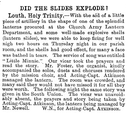
It is remarkable that, at the turn of the nineteenth century, social organizations very often reported the use of lantern views on topical war scenes, on the military or the royal family. Audiences regularly joined in the common singing of patriotic songs and the national anthem, the texts sometimes being projected on the screen. The probably most successful fictitious slide set in Church Army events, The Torn Bible (UK, Walter Tyler, n.d.) is temporarily set during the Anglo-Mysore Wars in India at the end of the eighteenth century.76 The war and military jargon is typical for reports on lantern exhibitions: The Church Army called slides “some well-made explosive shells” and spoke of “the great gun of the lantern”.77
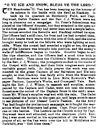
With lantern lectures on patriotic subjects, social organizations referred to a community beyond the actual circle of spectators/members. Following political scientist Benedict Anderson, they referred to “the nation: […] an imagined political community”. His commentary that it “is imagined [author’s marking] because the members of even the smallest nation will never know most of their fellow-members, meet them, or even hear of them, yet in the minds of each lives the image of their communion”,78 is also applicable to other processes of community-building such as within religious groups.79 Calling on national feelings during their lantern performances, social organizations provided their audiences with a powerful resource for shared identities.
Audiences were familiar with depictions of the war and the Empire. Throughout the nineteenth century, a “leisure-based patriotism” had been a tradition of popular culture.80 Patriotic and imperial subjects were “highly marketable products in the world of popular entertainment”.81 War portrayals were present everywhere: “not only in song, but on the stage, in the circus, in the pantomime and […] the music hall […].”82 It is therefore not surprising that lantern views of military conflicts such as the Boxer Rebellion, the Russo-Japanese War and the First World War respectively national events as the Funeral of Queen Victoria and the Coronation of King Edward were utilized to attract and to interact with audiences.83
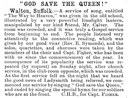
The peak of British nationalism was reached during the Second Boer War. Social organizations sometimes took Boer War topicalities for occasion to present lantern slides. 1900 in Walton, the Church Army exhibited the service of song The Way to Heaven (UK, Bamforth, 1892). According to the report, the relief of Ladysmith had been announced this same evening. The news aroused the excitement of the whole British population, manifest everywhere in spontaneous demonstrations, cheers, flag-waving and the singing of the national anthem: “By these means patriotic impulses spread, and were acted on.”84 In Walton, after a couple of days, the audience’s request to repeat The Way to Heaven was fulfilled. Now the patriotic subject was the frame and the point of reference for feelings of shared identity: “we commenced our service by singing ‘God save the Queen,’ and ended by singing the special hymn for our soldiers who are at the front.”85
Measured from the number of reports, co-operative societies responded to the audiences’ interest in the Boer War more often than religious organizations. This may be surprising at a first glance for labour organizations in whole Europe traditionally opposed war, militarism and imperialism.86 In Britain, however, the opinions diverged even within socialist groups such as the Clarion movement, the Independent Labour Party and the Socialist Democratic Federation.87 Social historian Pamela Horn estimates that “if the working people did not initiate the jingoistic mood, they certainly shared in it”.88
The co-operative movement even openly declared its patriotic attitude: The Co-operative News critically commented on social problems, but barely tackled with the imperial British politics and especially the Boer War. In co-operative events, “the monarchy was invariably the first toast given.”89 Very often, local societies associated the ‘greatness of the nation’ with the ‘greatness of co-operation’. Calling upon patriotic feelings, the movement celebrated itself as primarily British community: Its members were in the first place part of the nation, in the second place workers who, due to their co-operative membership, were able to build a stable existence. During a free lantern lecture with concert in Rhodes, one of the speakers appealed to the present co-operators to fulfil their duty towards their society by purchasing co-operative products. This was followed by “an account of the remarkable events in and progress of the British Empire”, illustrated by lantern views.90

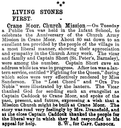
Calls upon national feelings were literally worthwhile to social organizations. On the occasion of its anniversary 1903 in Crane Moor, the Church Army gave a “Public Tea” with a lantern lecture on the subject “Fighting for the Queen”. During the gathering several songs were performed, among them the lantern illustrated song Ora Pro Nobis (UK, maybe Bamforth version, 1897), the story being “read very feelingly”. According to the report, the audience most willingly followed the appeal to financially support the social work of the Church Army.91
Conclusion
To summarize, lantern performances arranged by social organizations were in many ways colourful events, promising sensory, intimate and interactive experiences to audiences.
Even before a lantern exhibition, social organizations often aroused spontaneous interest by creating – sometimes unwillingly – an unusual media dispositif. This announcement of a sensation was kept during the lantern performances: These were part of varied programmes with diverse attractions. The multisensory events created deep impressions.
Social organizations provided intimacy for audiences by exhausting all possibilities lantern exhibitions offered for identification. They followed the spectators’ preferences and habits or referred to local particularities in order to create familiar ambiances: Audiences were to feel safe and comfortable during these gatherings. The lecturers, often well-known and popular figures or local heroes, were the most important performers to create trust.
Lantern performances in social care aimed at the lasting participation of audiences: at creating emotional bonds to a community beyond the (temporary) lantern exhibition. Interactive practices directly involved the spectators who sometimes even became active performers themselves. The lantern exhibitions also took their effects by referring to the imagined community, the British nation. Associating identities, social organizations expected to attract more (potential) members who would hopefully even become active participants in their communities.
I suggest, however, that exhibition practices developed their full potential because they were closely related: they also ‘interacted’. This is especially visible from events referring to the British nation. Patriotic subjects were a sensation, lantern lectures on the distant South Africa often part of multisensory events. These also provided audiences with intimate and interactive experiences. Lecturers whose reports were based on personal experiences in the war region, was given more credence than to those who referred to second-hand knowledge. Considering their target groups preferences, they easily entered into a dialogue with their audiences. The Church Army often combined calls upon patriotic feelings with the common tea. Particularly demonstrating unity, this ritual also reveals the close interaction of exhibition practices: The both tactile and tasteful experience intensified the multisensory event character. Equally, the common tea was a popular custom which produced a familiar ambiance. It was also an interactive experience: Being a form of “audience participation”,92 the tea ritual enabled spectators to become the main performers of the event. They sometimes even actively contributed to the merging of the national with the religious identity: At a “Church Army tea” in Worthing in 1897, all the participants joined in the common singing of the national anthem and a religious hymn. The first person plural again stressed the Church Army’s intention to strengthen feelings of belonging to the community: “Tea was soon followed by a Service of Song, entitled, ‘Mother’s Last Words,’ given by some of the soldiers and friends, and illustrated by the Lantern. At its close we sang, ‘God save our gracious Queen,’ and ‘Praise God from Whom all blessings flow.’”93

The use of lantern slides for social purposes and especially interactive exhibition practices point to basic mechanisms of bounding audiences to visual media. Social organizations arranged such lantern performances up to the Second World War and partly the late 1950s. They preferred lantern slides to moving images because these were obviously more suitable to convey welfare messages. Most probably, audiences were still attracted to such events because these fulfilled important entertainment needs and provided them with multiple opportunities to interact: Lantern exhibitions took their effect because they were combined with social practices such as processions, religious services and common singing. They were also part of a social audience experience.
- ^ The Church Army Gazette. A Church Gospel Paper for the Working Man (CAG), no. 497 (28 March 1894): 6.
- ^ Field Officer (April 1905): 127-129, here 127.
- ^ BHU, Annual Report. From April 1st, 1878 to March 31st, 1879 (London: BHU, 1879), 14.
- ^ SSU, Annual Report. For the Year Ending March 31, 1910 with Accounts to December 31, 1909 (London: SSU, 1910), 62.
- ^ CETS, 46th Annual Report, for the Year Ending December 31st, 1907 (London: CETS, 1908), 16-17.
- ^ Co-operative News (CN), vol. 24, no. 26 (1 July 1893): 728.
- ^ Joseph Edwards (ed.), The Labour Annual, 1897. A Year-Book of Social, Economic and Political Reform (Manchester, 1897), 245.
- ^ Sunday School Chronicle (SSC), vol. 14 (21 November 1884): 612.
- ^ CL, no. 168 (2 March 1895): 70
- ^ CN, vol. 32, no. 9 (2 March 1901): 235.
- ^ See CAG, no. 1158 (1 December 1906): 8; CAG, no. 683 (23 October 1897): 6.
- ^ CAG, no. 715 (4 June 1898): 6.
- ^ CAG, no. 939 (20 September 1902): 6.
- ^ CAG, no. 969 (18 April 1903): 6. For the slide set The Torn Bible: or Hubert’s Best Friend (UK, Walter Tyler, n.d.], see “Slide set: The torn Bible: or, Hubert’s best friend (service of song: Walter Tyler, 30 slides, n.d.)”, Lucerna Magic Lantern Web Resource, https://www.slides.uni-trier.de/set/index.php?id=3000774 (accessed 13 September 2017).
- ^ , no. 532 (5 December 1894): 6. See “Slide set: Mother’s last words (recitation: Bamforth & Co., 19 slides, 1880s)”, Lucerna Magic Lantern Web Resource, https://www.slides.uni-trier.de/set/index.php?id=3001958 and “Slide set: Mother’s last words (recitation: York & Son, 12 slides, 1885)”, Lucerna Magic Lantern Web Resource, https://www.slides.uni-trier.de/set/index.php?id=3000434 (both accessed 11 September 2017).
- ^ CAG, no. 525 (17 October 1894): 6. See “Slide set: Her Benny (story: Bamforth & Co., 42 slides, 1889)”, Lucerna Magic Lantern Web Resource, https://www.slides.uni-trier.de/set/index.php?id=3000526 (accessed 12 September 2017). For the life model technique, see Ludwig Vogl-Bienek, Lichtspiele im Schatten der Armut: Historische Projektionskunst und Soziale Frage. Nexus, vol. 103 (Frankfurt am Main, Basel: Stroemfeld, 2016), 93, 242-269, and Jürgen Berger, “Foto-Geschichten. Fotografische Laternenbilder im viktorianischen England”, Fotogeschichte. Beiträge zur Geschichte und Ästhetik der Fotografie, vol. 8 (1983).
- ^ Max Weber, Economy and Society. An outline of interpretive sociology. Ed. by Guenther Roth and Claus Wittich (Berkeley, Los Angeles, London: University of California Press, 1978 [first New York 1968, based on the 4th German edition, ed. by Johannes Winkelmann, Tübingen 1956]), 40.
- ^ Richard Butsch, The Making of American Audiences. From Stage to Television, 1750–1990 (Cambridge: Cambridge University Press, 2000), 14.
- ^ Michael Chanan, The Dream That Kicks (London: Routledge and Kegan Paul, 1980), 149.
- ^ Andrea Haller, “Das Kinoprogramm. Zur Genese und frühen Praxis einer Aufführungsform”, in: Heike Klippel (ed.), »The Art of Programming«. Film, Programm und Kontext (Münster: LIT, 2008), 18-51, here 31.
- ^ Constanze Bausch and Stephan Sting, “Rituelle Medieninszenierungen in Peer Groups”, in: Christoph Wulf et al. (eds), Das Soziale als Ritual. Zur performativen Bildung von Gemeinschaften (Opladen: Leske + Budrich, 2001), 249-324, here 254.
- ^ Christoph Wulf and Jörg Zirfas, “Das Soziale als Ritual: Perspektiven des Performativen”, in: Christoph Wulf et al. (eds), Das Soziale als Ritual. Zur performativen Bildung von Gemeinschaften (Opladen: Leske + Budrich, 2001), 339-347, here 340-341.
- ^ Stanley Tambiah, “A performative approach to ritual”, in: British Academy (ed.), Proceedings of the British Academy (London: Oxford University Press, 1981), 113-169, here 135-136.
- ^ Erika Fischer-Lichte, The Transformative Power of Performance: A New Aesthetics (Abingdon, New York: Routledge, 2008), 50-51.
- ^ Angus Stevenson, Oxford Dictionary of English (Oxford: Oxford University Press, 2010), 1621.
- ^ CL, no. 203 (26 October 1895): 342.
- ^ CAG, no. 563 or 564 (7 or 14 [date unreadable] March 1903): 6.
- ^ CAG, no 787 (21 October 1899): 6.
- ^ CAG, no. (8 February 1896); 6. See “Slide set: Given in charge: or, little Joy's mission (story: T.J. and W.F. Piggott, 30 slides, n.d.)”, Lucerna Magic Lantern Web Resource, https://www.slides.uni-trier.de/set/index.php?id=3005332 (accessed 12 September 2017).
- ^ See Neil Lyons, Robert Blatchford. The Sketch of a Personality. An Estimate of Some Achievements (London: The Clarion Press, 1910), 97-98.
- ^ The Scout, vol. 2, no. 2 (1896): 46-47.
- ^ See Urs Meyer, “Transmedialität (Intermedialität, Paramedialität, Metamedialität, Hypermedialität, Archimedialität). Das Beispiel der Werbung”, in: Urs Meyer, Roberto Simanowski and Christoph Zeller (eds), Transmedialität. Zur Ästhetik paraliterarischer Verfahren (Göttingen: Wallstein, 2006), 110-130, here 112.
- ^ CN, vol. 37, no. 2 (13 January 1906): 52. Also see other reports referring to cocoa lectures: CN, vol. 37, no. 4 (27 January 1906): 107, 108; no. 7 (17 February 1906): 193; no. 8 (24 February 1906): 217; no. 9 (3 March 1906): 248; no. 16 (21 April 1906): 433; no. 41 (13 October 1906): 1205; vol. 39, no. 5 (1 February 1908): 131.
- ^ War Cry, no. 965 (5 January 1895): 6. See “Slide set: Little Jamie (service of song: Bamforth & Co., 37 slides, 1891)”, Lucerna Magic Lantern Web Resource, https://www.slides.uni-trier.de/set/index.php?id=3000705 (accessed 12 September 2017).
- ^ Stevenson, Oxford Dictionary, 916.
- ^ Peter Borsay, A History of Leisure. The British Experience Since 1500 (Basingstoke: Palgrave Macmillan, 2006), 87.
- ^ Ibid., 137.
- ^ Joe Kember, Marketing Modernity. Victorian Popular Shows and Early Cinema (Exeter: University of Exeter Press, 2009), 15.
- ^ CAG, no. 812 (14 April 1900): 6.
- ^ CAG, no. 915 (5 April 1902): 3.
- ^ CAG, no. 1283 (24 April 1909): 3.
- ^ CAG, no. 1288 (29 May 1909): 3.
- ^ CN, vol. 35, no. (29 October 1904): 1323.
- ^ See Miriam Hansen, Babel and Babylon. Spectatorship in American Silent Film (Cambridge: Harvard University Press, 1991), 98.
- ^ See Ivo Blom and Ine van Dooren, “›Ladies and Gentlemen, Hats off, Please!‹ Dutch Film Lecturing and the Case of Cor Schuring”, IRIS. Revue de Théorie de l’Image et du Son. A Journal of Theory on Image and Sound, vol. 22, no. Le bonimenteur de vues animées/The Moving Picture Lecturer (1996): 80-101, here 95.
- ^ Kember, Marketing Modernity, 52. Also see ibid., 66.
- ^ See Max Nabarro, “This is My Life”, IRIS. Revue de Théorie de l’Image et du Son. A Journal of Theory on Image and Sound, vol. 22, no. Le bonimenteur de vues animées/The Moving Picture Lecturer (1996): 183-200, here 190-196.
- ^ CAG, no. 763 (29 October 1898): 6.
- ^ CAG, no. 858 (2 March 1901): 6.
- ^ See Blom and van Dooren, “Ladies and Gentlemen”, 95-96.
- ^ See Thomas Hallsworth (compiler), Little Jamie: A Service of Sacred Song (London and Manchester: S.W. Partridge & Co. and John Heywood, 1894).
- ^ CAG, no. 648 (20 February 1897): 6. See “Slide set: Her Benny (story: Bamforth & Co., 42 slides, 1889)”, Lucerna Magic Lantern Web Resource, https://www.slides.uni-trier.de/set/index.php?id=3000526 (accessed 12 September 2017).
- ^ CAG, no. 565 (24 July 1895): 7.
- ^ Martin Loiperdinger and Vanessa Toulmin, “Is it you? Recognition, Representation and Response in Relation to the Local Film”, Film History. An International Journal, vol. 17, no. 1 (2005): 7-18, here 8.
- ^ Ibid., 12.
- ^ Vanessa Toulmin, “›Local Films for Local People‹: Travelling Showmen and the Commissioning of Local Films in Great Britain, 1900-1902”, Film History. An International Journal, vol. 13, no. 2 (2001): 118-137, here 120.
- ^ CN, vol. 31, no. 7 (17 February 1900): 174-175.
- ^ CN, vol. 37, no. 12 (24 March 1906): 332.
- ^ CN, vol. 41, (12 February 1910): 179.
- ^ The Educational Committee of the Co-operative Union Limited (ed.), The Co-operative Educational Programme. 1908-9 (Manchester, n.d. [1908]), 88.
- ^ Isa Nicholson, Our Story. (The Co-operative Movement). Specially Written at the Request of the Educational Committee of the Co-operative Union, for Young Co-operators (Manchester, 1909 [first 1903], n.p. [2].
- ^ CAG, no. 888 (28 September 1901): 6. During the season 1908-1909, the Church Army Work Set contained 153 slides, which also illustrated the work of the Church Army Lantern Department. See Church Army Lantern Depot, Lantern and Slide Catalogue 1908-09 (London: Church Army, n.d. [1908]), 328-329.
- ^ CN, vol. 22, no. 50 (12 December 1891): 1255.
- ^ CAG, no. 903 (11 January 1902): 6.
- ^ Annette Hill, “The Audience is the Show”, in: Virginia Nightingale (ed.), The Handbook of Media Audiences (Malden/MA: Wiley-Blackwell, 2011), 472-488, here 482.
- ^ Kember, Marketing Modernity, 6.
- ^ CN, vol. 41, no. 47 (19 November 1910): 1510.
- ^ CN, vol. 40, no. 10 (6 March 1909): 269.
- ^ Frank Scheide, “The Influence of the English Music-Hall on Early Screen Acting”, in: Linda Fitzsimmons and Sarah Street (eds), Moving Performance. British Stage and Screen, 1890s-1920s (Trowbridge: Flicks Books, 2000), 69-79, here 70.
- ^ CAG, no. 914 (29 March 1902): 6.
- ^ Hallsworth, Little Jamie, front endpapers.
- ^ Ibid., 2, 17, 30.
- ^ See Vogl-Bienek, Lichtspiele, 93.
- ^ See ibid., 107.
- ^ Stevenson, Oxford Dictionary, 910.
- ^ See “Slide set: The torn Bible: or, Hubert’s best friend (service of song: Walter Tyler, 30 slides, n.d.)”, Lucerna Magic Lantern Web Resource, https://www.slides.uni-trier.de/set/index.php?id=3000774 (accessed 12 September 2017).
- ^ CAG, no. 814 (5 May 1900): 6; CAG, no. 1439 (20 April 1912): 8.
- ^ Benedict Anderson, Imagined Communities: Reflections on the Origin and Spread of Nationalism (London, New York: Verso, 1991 [first 1983]), 6.
- ^ See Andreas Hepp, Medienkultur: Die Kultur mediatisierter Welten (Wiesbaden: VS Verlag für Sozialwissenschaften, 2011), 99-100; Sigrid Kannengießer, Translokale Ermächtigungskommunikation: Medien, Globalisierung, Frauenorganisationen (Wiesbaden: Springer Fachmedien, 2014 [PhD Bremen University 2012]), 46.
- ^ Borsay, History of Leisure, 152.
- ^ Penny Summerfield, “Patriotism and Empire. Music-Hall Entertainment 1870-1914”, in: John Mackenzie (ed.), Imperialism and Popular Culture (Manchester, New York: Manchester University Press, St. Martin’s Press, 1986), 17-48, here 42.
- ^ Hugh Cunningham, “The Language of Patriotism”, in: Raphael Samuel (ed.), Patriotism. The Making and Unmaking of British National Identity (London, New York: Routledge, 1989), 57-89, here 77-82.
- ^ See Frank Gray, “Our Navy and Patriotic Entertainment in Brighton at the Start of the Boer War”, in: Richard Abel (ed.), Early Cinema and the “National” (New Barnet: John Libbey, 2008), 79-89, here 86.
- ^ The Guardian, 2 March 1900. Guardian Century 2011, https://www.theguardian.com/century/1899-1909/Story/0,6051,126325,00.html (accessed 12 September 2017).
- ^ CAG, no. 809 (24 March 1900): 6. See “Slide set: The way to Heaven (service of song: Bamforth & Co., 38 slides, 1892)”, Lucerna Magic Lantern Web Resource, https://www.slides.uni-trier.de/set/index.php?id=3000779 (accessed 12 September 2017).
- ^ James Docherty and Peter Lamb, Historical Dictionary of Socialism (Lanham/Maryland, Toronto, Oxford: Scarecrow Press, 2006), 357-361.
- ^ See Paul Ward, Red Flag and Union Jack: Englishness, Patriotism, and the British Left, 1881-1924 (Woodbridge, Rochester: Royal Historical Society, The Boydell Press, 1998), 59, 60-62, 74-75; Docherty and Lamb, Historical Dictionary of Socialism, 58, 303; Gregory Claeys, Imperial Sceptics: British Critics of Empire, 1850-1920 (Cambridge: Cambridge University Press, 2010), 125-126, 172-180.
- ^ Pamela Horn, Pleasures and Pastimes in Victorian Britain (Stroud: Amberley, 2011), 325.
- ^ See Peter Gurney, Co-operative Culture and the Politics of Consumption in England, 1870-1930 (Manchester, New York: Manchester University Press, 1996), 106-107.
- ^ CN, vol. 32, no. 11 (16 March 1901): 316.
- ^ CAG, no. 973 (16 May 1903): 6. See “Slide set: Ora pro nobis (song: Bamforth & Co., 8 slides, 1897)”, Lucerna Magic Lantern Web Resource, https://www.slides.uni-trier.de/set/index.php?id=3001696 (accessed 12 September 2017).
- ^ Yvonne Zimmermann, “Training and Entertaining Consumers. Travelling Corporate Film Shows in Switzerland”, in: Martin Loiperdinger (ed.), Travelling Cinema in Europe. Sources and Perspectives (Frankfurt am Main, Basel: Stroemfeld/Roter Stern, 2008), 168-179, 173.
- ^ CAG, no. 660 (15 May 1897): 6.