Apparatus

The superior new lantern of `sGravesande and Musschenbroek
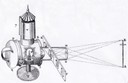
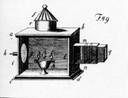
In 1720, a new design of magic lantern appeared that historian John Barnes considered to be "the most advanced form of the instrument so far described", one which "was not to be surpassed until almost exactly one hundred years later."1 Made by the Leiden instrument workshop of Jan van Musschenbroek (1692-1761), and designed by Willem Jakob 'sGravesande (1688-1742), professor of mathematics and astronomy at the university in Leiden, this lantern in a long horizontal case on its own floor stand used two lenses, a condenser and parabolic reflecting mirror.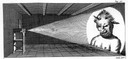
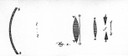
Apart from Musschenbroek, who had worked in close partnership with 'sGravesande in developing an elegant group of experimental instruments in which this new lantern was included, several other instrument workshops offered their own copies of the 'sGravesande apparatus, which had been published in his widely-translated and read Physices Elementa Mathematica.2 Georg Friedrich Brander in Augsburg offered "Gravesand [sic.] new improved magic lantern with 8 moving figures fl. 100," in his catalogue of 1753, a substantial price when his largest Gregorian telescope, 27 inches long, was offered at the same cost.3 Brander sold one of his "sGravesande" lanterns sometime before 1757 to Dr. Johannes Gessner, a founder of the Zürich Naturforschende Gesellschaft. In a book published in 1748 the Zürich optician and clockmaker also offered "Magic lanterns after Herr Gravesand's [sic.] instructions, but a little smaller, for use both with the sun and with a lamp, without slides at 36 fl."4 The Musschenbroek workshop itself sold `sGravesande lanterns to Czar Peter the Great in St. Petersburg (1721), to Jean- Pierre de Crousaz and Nicolaas Tilborg, jointly appointed to the physics professorship at the University of Groningen (1725), and to Petrus Musschenbroek at the University of Utrecht (1732).5 Given the substantial business dealings of the Musschenbroek workshop in equipping physics lecture rooms at universities throughout northern Europe, there were most likely further sales of this magic lantern as well. Certainly sGravesande himself had one of the lanterns at the University of Leiden, which survives today at the Museum Boerhaave,6 while an example of the smaller model of the lantern survives in a private collection. So for almost a half-century the `sGravesande design remained the finest design of magic lantern available throughout Europe.
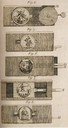
Musschenbroek typically sold the `sGravesande design of magic lantern with a massive number of slides, usually described as "many" for the larger lantern and 50 slides for the smaller. The price of the larger lantern was stable from about 1730 to 1751 at f 100 with slides and f 75 without; the smaller lantern sold for f 42 in 1720 and 1730, after which the price rose to f 50, always with 50 slides included.7 It appears that the smaller lantern was the first to be introduced, since it is offered in a c. 1720 catalogue where the magic lantern is marked as an "improved" instrument, while the larger and more expensive model is not present.8 Surviving correspondence between Johann Daniel Dorstenius and Johan van Musschenbroek indicates that the workshop contracted with unnamed artists in Leiden and Amsterdam to paint the slides, and that Dorstenius could freely choose the subjects he wished to have portrayed.9 Zacharias Conrad von Uffenbach gives some further information about the production of magic lantern slides in the published diary which records his visit to the workshop on 20 January 1711. Apart from noting that he had previously bought a lantern from the workshop, von Uffenbach reported, "We hear that the youngest brother makes the figures for it [the magic lantern]. But they are not as faultless as those the father made."10 Petrus seems to have been a main source of the workshop's painted lantern slides before he left for university in 1714, and it is likely that the very well-known mechanical moving slides which he illustrated in his physics textbook Beginselen der Natuurkunde in 1736 were also produced during this early period.11
The dual nature of the magic lantern emerges
During the 18th century, the dual nature of the magic lantern became clearly apparent. No longer a novel instrument of the 1660's slowly spreading across Europe, it came into the widest use amongst all social classes. Musschenbroek's exceptional lantern for `sGravesande represents one side of the growing separation of Lantern use. On the one hand, lanterns of high quality and decorative splendor were produced for scientists, gentlemen, instrument collectors and public lecturers; on the other hand less sophisticated lanterns became very cheaply and widely available to itinerant showmen and amateurs who used it for a variety of purposes that ranged from casual demonstration to outright deception and trickery. If this division makes a convenient structure for telling the story of the lantern in the 18th century, it is nonetheless somewhat unreliable: the upper classes often used the magic lantern for casual amusement and diversion, while the itinerant lanternist sometimes used his simple instrument as a means of education, reportage, or political satire. Since there is some evidence that both groups were supplied in the main from the workshops of the same commercial instrument makers, the real story of the dissemination of the lantern and lantern practise in the 18th century is a complex one with many interrelated elements. Today, it is often difficult clearly to separate these two strands of lantern evolution, partly because so few actual lanterns and records of their usage survive, and partly because the social context of public interest in scientific developments at the time is so distant from modern thinking. The 18th century was an age with a remarkable public interest in "physique" or "natürliche Magie," terms which covered a wide range of interests both sensational and educational. Under the influence of a quicklygrowing middle class, a public that was passionate about science and instruction flocked to see public demonstrations of electricity, magnetism, hydraulics, air pumps and a plethora of scientific principles and ephemera during a period that early modern historian Barbara Stafford has characterized as "the eighteenth-century culture of curiosity."12 Public lecturers drew large crowds to "courses" that were showmanly displays of exotic scientific and semi-scientific phenomena.
Abbé Jean-Antoine Nollet and the public display of science
The Abbé Jean-Antoine Nollet (1700-1770), is a typical example of this interplay between science and the public, between experiment and showmanship.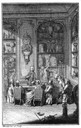
The fashion for dazzling scientific displays of physics and optics
Nollet was far from the only figure of the Enlightenment to combine savant, craftsman and showman in a single role. The list of 'dazzling operators' who fell "outside the rational orbit of the Encyclopédie and the theoretical pretensions of professional academies,"15 and used the magic lantern in their public displays, or promulgated its use by children of the gentry, or by shopkeepers, tradesmen and artisans eager for self-education is widespread across the entire century. No scientific discipline was excluded from this repertoire, and those who emphasized the diversions and development of the magic lantern included Jacques Charles (1746-1823), a financial clerk turned electrician whose public lectures in the 1780s seemed particularly attractive to fashionable ladies; Gilles-Edme Guyot (1706-1786), a geographer and director of the Post Office whose influential Nouvelles récréations physiques et mathématiques of 1769/70 explained all of the tricks of magicians and illusionists;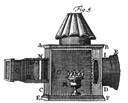
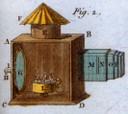
This fashion for dazzling scientific displays and for entertaining scientific lectures replete with showy instruments was often denigrated by serious experimental scientists. The foreword to a 1749 multi-volume translation of the papers presented to the Swedish Academy of Sciences noted that only a single scientific principle, that of the reflection of light, had managed to encourage the making of "countless" peepshow boxes, "in which the eyes never get enough, but the mind, having understood one, has understood all of them. There are such toys everywhere in nature, knowledge of which many people in their own or in others's imagination make into a study of nature, but only as long as these toys are still new and rare."17 For those who could afford it, collecting scientific instruments was both a respectable and an educative hobby: apart from major collections like those of Martin Trewald at Newcastle, the Landgrave of Hesse at Kassel, Voltaire at Cirey, and those of the lecturers 'sGravesande, Nollet, and Desaguliers, nearly a hundred private collections are known from the 18th century, and it is likely that this is only a portion of the activity.18 In 1712, the Crown Princess of Prussia had in her jewelry chest a magic lantern made of finely engraved silver, the product of Berlin goldsmiths; given the heat conducting properties of silver, this was clearly a fashion item rather than a practical lantern. The Crown Princess's instrument no longer survives: a few decades later it was turned over to Johann Nathaniel Lieberkühn, the pioneer of the solar microscope, with other pieces of "old silver" to be melted down.19
Every city and town had a local example of the genre of the science populariser. In Nürnberg, for example, it was Johann Christian Gütle (1747-1827).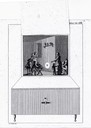
At the same time as the teaching of physics spread to universities across Europe and tantalised a populace eager for instruction in the new physics, the 18th century was simultaneously replete with charlatans, frauds, and deceptive artists who exploited the rapid development of scientific knowledge and the enthusiasm of the public. The "culture of curiosity" was also receptive to showmen offering the most astonishing feats of "science" mixed with a strong dose of superstition and magic. The magic lantern served all sides: academic scientific demonstrators, roving pseudo-scientific showmen, simple exhibitors of exotica, entertainers intending either to astound or to admonish an awakening if still illiterate public. Jacques Ozanam's famous Récréations mathématiques is a good example of the changing nature of lantern culture across the century. First published in 1692 it was hugely expanded and brought fashionably up-to-date in editions revised by Jean-Etienne Montluca in 1778 and 1790. The earliest texts of Ozanam noted that the lantern was used to show "monsters and fearful Apparitions which the Ignorant impute to magick,"23 but by 1778 Montluca could say that the lantern had become "a useful resource to a great number of people who gain their livelihood by exhibiting this spectacle to the populace. But though it has fallen into vulgar hands, it is nonetheless ingenious.... ”24
Prominent magic lantern makers
From around 1720 at the latest, the magic lantern was a standard item in the catalogue of most active makers of scientific instruments. In England, the price lists, advertisements and trade cards of many instrument makers indicated that lanterns were amongst their repertoire of optical apparatus, including the makers James Wilson (active 1702-10), George Adams (1730s), Edward Scarlett (1705- 43), Matthew Richardson (1730s), Oliver Combs (1691-1750), John Cuff (1731-1770), John Jones (c. 1740-90), Samuel Whitford (1765-1789) and many others. In France, quality lanterns were made by opticians like Jacques and Pierre Lemaire (active 1700-1750), Letellier (c. 1770-1790), Marc-Mitouflet Thomin (1740s),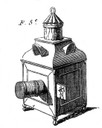
Apart from the many anonymous makers/assemblers in Nürnberg who were beginning to industrialise the production of the lantern and turn it into a mass manufacture by the end of the century, German lantern makers of the 18th century include Joachim Friedrich Meyen (Dresden, from at least 1747), the optician Löw (Hannover, 1765), the optician Reuter (Hannover, 1753), and others. Johann Michael Dobler built lanterns in Berlin from at least 1712, and in a list of his instruments from November, 1727, offered "9) Lucerna magica, which presents moving figures, painted one finger long on a glass, sixteen feet tall on a white wall."26 The clear explanation of the instrument perhaps indicates that it was still something of a novelty to Dobler's customers. In Augsburg, the glass-maker Berkenstein was reported around 1740 to be making eyeglasses, burning glasses, geometric figures of glass, and other optical diversions, including magic lanterns, cameras obscura and peep-shows.27 The optical instrument maker to the Berlin Academy of Sciences in 1715, Johann Christian Rembold, offered a range of magic lanterns in a list of his instruments from 1720.
The anonymous 'London Lantern Maker'
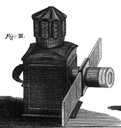
To a large extent, the lanterns made by these instrument makers reflected the general trends in their overall trade. The production of scientific instruments, including lanterns, increased rapidly in the second half of the 18th century, with specialist London makers supplying both domestic customers and much of the world trade; manufacturers in France, Germany and the Netherlands were generally limited to only domestic supply, with rare exceptions like Georg Friedrich Brander of Augsburg. Most of Europe, but especially Italy, Spain and the Scandinavian countries, bought almost all of their instruments abroad, buying in London "when they could afford to."28 One example of this buying preference is the series of instruments purchased in London for King Gustav of Sweden in the late 1730s, which includes a magic lantern bought in October, 1739 for £1 10s -. This lantern, a rare surviving London lantern from the first half of the 18th century, has a distinctive design. The body of the lantern is a tall vertical cylinder, with a quite fat lens tube supported by a short tapered leg at the front and an elegantly curved handle at the back. It stands on a slightly flared base perforated with holes for air circulation, and the top third of the lantern's cylindrical body has a collonade of corrugated metal under the chimney rosette, which is topped by a cone-shaped filial. This unusual lantern design is illustrated on the trade cards of several London instrument makers from about 1725 to about 1746, including those of Edward Scarlett (senior), R. B. Bate, Dudley Adams, Nathaniel Hill, John Bennet, and others.29 It also shows up on a Dudley Adams trade card of c. 1800 which advertised the longevity of his business by illustrating instruments from about 1734 during his father's time in the shop.30
Lanterns in this design are not found outside of London publications and there are virtually no illustrations that originated in London of any other lantern designs in the period up to around 1765.31 Yet none of the instrument makers who advertised this lantern are related by either apprenticeship or association.32 The inevitable conclusion is that one shop was making this lantern and supplying it to the others, or, even more likely, there was a sub-contracting workshop in London which was supplying this lantern to the instrument trade as a whole during this period. While the picture of sub-contracting from named instrument makers is murky and has little surviving documentation, it is known that specialists were often used for specific processes and that contracting out was not an unusual practise, whether for seeking specialist skills or because of large orders that put a strain on a small workshop. Matthew Richardson, for example, who was active between about 1737 and 1752 was a specialist sub-contractor supplying the London instrument trade, grinding lenses for spectacles, magic lanterns, cameras obscura and scioptric balls, as well as being a maker of mirrors and prisms.33
The lantern loses its novelty and becomes a commodity
There are hints that by mid-century the magic lantern had entered a curious kind of limbo. In its first hundred years it had so far failed to find a strictly scientific purpose, and regardless of continuing suggestions about its educational value for instruction it was put to this use by only a limited circle of public lecturers and the rare academic. By mid-century knowledge about the optical requirements of projection meant that the magic lantern was no longer a specialist apparatus that could be made only by specially skilled craftsmen using advanced knowledge. One example is the instrument made by a local instrument maker in Utrecht, Jacob Lommers, in 1757. Appointed to clean and maintain the university's collection of instruments from 1743, Lammers also made physical, astronomical and mathematical instruments. Altogether this is a provincial lantern of limited usefulness, and it demonstrates only that a magic lantern of some sort had become a common part of every optical instrument maker's repertoire. At the same time, it is probably the case that by the 1750s the magic lantern held little interest for these makers, since it did not require the extraordinary quality of lenses on which reputations could be won or lost, and it lacked the ongoing technical evolution present with an instrument like the microscope that was deployed in new and demanding scientific situations. Once an outstanding design like that of `sGravesende was publicly known, i. e., after 1720, the magic lantern could be made to a high standard by any leading instrument maker who had a demanding professional clientele.
Although the manufacture and retailing of the magic lantern was still wholly contained within the scientific instrument trade, the idea that by mid-century it was of less interest to instrument workshops is supported by evidence from surviving inventories. These shop inventories indicate that whilst the magic lantern is invariably present in a retail shop, there are never more than a very few lanterns as opposed to scores or even hundreds of other instruments. In the shop of Thomas Sterrop, the partner and then successor to John Yarwell, are found at his death in 1728 some 708 microscopes of different sorts (valued at £13 3s 8d), 69 telescopes (£26 16s 11d), 792 prospect glasses (£26 3s 10d), and a multitude of spectacles, lenses, burning glasses and other goods to the value of over £324, but only a single magic lantern, with slides, valued at £1 13s 0d.34
Another inventory, meticulously recording the domestic possessions and business stock of Nathaniel Adams after his unexpected death in 1741, tells the same story. Adams had been an apprentice of Edward Scarlett (senior) and his own business had been established for just over a decade when he died. His business stock and tools were valued at more than £256, and included 30 telescopes, about 15 microscopes of various kinds, and 88 prospects, but only two magic lanterns, one of which is described as "old".35 When the instrument maker and retailer Benjamin Martin died in 1782, his stock was auctioned over five days in 650 lots. Instrument historian John R. Millburn declared that Martin "held an astonishingly large quantity and variety of instruments in stock at his death, far exceeding what a comparable business would expect to hold today."36 Ranging across air pumps, barometers, clocks, drawing instruments, electrical machines, orreries and surveying instruments, Martin's inventory also included 135 lots of telescopes with about 224 items (sold at £256 3s 0d), 34 lots of microscopes making up some 40 items (£47 15s 0d), and 60 lots of spectacles comprising 550 items (£67 18s 0d). There was a single magic lantern, which with 6 slides was sold for £2 3s 0d.37
The paucity of lanterns in these inventories supports the idea that, in London at least, the magic lantern had turned into a commodity that was supplied to the instrument trade by an outsourced maker, with most shops simply keeping a demonstration model on hand for enquiring customers. The inventories also suggest that the magic lantern was beginning to be an orphaned instrument: still within the culture of scientific instruments but already recognized as having little scientific purpose. It was already an instrument waiting for some breakthrough that could give it purpose. Today, the inventories also suggest that the magic lantern was a much scarcer instrument than its optical cousins from the 17th century, and that the very small number of surviving lanterns in museum collections is not solely a result of neglect of the instrument but is caused in good part by their rarity and low production numbers before the lantern's shift from the world of scientific instruments to the world of photography in the mid-19th century.
The ubiquity of the magic lantern in instrument catalogues of the 18th century was in part a practical economic decision by the expanding instrument workshops of the second half of the century, since there is some evidence that they were supplying not only the "recognised" market of academics, experimenters and showy middle class collectors, but also a more nebulous market interested in magic and optical tricks. A 1753 list of Georg Brander's instruments includes not just his model of the 'sGravesande lantern, but also a very inexpensive "Laterna magica which one can put in a pocket, along with 1 dozen sliders, fl. 14.38 This lantern was useful for a trick described by Karl von Eckartshausen where a small lantern kept in a lead-lined coat pocket could be stealthily ignited and suddenly show a ghostly image on any dark wall during an evening stroll, to produce a diverting illusion.39 Although scarce, such references indicate that there was probably a profitable "underground" market for the lantern, even for the most respected instrument makers. The optician Reuter in Hanover advertised also in 1753 "cameras obscura and magic lanterns, which can be carried in one's own pocket."40 Certainly the development of the market for magic lanterns over three decades in mid-century is shown by Brander's catalogue of 1783, which no longer specified a particular scientific lantern but included amongst its 102 instruments such as hygrometers, microscopes, quadrants, magnets and electrical machines the general offering of "magic lanterns with beautiful paintings at various prices".41 Slowly, the retailing of optical goods began to separate from the workshops that made them. Gottfried Christian Bohn opened a shop for general merchandise in Hamburg in the 1760s where a variety of lamps and lanterns could be found along with "all practicable trade goods" including "magic lanterns, artistic lanterns, which have been made by opticians, and with which all kinds of figures are shown in the dark on a white wall."42
The struggle for better Illumination and other improvements
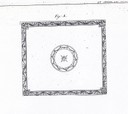
Throughout the 18th century, there continued to be a variety of suggestions for improvements and variations for the magic lantern. Édmé-Gilles Guyot suggested that the lens and its extension be square shaped instead of tubular, "so that the image on the sheet has the shape of a painting, which is preferable to the usual circular picture."43 Christian Gottlieb Hertel incorporated two openings for slides in his lantern, allowing either a second slide to be projected simultaneously, giving some movement to the image on the first, or permitting the use of a black slide to darken the screen as the first slide was moved."44 In his Lehrgebäude der Optik of 1757, C. L. Denecke added a water-filled sphere to his lantern, placed between the oil lamp and the lantern's lens, which served both to align the rays of the lamp in parallel and to keep the heat of the lamp from damaging the hand painted slide.45 A surviving lantern in the museum of the observatory at the Benedictine monastery in Kremsmünster, dating from c. 1761, is remarkably similar to Denecke's lantern, sitting on four turned button feet and with a unique forward-tilted tubular chimney and arc-shaped oil lamp.
One of the most intriguing suggestions for the lantern was described by Johann Gabriel Doppelmayr in his additional volume to the German translation of Nicholas Bion's important treatise on mathematical instruments.46 The magic lantern Doppelmayr describes had a crescent shaped oil lamp whose two wicks would not block the rays of light reflected from the concave mirror at the rear of the lantern.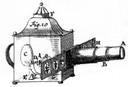
The quality and amount of illumination was one of the two major practical issues facing constructors of the magic lantern in the 18th century, the other issue being the quality of the instrument's lenses. An lamp burning either animal or vegetable oil was the principal source of illumination for the magic lantern until the very end of the 18th century. Olive oil, wine spirit, and Colza oil, sometimes also called rapeseed oil, were the usual fuels for the lamp, producing an illumination of about 28 candlepower, which could be increased slightly by concentrating the light of the flame with a shaped reflector or mirror. Oil from the sperm whale (Physeter macrocephalus) became available in the later 18th century and gave a similar level of illumination; the addition of a few ounces of powdered camphor noticeably increased its light and produced a smoothly-burning flame. Many other variations of fatty oils were also suggested from time to time but without significantly changing the illuminating power of the lantern, which was adequate to produce an image of up to about 8 feet in diameter at a distance of about 10-14 feet. At this time, it was the precise arrangement of the lamp, lens, and reflector on the still imperfectly understood optical axis of the lantern which had the most noticeable effect on the power of the lantern, and many different arrangements of lamp and wick were tried, such as the one proposed by Johann Christian Wiegleb in 1779, where a lamp with three wicks was placed so that their flames burned just at the mid-point of the lantern's adjustable concave mirror.47
The lenses for the magic lantern in the 17th and 18th centuries, and the lantern's hand painted slides, were the most expensive part of the instrument. The very best lenses, both those from famous lensmakers and those from other makers which by happy chance lacked imperfections or aberrations, were normally used in the vast market for microscopes and telescopes; it was a rare lantern (like the one of 'sGravesande) that was furnished with a superior lens. To obtain the small buttons of solid glass that could be roughly ground and then polished into a lens, one method of manufacture was simply to smash molten glass between pieces of wood: the resulting glass beads suffered somewhat less from the presence of tiny air bubbles or striations from the blowpipe that were the bane of lens makers. More typically, the irregular lumps or "crowns" that formed at the end of the blowpipe during the manufacture of window glass were often used as the basis for grinding early lenses, even though the glass was frequently of unknown composition and no two pieces were alike.
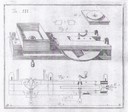
Optically, early lenses were subject to severe chromatic aberration, where light of different wavelengths passing through the lens did not focus at precisely the same spot, leaving a colourful halo around the image produced by the centre of the lens. This was a more noticeable and serious problem than the spherical aberration that was also present, caused by the fact that light passing through the edge of the lens does not have exactly the same focal point as light passing through its centre. Both of these optical faults, which were not significantly improved until the second half of the 18th century and the first half of the 1 9th, respectively, were intensified in any instrument using more than one lens, as in the normal two lenses of the magic lantern. Flint glass, as opposed to crown glass, appeared in lenses from the early 1700s, under the influence of John Dolland, who used the glass meant for fine tableware for his lenses. In flint glass, broken pieces of flint substituted for the common sand that was the source of silica for crown glass, and as a result the finished product had fewer impurities, plus a higher refractive index and higher dispersion of light.
Magic lantern slides and the lantern audience
A principal reason for the concentration of magic lantern makers on solving problems of illumination and overall structure in the instrument at this time, rather than developing new and more exacting lenses, is found in the nature of the imagecarrying transparencies or slides used in the lantern. These normally held images hand painted on glass or thin sheets of mica, and therefore the amount of detail that they could carry was severely limited. Slides were "painted in dilute and transparent colour on plain thin glass" according to Molyneux in 1692;48 Nollet advised in the mid-1700s that slides "were longer-lasting, if they were painted with a transparent glaze and then fired again. Commonly, one is content that these playful figures are painted with very bright colours, which are then fixed with varnish."49 Many recipes were given in the literature for the production of specific colours or for methods of making the image more permanent when they were repeatedly shown in a lantern which produced a reasonable amount of heat when in use. Apart from the lantern lens itself, slides were both expensive and valuable due to both their use of good flat glass and to the cost of having them finely painted. At the end of the century, the encyclopaedist Johann Georg Krünitz summarised the importance of the quality of the lantern slides: "Correctly painting the images is the most important work on which everything depends; for when the lantern is perfectly arranged, and the sliders are perfectly placed, but the pictures appear on the wall with their colours unclear and lifeless, and are poorly drawn, then one will have little pleasure from the costs incurred."50
lt was the illumination available for magic lanterns in the 18th century that generally limited the instrument to use in domestic settings or in intimate public lectures of usually not more than 40 persons or so; Gütle's lectures in Nürnberg were attended by about 20 people at a time. Although some idea of the content of magic lantern projections has survived from the anonymous travelling lanternists of the century, often through complaints about their quality, the essentially private nature of lantern shows in this period apart from public science lectures and courses means that few reports of their content and structure survive. As in the previous century, Biblical and Classical subjects continued to be prepared for the magic lantern: Johann Beuther chose a number of subjects from an illustrated Bible and commissioned magic lantern slides on glass from an Augsburg miniature painter.51 Interestingly, Beuther's slides were then already copies of works made by other optical apparatus; as he recorded in his notebooks: "In the Strasbourg Bible published by the descendants of Lazarus Zehmer in 1630 are found many copper engravings, particularly illustrations by Merian; most of these are pleasant landscapes, which the artist has drawn from nature with the help of the camera obscura."52
Lantern shows both educational and erudite
Father Anselm Desing, a Benedictine monk who drew up the plans for the observatory at Kremsmünster and later was a member of the Bavarian Academy of Science, used a magic lantern (which he called Lucerna magica) for teaching geography, writing in 1731:
In my opinion the easiest and most enjoyable way to learn history is through the land-maps that I have made for this purpose. One imagines him [the student], and puts the world before his eyes, therefore, how the countries lie each on the next. Then a picture is painted of the most remarkable events from the beginning of the world; each portrayed in whichever land, or region, in which it took place. So the entirety of history is represented as a picture, or as a play. This is even more enjoyable when it is shown with a magic lantern, or a camera obscura. Whomever wants to experience this, can see it by me.53
Georg Christoph Lichtenberg (1742-1799), the noted scientist, disciple of Kant, and professor at Göttingen, was also entranced by the magic lantern. His correspondence with Johann David Ramberg, Secretary of War and commercial councillor in Hanover, notes their exchange of lantern slides and experiences over more than a decade, sometimes including quite advanced experiments. In 1794 Lichtenberg wrote to Ramberg "On one of your old pictures stands a figure opposite a fire, wearing green with dark, almost black pleats. I showed this once life-sized in a large room; there was enough space to walk into the distance, which had an incredible effect."54
A more detailed description of a lantern show comes from an anonymous travel diary, The German Spy, published in London in 1738.
This melancholy Scene was no sooner at an End, than a more agreable one appear'd, in which I discover'd a Woman of a staid, serene Countenance, sitting on a very low but decent Vehicle, which moved but just above the Surface of the Earth. In one Hand, she held a broken Heart, and, in the other, a Shepherd's Crook. Every Circumstance gave me to understand, that this Figure could be no other than that of Humility; especially as she was accompanied by Faith, Hope and Charity, the latter having a Child at her Breast, and leading two more by the Hand. This humble Vehicle was drawn by Meekness and Sobriety, led by Timorousness. The Landscape, as I have before observ'd, was more agreable, than that of the preceding scene; but with what Satisfaction did I see it, in an Instant, changed into one of the most beautiful and noble Views, I had ever seen; upon the Appearance of a lovely Nymph, seated in a costly Char, which, as well as her Person, was embellish'd with every Thing that could please the Eye and the Imagination. I concluded, without any Hesitation, that this pleasing Figure must be the Goddess of Peace, and with that amiable Denomination it was my Friend distinguished her. Concord and Public Good, guided by Love, drove the Char; and Truth, Justice, Diligence and Liberty accompanied it. At the Goddess's Feet lay all Manner of Mathematical, Mechanical and Musical Instruments, together with a Cornucopia; and looking more narrowly, I observed, in the Char with her, the little Figure, which, at the Beginning, I had discover'd, with the Help of my Glass, to be the Goddess of Riches....56
The author of The German Spy introduced his description of this show as being the product of "a curious Laterna Magica, the Invention of a very great Artist," and the technical construction of the lantern, along with its physical placement outside the viewing room and projecting into a theatrical proscenium, has many similarities to the "Magic Theatre" discussed in detail by Edm6-Gilles Guyot in 1770. The allegorical and philosophical nature of the evening's exhibition gives a rare clue about how the magic lantern was deployed by gentlemen of leisure and means in the 18th century. But the main practitioners of magic lantern work at the time, whose shows were given in great numbers across Europe and Britain were those of the anonymous travelling entertainers who cris-crossed the Continent and have come to be known as Savoyards.
- ^ John Barnes, Barnes Museum of Cinematography. Catalogue of the Collection, Part 2: Optical Projection (Saint Ives, Cornwall: 1970), P. 16.
- ^ Willem Jacob 'sGravesande, Physices Elementa Mathematica (Lugduni Batavorum [Leiden], 1720). This book was a basic textbook for teaching Newtonian mechanics through experiments, for which Musschenbroek made a suite of scientific instruments according to 'sGravesande's new designs.
- ^ Alto Brachner, et. al.,: G. F. Brander, 1713- 1783. Wissenschaftliche Instrumente aus seiner Werkstatt (München, 1983: Deutsches Museum), p.341.
- ^ Johann Ludwig Steiner, Kurze Abhandlung von den Vergrösserungs-Gläsern, 1748; Letter of Inge Keil to Deac Rossell, 4 November 2003.
- ^ See Peter de Clercq, op. cit. (Note 2), pp. 165-67, 145, and 148; plus Chapter 6: The 'sGravesande Models.
- ^ Peter de Clercq, The Leiden Cabinet of Physics. A Descriptive Catalogue (Leiden, 1997: Museum Boerhaave Communication 271), p. 108. I am indebted to Peter de Clercq for a copy of the relevant page; and also for his patience in answering numerous questions.
- ^ The known Musschenbroek catalogues are published as appendices A - I (pp. 217-253) in Peter de Clercq, op. cit., (Note 2). An additional catalogue of c. 1720 is discussed in Peter de Clercq, "A Musschenbroek Trade Catalogue in the Library of Sir Hans Sloane", in: Bulletin of the Scientific Instrument Society, No. 70 (2001), pp. 10-13.
- ^ I am indebted to Peter de Clercq for checking his copy of the Sloane catalogue and confirming this entry.
- ^ ibid., p. 60.
- ^ Zacharias Conrad von Uffenbach, Merkwürdige Reisen durch Niedersachsen Holland und Engelland (Ulm, 1754: Auf Kosten der Gaumischen Handlung). Dritter Theil, p. 433.
- ^ Petrus van Musschenbroek, Beginselen der Natuurkunde, Beschreven ten dienste der Landgenooten (Leiden, 1736: Samuel Luchtmans). The often cited 1739 edition is for the French translation of this work issued by the same publisher.
- ^ Barbara Maria Stafford, Artful Science. Enlightenment entertainment and the eclipse of visual education (Cambridge/London, 1994: MIT Press), p. 29.
- ^ Barbara Maria Stafford, op. cit., (Note 12), p. 29.
- ^ Jean-Antoine Nollet, op. cit., (Note 4), Vol. 5, p. 567.
- ^ Barbara Maria Stafford, op. cit., (Note 12), p. 190.
- ^ Benjamin Martin, "The Young Gentleman and Lady's Philosophy in a Continued Survey of the Works of Nature and Art; by Way of a Dialogue", in General Magazine, II, p. 162.
- ^ Abraham Gotthilf Kästner, "Vorrede zur deutschen Übersetzung", in: Der Königlich Schwedischen Akademie der Wissenschaften,eds., Abhandlungen aus der Naturlehre, Haushaltungskunst und Mechanik (Hamburg/Leipzig), Vol. 1. I am indebted to Oliver Hochadel for bringing this passage to my attention.
- ^ J. L. Heilbron, Elements of Early Modern Physics (Berkeley/Los Angeles/London, 1982: University of California Press), p. 72.
- ^ Walter Stengel, Guckkasten. Altberliner Curiosa (Berlin, 1962: Verlag Walter de Gruyter & Co.), p. 173.
- ^ C. G. von Murr, in: Neues Journal für Kunstgeschichte 1 (1798), p. 385. On Gütle, see Alexander Rüger, "Populäre Naturwissenschaft in Nürnberg am Ende des 18. Jahrhunderts. Reisende Experimentatoren, öffentliche Vorlesungen und physikalisches Spielzeug", in: Berichte zur Wissenschaftsgeschichte 5 (1982), p. 173-191.
- ^ J. L. Heilbron, op. cit. (Note 25), p. 8.
- ^ J. L. Heilbron, op. cit. (Note 25), p. 132.
- ^ Jacques Ozanam, Récréations mathématiques (Paris, 1692); quoted: London edition of 1708, p. 252.
- ^ Jacques Ozanam, Récréations mathématiques, revised edition by Jean Etienne Montluca, (Paris 1778); quoted: London edition of 1803 translated by Charles Hutton, Vol. 2, p. 300.
- ^ Laurent Mannoni, The Great Art of Light and Shadow. Archaeology of the Cinema (Exeter, 2000: University of Exeter Press), p. 133-5.
- ^ Andreas Elias Büchner, Miscellanea physico, medico, mathematica, Band I: Nachrichten von 1727 (Erfurt, 1731: bei Carl Friedrich Jungnicol), p. 738. I am indebted to Inge Keil for bringing this reference to my attention. 27.
- ^ Inge Keil, Augustanus Opticus. Johann Wiesel (1583-1662) und 200 Jahre optisches Handwerk in Augsburg (Berlin, 2000: Akademie Verlag), p. 190, & Inge Keil, letter to Georg Füsslin, 26 July 2000, p. 2.
- ^ J. L. Heilbron, op. cit., (Note 25), p. 71.
- ^ Trade Card of Edward Scarlett (senior), c. 1725, Science Museum London; Trade Card of John Bennet, c. 1735+, Science Museum London; Trade Card of Nathaniel Hill, c. 1746, Science Museum London.
- ^ Trade Card of Dudley Adams, c. 1800, Science Museum London. On the dating of this card and of the instruments represented, as well as on the accuracy of representation on instrument makers' trade cards in general and the Edward Scarlett card in particular, see M. A. Crawforth, "Evidence from Trade Cards for the Scientific Instrument Industry", in: Annals of Science, 42 (1985), pp. 453 - 554, especially pp. 456-459.
- ^ The square-bodied, tapered lens tube lantern illustrated in E. Chambers, Cyclopaedia: or, an Universal Dictionary of Arts and Sciences (London, 1738), Tab. Opticks, Fig. 10, is directly copied from Christian Friedrich Wolf, Elementa mathesos universae (Halle i. M., 1713-1715: Renger), V. 2, Tab. XI, Fig. 86. The vertical cylindrical lantern in Robert Smith, A Compleat System of Opticks... (Cambridge/London, 1738: Cornelius Crownfield/Stephen Austen/Robert Dodfley), Pl. 57, Fig. 639, p. 385, is neatly re-engraved after Willliam Molyneux, Dioptrica Nova. A Treatise on Dioptricks (London, 1692: Benj. Tooke), Pl. 38, Fig. 2. A rectangular-bodied lantern also in Smith (Pl. 57, Fig. 640, p. 385) is adapted from Willem Storm van `sGravesande, Physices elementa mathematica, experimentis confirmata (Leiden, 1720-21: Peter Vander), V.2, Tab. XIV, Fig. 1. Dennis de Coetlogon also copies Wolf's 1713-15 lantern in his An Universal History of Arts and Sciences (London, 1745: John Hart), Pl. Opticks. Indeed, it is likely that it was the omnipresence of this vertical lantern design in the first half of the 18th century that accounts for the remarkable longevity of republications and re-engravings of the superficially similar vertical-bodied lantern illustrated by Molyneux in 1692, which was published not only by Smith but also by William Emerson (1768), the Encyclopaedia Britannica (1771, 1780 & 1781), Joseph Priestley (1772), and others. Benjamin Martin's re-working of Molyneux, in fact, presents a kind of halfway house between Molyneux and the contemporary lantern of the London instrument makers: see Benjamin Martin op. cit. (Note 39), Pl. )00(IV, p. 294.
- ^ According to Gloria Clifton, Directory of British Scientific Instrument Makers 1550- 1851 (London, 1995: Zwemmer/National Maritime Museum).
- ^ M. A. Crawforth, op. cit. [Note 30], p. 477.
- ^ Corporation of London Record Office, Orphans' Inventories, Thomas Sterrop 3285 f.123. This inventory was discovered by Anita McConnell, and I am indebted to her for access to her unpublished work-in-progress which contains this information at Ch. 8 pp. 11-12: A Survey of the Networks Bringing a Knowledge of Optical Glass-working to the London Trade, 1500 - 1800 (Copy of typescript, April 1997).
- ^ Peta Buchanan and Brian Gee, "Inside the Shop of an Eighteenth Century Optician. The Inventory of Nathaniel Adams of St Martin-in-the-Fields, Westminster", in: Bulletin of the Scientific Instrument Society, No. 82 (2004), p. 10-15, esp. p. 12-13.
- ^ John R. Millburn, Retailer of the Sciences. Benjamin Martin's Scientific Instrument Catalogues, 1756- 1782 (London, 1986: Vade-Mecum Press), p. 75
- ^ ibid., pp. 76, 81.
- ^ Letter of J. G. F. Brander to J. F. A. Uffenback, 7. Juni 1753, cit. Alto Brachner, etc., G. F. Brander, 1713-1783. Wissenschaftliche Instrumente aus seiner Werkstatt (München, 1983: Deutsches Museum), p. 341.
- ^ Karl von Eckartshausen, Aufschlüsse zur Magie, aus geprüften Erfahrungen über verborgene philosophische Wissenschaften und verdeckte Geheimnisse der Natur (München, 1788: bey Joseph Lentner), p. 79-84.
- ^ Hannover Anzeiger, 17 September 1753, cit. Walter Stengel, Guckkasten. Altberliner Curiosa (Berlin, 1962: Verlag Walter de Gruyter & Co.), p. 173-4.
- ^ G. F. Brander, C. C. Höschels Nachricht von dem katoptrischen Zirkel (Augusburg, 1783), Appendix: Verzeichnis von Instrumenten zur praktischen Geometrie, Astronomie, und Naturlehre, p. 29, Nr. 91, cit. Aalto Brachner, etc., G. F. Brander, 1713-1783. Wissenschaftliche Instrumente aus seiner Werkstatt (Munchen, 1983: Deutsches Museum), p. 327. Christoph Caspar Höschers undated Catalog verschiedener mathematisch-physikalisch-und astronomischer Instrumente, also reproduced in this volume, offered as Nr. 159, "Laterna magica or Zauber-Laterne with the painted glass-sliders belonging to it." (ibid., p. 339)
- ^ [Gottfried Christian Bohn] Gottfried Christian Bohn's neueröffnetes Waarenlager, worinner aller im Handel und Wandel gangbaren Waaren...kurz und deutlich beschrieben wird... (Hamburg, 1763: bey Johann Carl Bohn), pp. 471-2.
- ^ Edm6-Gilles Guyot, Nouvelles récréations physiques et mathématiques (Paris, 1799), Vol. II, p. 249.
- ^ Christian Gottlieb Hertel, ...vollstandige Anweisung zum Glassschleifen.. (Halle, 1716: Zu finden in der Rengerischen Buchhandlung), Taf. XV, fig. 3.
- ^ C. L. Denecke, Lehrgebäude der Optik oder der Sehespiegel und Strahlbrechkunst (Altona, 1757: Iversen), cit. Johann Georg Krünitz, Oekonomisch-technologische Encyclopädie (Berlin, 1787-1858: Joachim Pauli), Vol. 65 (1794), p. 481-2.
- ^ Johann Gabriel Doppelmayr, Weitere Eröffnung der neuen Mathematische Werckschule / Nicolai Bion, in welcher So wo! die Zubereitung als der Gebrauch verschiedener anderer Mathematischen, absonderlich der zur Geometrie und Optique gehörigen Instrumenten, die im besagten Auctore nicht zu finden, denen Liebhabern deutlich vor Augen geleget und erkläret werden von Johann Gabriel Doppelmayr (Nürnberg, 1727: Peter Conrad Monath). The original French publication to which Doppelmayr is adding this volume is Nicolas Bion, Traité de la construction et des principaux usages des instruments de mathématiques (Paris, 1713). Doppelmayr's translation and revision of Bion's original text had appeared in 1726. The attribution of Doppelmayr's magic lantern to Bion is deeply embedded in the literature: Bion is cited as the source even in Krünitz's Oekonomisch-technologische Encyklopädie in 1794 (Vol. 65, p. 488 & Fig. 3928) which has been a principal source for many historians. The error is not simply a matter of ascribing material to Bion rather than Doppelmayr, but instead of attributing material to Paris and France rather than to southern Germany, which distorts the exchange of information about the magic lantern as it evolved across Europe. The real mystery is why Bion did not include any mention of the magic lantern in his original publication.
- ^ Johann Christian Wiegleb / Johannes Nikolaus Martius, Unterricht in der natürlichen Magie (Berlin und Stettin, 1779).
- ^ William Molyneux, Dioptrica Nova, A Treatise of Dioptricks, in two parts (London, 1692: Benj. Tooke), p. 183.
- ^ Abbé Jean-Antoine Nollet, Die kunst, physikalische Versuche anzustellen und Beschreibung aller Instrument (Leipzig, 1771)[original French edition, Leçons de physique expérimentale (Paris, 1743- 48)]
- ^ Johann Georg Krünitz, Oekonomisch-technologische Encyklopädie oder allgemeines System der Staats- Stadt- Haus- und Land-Wirthschaft und der Kunst-Geschichte, in alphabetischer Ordnung.... (Berlin, 1787-1858: Joachim Pauli), Vol. 65 (1794), p. 476.
- ^ Inge Keil, op. cit., (Note 27), p.354-5.
- ^ ibid., p. 354-5.
- ^ Anselm Desing, Kürtziste Universal-Historie nach der Geographia auf der Land-Karte zu erlernen von der studirenden Jugend des Bischöflichen Lycei zu Freysing... (1731), p. 7.
- ^ Leitzman, A. u. E. Schüddekopf, Lichtenbergs Briefe (1901-04), Bd. 2, p. 314.
- ^ Anonymous [Thomas Lediard?], The German Spy: or, Familiar Letters from A Gentleman on his Travels thro' Germany, to His Friend in England (London, 1738: Printed for T. Cooper, in Pater-noster Row), Letter XXXIV, p. 312.
- ^ ibid., p. 316-7. For the complete text, and observations on the origins of the book, see Hauke Lange-Fuchs, "The German Spy", in: The New Magic Lantern Journal, Vol. 8, No. 5 (December 2000), p. 10-12.