Fundamentals


A Heuristic concept for interdisciplinary research
The ‘historical art of projection’ took place in a vast variety of live performance events. The performances were staged in a wide range of venues like theatres, public halls, churches, universities and schools. Today they are often referred to as ‘magic lantern shows’ or ‘lantern shows’. The following article describes the required technical and compositional arrangements as well as the fields of action and experiences of all involved organisers, producers, performers, technicians and spectators as the ‘dispositif of the historical art of projection’.
This heuristic concept was originally based on the German loanword Dispositiv which is derived from the French dispositif. According to the German dictionary Duden, the term Dispositiv comprises “the entirety of all people and means ready to be employed for a specific task, at someone´s disposal”.1 Following Frank Kessler's practice of applying the term to early cinema, this article will use the original French term dispositif.2 The common English translation of dispositif as ‘apparatus’ does not sufficiently capture the complex arrangement of the historical art of projection. Furthermore, it would lead to unnecessary confusion in descriptions of the projection apparatus as a part of this arrangement.
Apart from source-based descriptions of a complex performance context, the use of ‘dispositif’ also suggests a connection to other media- and socio-historical usages of the term. In media history, this applies mainly to more recent concepts of the term, which have been conceived with historical varieties in mind. Kessler describes the arrangements of film presentation in early cinema as independent dispositifs based on a critical reception of 1970s ‘apparatus theory’.3 One of the key texts on the concept of ‘dispositive’ within the so-called ‘apparatus debate’ is the essay “Le dispositif: approches métapsychologiques de l’impression de réalité” by Jean-Louis Baudry.4 He describes the performance context of the cinema analogous to Plato's allegory of the cave: Just as the prisoners there, the cinema audience sits immobile and fixed facing an illusory event without being aware of the technology and composition of its production. According to this reading of the term ‘dispositif’, the psychological apparatus of the immobilised spectators is linked with the cinematographic apparatus. This link creates a perceived reality in motion (similar to the perceptions in dreams). Baudry's approach has been criticised for his articulation of metapsychological assumptions on the spectator as trans-historical norms.5 Kessler, therefore, ʻre-interprets’ the film historical concept of the dispositif from a pragmatic perspective and focuses on diverse historical performance contexts which determine differing perceptions of the same film:
“[…] in the 1910s a travelogue about Africa could function as an exotic attraction in a moving picture theatre, and as colonial propaganda when screened by the Deutsche Kolonialgesellschaft. A historical investigation of historical and present dispositifs would thus have to take into account the different viewing situations, institutional framings, the modes of address they imply, as well as the technological basis on which they rest.”6
This pragmatic approach also accounts for changing usages and functions of media over time:
“[…] in spite of a continuity in naming a given medium (cinema, television, telephone, etc.) its functions and its functioning can vary so much over time that it would be more accurate to describe the different dispositifs in which it takes shape, rather than to look for the ʻidentityʼ or ʻspecificityʼ of that medium.”7
Most conceptions of the term ʻdispositifʼ in social history seek to establish wide-ranging social connections. They frequently adopt an approach devised by Michel Foucault for his investigations of the history of sexuality.8 He understands a dispositif as:
“[...] a thoroughly heterogeneous ensemble consisting of discourses, institutions, architectural forms, regulatory decisions, laws, administrative measures, scientific statements, philosophical, moral and philanthropic propositions–in short, the said as much as the unsaid. Such are the elements of the apparatus [dispositif]. The apparatus [dispositif] itself is the system of relations that can be established between these elements.”9
Foucault’s explanation emphasises the open concept of the notion ʻdispositifʼ and its capability to account for disparate elements which manifest themselves in the exploratory examination of an undeveloped field of research. Thus, the “heterogeneous ensemble” of the dispositif creates a suitable framework for the interpretive study of the interrelations between these elements.
The term ʻdispositif of the historical art of projectionʼ widens the basic configuration of performance events to not only include the spectator's relation to the technological apparatus but also any relations among participants, as well as their relations to the screen performances, the technical components of the dispositif and finally its structural and organisational prerequisites. This heuristic conception distinguishes essential elements common to all dispositifs in the history of the art of projection from variations of the individual dispositif in different performance contexts which could comprise additional elements. Depending on the research approach, all elements may either be studied as parts of the general dispositif or could each be examined as separate dispositifs. The article “Sentiment to Order / Bamforth's production of lantern slide sets on the ‘social question’” describes the production of lantern slide sets as a discrete dispositif linked to the dispositif of live performances.
This article introduces the basic configuration of live performances within the dispositif of the historical art of projection. The dispositif comprised recitations, lectures, singing and music which were coordinated with visual performances and experienced collectively. Performance events within this dispositif united all participants in a social microcosm. At the same time, these performances were linked to the social and cultural circumstances in which they occurred, the textual, performative and visual elements followed contemporary conventions that were adapted to the compositional repertoire of the art of projection.
Dispositifs of the art of projection
Two contemporary engravings illustrate basic dispositifs of the art of projection. Both show distinct spatial arrangements marked by a light cone connecting the projection apparatus and the screen. More importantly, they highlight the screen, the apparatus and all operators, performers and spectators involved in relation to each other and to the projected screen images.
The first engraving shows a well-attended performance using projected images in a theatre venue. 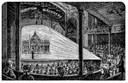
The article “Vorstellungen mit dem Projektionsapparat” (performances with the projection apparatus) in the trade paper Laterna Magica addresses 1887 the relations between operator, lecturer, spectators and screen. The paper published an article by British lantern showman Andrew Pringle translated into German. Pringle emphasises the universal possibilities of presentations of the medium: “Is there a better method to illustrate descriptions, to relate experiences to numerous audience members, than the projection apparatus?”12 As an experienced lantern lecturer, he explains to his readers how to realise this potential in a successful performance: well-serviced, functional technology, precise communication between lecturer and operator as well as an enticingly composed presentation of the projected images. The discussed topic must be researched soundly and matched to the intended audience. Lecturers are also advised to pay special attention to their vocal skills and adjust them to the size of the room. In The Optical Lantern, for Instruction and Amusement, Pringle advises lecturers that their style should be neither ‘dry’ nor ‘boring’: “In a popular lecture jokes are valuable, in fact nearly necessary. But the jokes must not be too stale, a jest familiar to everybody is worse than useless. We must try to suit our jokes to our audience.”13 Pringle enthusiastically describes an experience-oriented presentation and the emergence of a community for the duration of the performance:
“A good performance educates and entertains the auditorium. Good lantern images must bring joy and educate taste. We, as human beings, resemble a big herd, we find it easier to learn and easier to enjoy ourselves in company than we do in solitude; this is the advantage of a lecture illustrated by lantern images: everybody listens, sees and learns at the same time. Everyone partakes in the communal delight.”14
The lecturer in the illustration interacts live with the spectators and represents a variety of agents who performed in vocal or musical presentations. These agents were not only lecturers from the sciences and scientific entertainments: reciters, actors, clerics, social activists and political speakers alike were among the performers who presented projected images to audiences. Just like all performing artists, they had to be mindful of the staging of their performance. The spectators’ attention rested on the virtual space of the screen as well as on the performers who acted on stage. They in turn addressed the audience while referring to the living creatures, buildings, objects and sceneries projected on the screen.
Projected images and projection effects were produced live by an operator, who remained invisible or mostly unnoticed. Operators were part of the creative team of performers since they had to be skilled at operating the projection apparatus quite like musicians have to be skilled at their instruments. The operator’s field of action within the dispositif of live performances is a skilful combination of technology and composition in order to be able to present projected images and projection effects both in time with the performance sequence on stage.15
This article considers the dispositifs of the historical art of projection as a discrete form of the performing arts, characterised by the synergetic interaction of live performers and visual experiences. The relations between performers and spectators are similar to those of live performances in theatre, but the relations between screen performances and audiences as well as those between screen performances and performers constitute the art of projection also as a visual medium. The screen as a source of changing visual experiences is the distinguishing feature of the art of projection within the performing arts. Surviving lantern slide sets represent potentials of the staging and performance practices within the dispositif of the historical art of projection. These practices combined the technical and aesthetic requirements of the medium with live performances.
The wood engraving Une Scène de fantasmagorie 
The engraving is taken from the point of view of an enlightened observer surveying the entire venue. This perspective illustrates how the stimulating images appear on the screen through rear projection while the technical and compositional aspects of the event remain hidden from the audience. The split depiction of the illustration seemingly supports the impression that two sides of one event are in opposition to each other. In the perspective drawing, the screen divides the venue into two spaces allocated to different agents: the left space is dedicated to the creatively working operator with the technical apparatus while the right one is dedicated to the spectators. At the same time, all occurrences in this venue are divided into three sections, each equalling exactly one third of the image area. The left section shows the operator at the projection apparatus, the right section shows the audience while the apparition on the screen appears in between the two. Although the screen clearly separates both spaces of the venue, it is still permeable for the staged screen performance. The rectangular compartment on the left is self-contained and illuminated by stray light from the projection. The technical apparatus dominates this functionally furnished space. A cone of light emerges from this kind of lantern which is different from that of a common lantern. To the well-informed observer of the engraving it is apparent that this light cone causes the bright apparition of the projected image on the screen in the well-decorated auditorium on the right. The actual space of the projection room is hidden from the viewers’ gazes by the virtual space of the projection. This virtual space is dominated by the bright phantasmal figure on the screen. The audience in the darkness in turn shrinks back in terror. The spectators’ gazes, however, remain mesmerised by the apparition. Their reactions are differentiated by their respective body language and facial expressions. It is mostly the women and one child who are depicted in a state of excitement: their facial expressions and postures indicate horror. The differences between the depictions of the men in the engraving are more nuanced. One man seems to be in terror just like the women, another man is craning his neck and clenching his fist ready to fight while a sceptic directs a scrutinising look towards the screen image with his arms crossed. A critical approach to the engraving Scène de fantasmagorie suggests an obvious challenge of the pictured audience reactions: surely women at an actual performance event would exhibit nuanced and varying reactions, too. The auditorium is not limited by the picture margin, instead, silhouetted figures imply a larger audience.
This arrangement with the deliberately hidden operator emphasises the autonomous potential effects of projections in an ideal-typical manner. The spectators react directly to the perceived illusion of the figure on the screen even without an intermediary performer. The phantasmagoria showman Étienne-Gaspard Robertson, in fact, acted as a visible performer in front of the audience at his events. He also used other performers’ voices and orchestrated his performances with music and sound effects.19 Occasionally, however, it can be very effective to stage a lantern performance by solely making the projected images on screen affect the audience. This method is not only useful to enhance the illusion of an apparition, but also allows smooth changes of scenes in a narrative. Additionally, it complements the change of time and scenery during superimpositions for dissolving views. The performance arrangement depicted in the engraving demonstrates two separate relations to the virtual space of the projection with respect to technology and composition: On one side operators determine and create the events on the screen; on the other, the spectators perceive and appropriate the experience.
Venues in the dispositif of the art of projection
Both illustrations show typical examples of venues in the dispositif of the art of projection. The lantern show depicted in the McAllister catalogue takes place in a theatre with stage and balconies. The Scène de fantasmagorie happens in a specially arranged environment. Most of the venues in which the art of projection was practised were an inherent part of the cultural infrastructure of industrial societies: they provided space and furnishing for performance events or generally for public gatherings. By the end of the 19th century, venue sizes ranged from small classrooms to large auditoriums with over 1,000 seats. The projection technology and the large supply of mass-produced lantern slides became part of the cultural infrastructure of the late 19th century as well: combined with the suitably furnished venues they made frequent performances with projected images possible.
Beneath the virtual reality of the screen the tangible reality of the venue holds in itself stimuli for all senses of the spectators in the audience. The projection surface in the Scène de fantasmagorie is framed by a heavy draped fabric so as to not detract from the illusion. The drapery and the armchairs suggest decorative furnishings of the auditorium. Along the same lines, lantern expert Andrew Pringle gives the following advice: “the screen is all the better for having the frame-poles concealed by a tasteful but simple pair of curtains.”20 In a detailed description of a magic lantern show, the author Thomas Burke mentions “many rows of highly varnished and slightly sticky benches of pinewood”21 in a sparsely decorated public hall; thus conveying the experiential value of circumstantial haptic stimuli. These secondary attractions add, often unnoticed, to the overall experience of performance events.
The darkening of the auditorium plays an active part in enhancing the luminous manifestations of the screen performances in the dispositif of the art of projection. In the darkness, the spectators’ gazes are focused on the events on the screen. Albert W. Scott, a renowned British expert on projection technology, emphasised the importance of the darkened room in an article published in the magazine Laterna Magica:
“The projected image will only appear in all its vibrancy and beauty if all sidelight has been cut off. Moonlight streaming in through the windows takes all the brilliance from the image; the same is true if the walls of the hall are painted white or covered in light wallpaper and thus, instead of absorbing the light emitted from the screen, reflect the light back on the screen.”22
While setting up the dispositif of the art of projection in a venue, it is of the utmost importance to efficiently darken the room in order to prevent any loss of luminosity of the projections by incidental light. The projected images and the performers alone are supposed to attract the audience’s attention while their surroundings dissolve in darkness. Manuals, such as Liesegang’s Die Projektionskunst or Andrew Pringle’s The Optical Lantern, for Instruction and Amusement, recommend suitable material and outline efficient methods to darken a venue.23 The seats in a thusly prepared room face the erected screen and the performers, ensuring an unobstructed view. The operator positions the apparatus based on diverse technical criteria while trying to prevent any disturbance of the performance’s course.
The axis of screen performance in the dispositif of the art of projection
The spectators in the illustration in McAllister’s catalogue watch the screen images attentively. In the Scène de fantasmagorie exciting experiences originate from the appearance of motion through a projection effect. What unites these distinct dispositifs of the art of projection is the arrangement of the main elements in the same sequence. The following examination of this sequence of elements describes them along an imagined axis. Bright light cones emphasise one part of the axis: they connect the apparatus to the screen. The second part connects the screen to the audience. On the McAllister engraving these two partial axes are parallel to each other: The projection beam and the spectator’s gaze hit the screen from the same point of view. In the Scène de fantasmagorie these two partial axes face each other from opposing sides but are nonetheless both geared towards the screen.
Both parts of the imagined axis are coupled by the screen and form ʻthe axis of screen performanceʼ in the dispositif of the art of projection. The contemporary term ʻscreen performanceʼ usually distinguishes the performance of actors in films from live performances on stage. In technological terms it describes the quality of electronic screens. In both cases, ʻscreen performanceʼ references the creation of time-based image sequences on the screen. The use of the term ʻaxis of screen performanceʼ locates the production of variable screen images historically in the dispositif of the art of projection. The time-based presentation generates performing images in front of an audience – regardless of whether they show people or not. All specific elements of the art of projection as a dispositif align along these two partial axes: the ʻscreening axisʼ transfers the screen images from the apparatus to the screen; it represents the operator’s field of action. The ʻperceptual axisʼ connects the audience’s visual perceptions to the screen images.
The axis of screen performance is the distinguishing element of the dispositif of the art of projection within the performing arts. The performance of images on a screen sets it apart from all other dispositifs of public live performances. However, the performing arts in general and the art of projection share the performances by live performers as well as the venues and their furnishing. The elaborate evolution of the technical and compositional elements of the axis of screen performance established the screen as a social site of visual communication within the cultures of public performances. In the second half of the 19th century, the optical and photographic industry produced and distributed the apparatuses, lantern slides and effect slides which allowed performers to establish and utilise the axis of screen performance in various venues.
This article uses the generalising term ‘dispositif of the art of projection’ in the singular form to describe live performance arrangements that comprise an axis of screen performance. The plural dispositifs of the art of projection serves to differentiate and emphasise variations in performance practice, as illustrated in the two engravings or described in detail in section D ‘Performance’.
The following detailed description of the axis of screen performance investigates the technical and compositional processes of the projection of screen images within the dispositif of the art of projection. The analysis distinguishes three transition points in the projection of screen images: first the technical transmission of image content to the light cone emitted by the projection apparatus; second the reflection as a perceivable luminous image on the screen, and third the appropriation of the visual experience by the audience.
The projection apparatus in the operator’s hands – transition point of technical image information
Handbooks, manuals and trade publications explained the technical and compositional handling of projection apparatuses to the contemporary user. The manual Die Projektionskunst (The Art of Projection)24 , published by the lantern manufacturer Liesegang, starts with a short description:
“A ʻprojectionʼ is what we call the enlarged image of a small object illuminated by a tightly focused beam of sunlight or artificial light; a ʻprojection apparatusʼ or magic lantern is used to create this image. The ʻart of projectionʼ is concerned with the endeavour to make these images emerge as perfect and beautiful as possible.”25
The term projection ‘apparatus’ emphasises the correlation of the distinct components of an instrument that enables the repeatable use of projections. Similar to a common lantern, the projection apparatus or ‘magic lantern’ (often called ‘the lantern’) emits light from an internal light source to illuminate a specific area. The emitted light cone, as shown in the engravings above, strikes a projection surface that discontinues its further diffusion and reflects the light. To ensure bright and even illumination of this surface the diverging light rays from the light source are collected by an optical system of glass lenses in the apparatus to form a beam path.26[26] Only once the light rays of this beam path are inscribed with the image content of lantern slides, the fleeting manifestations of projected images appear on the screen. This is the ‘magical’ effect the magic lantern owes its name to. The two optical terms ‘illumination beam path’ and ‘imaging beam path’ identify the technical characteristics of projected light, which are illumination and the ability to transfer images.
A schematic drawing in Franz Paul Liesegang’s Einführung in die Projections-Kunst (Introduction to the art of projection)  illustrates and describes the path of the image-carrying light rays and the technical makeup of the projection apparatus in a simplified manner.27 The light source or “illuminant”28 and the optical system are integral components in an enclosed casing. The casing prevents unwanted light emissions and includes a chimney which acts as an exhaust for gas and heat dissipation. The drawing shows that the diverging rays from the light source are collected by the lenses of a condenser to form the illumination beam path. The operator had to adjust the position of the light source accurately in relation to the condenser before each performance.29 Positioning the slides right in front of the condenser, the operator inserts the slides into the lateral opening of the slide stage. Thusly focused through optical lenses, the light permeates the colours and greyscales on the transparent plane of the glass slide. The slide accordingly inscribes the image information onto the illumination beam path. Subsequently, the image information inscribed on the illumination beam path moves through the projection lens. As a result, the projection optics convey the information on the imaging beam path towards the screen. The screen in turn reflects the glass slide’s image information as a much-enlarged screen image. It is necessary to precisely adjust the distance between projection lens and slide within the apparatus to ensure a sharp screen image. Due to the different widths of slide frames, the operator had to readjust the sharpness of the images frequently after a slide change. However, variations in sharpness and blurring of the images were also creative means that could be used in performances.
Based on these technical prerequisites the operator pays attention to two distinct images while handling the projection apparatus. He inserts the material artefact of the glass slide into the apparatus while the resulting ‘immaterial’ screen image manifests itself as a large-dimensioned, luminous representation of the glass slide on the screen. The slide itself is not visible while employed as intended. It does not, therefore, serve the immediate function of an image. Instead, its purpose is to transfer the image content to the illumination beam path which in turn, by means of a technically controlled process, transfers it to the imaging beam path. Consequently, the function of lantern slides in the dispositif of the art of projection is to be termed ‘technical image information’.
The creative and compositional potential of the medium art of projection is based on the characteristic difference between prefabricated technical image information and performative screen image manifestation. All visual representations and visual effects utilised as technical image information to produce screen image manifestations had to be available on glass slides (respectively similar transparent materials or film) prior to a performance for the operator and performers to choose the appropriate slides for the staging of the performance. To the well-trained eye of an operator, the potential screen image manifestation was apparent on direct inspection of individual slides. This experience informed the staging of performances. Experimental approaches to the projection of historical slides yielded considerable differences between lantern slides and screen images only visible on the projection surface. Most slides have an image diameter of roughly three inch. Elaborately designed unique specimens display image diameters of up to eight inch. As projected images they are enlarged to sizes ranging from six to twenty-five feet in diameter. Thus, delicate details and image errors are only visible in the projection on the screen – not necessarily on inspection of the artefact. Additionally, the mechanical components of movable slides – such as cranks, rack-wheels and sliding glass panes – are always visible when the artefacts are examined. The motion effects for which these mechanisms were designed are, however, only realised detached from the artefacts in their representation as screen images. The technical image information of dissolving views consists of multiple individual slides. The ‘dissolving view’ effect, however, is achieved through dissolves and superimpositions only visible on the screen. Accordingly, operators recognised the indispensable need to check the screen image manifestations before coordinating them with the performances of live performers and musicians.
The screen – transition point of luminous image manifestations
The screen – as a projection surface is usually called– is the stage on which the image information inscribed onto the imaging beam path is converted into the visible manifestation of the screen image. The images, provided on glass slides or similar transparent materials, appear there as luminous images made of light through diffuse reflection. The complex potential to produce images that appear and disappear, move or stay for a while in front of an audience, is the compositional basis of the art of projection.
The screen works as an interface between projection apparatus and audience. It divides the axis of screen performance into the screening axis and the perceptual axis. The audience’s and operator’s gazes are fixed on the screen. Their gazes, however, experience the luminous images in very different ways. To the operator at the apparatus, the manifestation of the screen images is merely the result of his technical and compositional execution of the performance. To the audience, on the other hand, it is a surprising, entertaining, or educational viewing experience. The live performers are positioned next to the screen and interact with the screen performances visible on its surface. Most 19th century screen sheets were square. Screen sheet sizes usually ranged from five feet (one and a half metres) to 20 feet (six metres) in edge length. Other formats and sizes were available on order.30
The projection apparatus does not attract the audience’s attention and stays mostly hidden. The text, illustrated by Une Scène de fantasmagorie, names the screen as rideau (curtain) and miroir (mirror), emphasising its respective function in the pictured arrangement of back projection. While the images show up on its surface, it ‘screens’ the apparatus from the spectators’ gazes.31 The projection surface within this specific arrangement was initially named ‘screen’. An early example is a catalogue of the Birmingham-based optician Philip Carpenter in 1823:
“For this purpose, instead of the image being exhibited on a white wall or sheet, it is thrown on a transparent screen placed between the spectators and the lantern. The screen not being seen, the image appears to be suspended in the air, and when the image is increased or diminished, it appears to the spectators to approach, or recede from them. The deception is so complete, that even those who are accustomed to the exhibition, and know where the screen is placed, are deceived by it. For the production of this very amusing and striking exhibition, no additional apparatus is necessary, except a transparent screen.”32
The etymology of the term ʻscreenʼ for the projection surface is mostly unknown. Carpenter uses the term when the projection surface functions as a room divider in an arrangement that enhances the illusion of the projection. In the course of the 19th century, screen becomes the established term for all manners of projection surfaces. Coincidentally, the terms écran in French and Schirm or Bildschirm (in addition to Wand or Leinwand) in German take hold. Contemporary international language use employs the English term screen for computers, tablets and smartphones.
Careful choice and maintenance of the respective projection surface ensure that the texture or any staining or damages of the material do not detract from a uniformly bright surface. “The screen […] must be in good condition, clean, smoothly stretched and of sufficient size.” (“Der Schirm […] muss in gutem Zustande, rein, glatt ausgespannt und von hinreichender Grösse sein.”)33 Pringle further emphasises:
“A good ‘screen‘ or surface for receiving the image makes a great difference in the results, a bad screen may easily absorb or disperse uselessly 25 per cent of the illumination. A screen ought to be opaque, white, and matt, not translucent (except for certain almost obsolete arrangements), nor ‘shiny,’ nor yellow.”34
When these technical requirements are faithfully complied with, the audience will only perceive the manifestation of the screen images. The material characteristics of the projection surface remain unnoticed. Screen images appear and disappear without leaving any trace: “projections are designed light apparitions”.35 This is what distinguishes the screen from all other surfaces on which images are permanently fixed by painting, drawing or photographic and repro techniques. Within the dispositif of the art of projection, the screen stands as a blank surface facing the auditorium. The operator presents a previously determined and well-timed sequence of screen image manifestations on this blank canvas during the performance. Any visual effects and representations which may be fixed on glass or any other transparent image carrier as technical image information by any imaging process are ready to be projected as often as desired. The dispositif of the art of projection introduces the structural and compositional principle of the screen to modern cultural techniques. It is based on the theatrical volatility of the projected images: An empty image-surface, itself unalterable, enabled the presentation of an arbitrary number of mutable images in freely structured succession. Time-based visual media as well as the historical art of projection, film, television, slide AV and multivision, 2D and 3D animations and interactive design are all based on the structural and compositional principle of the screen.
Audience and screen – visual experiences in live performances
The final transition of the image-carrying light rays takes place when they reach the eyes of the spectators. The screen proves its function as the interface between projection apparatus and audience when the screening axis is connected to the perceptual axis: luminous images generated through technology gain the audience’s attention and seek to impart visual experiences. Screen images and the live acts of the performers are perceived collectively as illustrated by both engravings above. But they are also subject to individual appropriation. So the individuality of the audience members’ reactions in the Scène de fantasmagorie appears in stark contrast to their gazes which are homogenously oriented towards the moving apparition. The illustration shows that the events on the screen on the one hand synchronise the spectators’ experience while the members of the audience appropriate the aesthetic presentation in various moods and with individual evaluations.
The axis of screen performance is oriented towards the transition between screen image manifestation and visual perception. First of all, the audience perceives variations of colourful light projected on the screen. In the form of representational images the projections on screen are used to tell stories and to illustrate reports and topical lectures. These screen performances function as “surrogate stimuli” on which “iconism” rests according to Umberto Eco:36 “We encounter surrogate stimuli in all those cases in which the same receptors react as they would in the presence of the real stimulus.”37 “Chromatic contrasts” replace the light reflected from the surface of a real object and produce similar effects in perception “or an effect that was satisfactorily equivalent.”38 Even though the spectators realise that they are looking at a picture of the object and not the object itself, the same “perceptual inferences” are employed which the spectator “would bring into play to perceive the real object.”39 Individual appropriation of the virtual reality on the screen is therefore very similar to the processing of stimuli from a physical environment and its perception as reality. The light reflected from the screen hits the retina and is transformed into pulses which are perceived as a sequence of “surrogate stimuli”. “From the relatively satisfactory way in which these surrogate stimuli stand in for the effective stimuli, I will take the image either as a good approximation or as a miracle of realism.”40 Eco outlines a spectrum “from the highest of high fidelity, as we shall see, to a simple invitation to behave as if we were receiving a nonexistent stimulus.”41 The audience experiences and interprets the virtual reality on the screen depending on the representational image information on the slides and the appropriation of the resulting screen performances.
This potential to stage virtual worlds utilising the axis of screen performance within the dispositif of the art of projection was refined and comprehensively realised over the course of the 19th century. If suitable lantern slide sets were available for purchase or rent, there was no limit to the variety of topics and motifs. Their composition could be realistic or stray far from realism. As long as perception affords comparative patterns and interpretation of surrogate stimuli, fantastical realities like the phantasmagoria could be brought to life on the screen.42 Whetting their appetite for welcome thrills, the audience saw themselves presented with appealing illusions, indulging, perhaps, in the charming inclination to give credence to deceiving appearances. In contrast, the potential of the projection enabled the allegorical visualisation of intangible beliefs in religious contexts such as evil in the guise of the devil. Social interventions against alcohol abuse by the temperance movement in the second half of the 19th century used models similar to the phantasmagoria of the previous century. Mervyn Heard and Richard Crangle prove significant continuities in the representation of the consequences of alcohol consumption with images used to project nightmarish visions and admonish drinkers.43
It is unlikely that spectators took the screen performances in the dispositif of the art of projection as perfect illusions; despite their possible willingness to be taken in by the virtual worlds or the scale of the projections in darkened rooms. It is more likely that perception, recollection and interpretation incorporated the virtuality of screen image manifestations. The virtual reality of screen images in their presentation in live performances is closely connected with emotions – whether the subjects are phantasmagoria, fictional narratives or documentary portrayals. At a visual level, these emotions might be prompted by representational images as well as variations of vibrant colours and shapes. Based on practical experience, many 19th century authors describe the art of projection as an ideal combination of education and entertainment for the masses.
- ^ Cf. Duden Online. ‘Duden | Dispositiv | Rechtschreibung, Bedeutung, Definition, Herkunft’. Accessed 21 March 2017. https://www.duden.de/rechtschreibung/Dispositiv.
- ^ Cf. Kessler, Frank. ‘The Cinema of Attractions as Dispositif’. In The Cinema of Attractions Reloaded, edited by Wanda Strauven, 57–70. Amsterdam University Press, 2006.
- ^ Cf. Kessler, Frank. ‘Programming and Performing Early Cinema Today: Strategies and Dispositifs’. In Early Cinema Today: The Art of Programming and Live Performance, 1:136–46. KINtop Studies in Early Cinema. Loiperdinger, Martin, 2012.
- ^ Cf. Baudry, Jean-Louis. ‘Le dispositif: approches métapsychologiques de l’impression de réalité’. Communications. Psychoanalyse et cinéma 23, no. 1 (1975): 56–72. English edition: Baudry, Jean-Louis. ‘The Apparatus: Metapsychological Approaches to the Impression of Reality in Cinema’. In Narrative, Apparatus, Ideology: A Film Theory Reader, edited by Philip Rosen, 299–318. New York: Columbia University Press, 1986.
- ^ Cf. Hick, Ulrike. Geschichte Der Optischen Medien. München: Wilhelm Fink Verlag, 1999.
- ^ Kessler, Frank. ‘The Cinema of Attractions as Dispositif’. In The Cinema of Attractions Reloaded, edited by Wanda Strauven, 61-62. Amsterdam University Press, 2006.
- ^ Ibid., 62.
- ^ Cf. Foucault, Michel. Histoire de La Sexualité, 1: La Volonté Du Savoir, 101-173. Paris: Edition Gallimard, 1976.
- ^ Foucault, Michel. ‘The Confession of the Flesh’. In Power/Knowledge: Selected Interviews and Other Writings 1972-1977, 194. New York: Pantheon Books, 1980.
- ^ Cf. McAllister, T. H. Catalogue and Price List of Stereopticons, Dissolving-View Apparatus, Magic Lanterns, and Artistically-Coloured Photographic Views on Glass, Back Cover. New York, 1891.
- ^ Cf. Ibid., 164.
- ^ Pringle, Andrew. ‘Vorstellungen Mit Dem Projectionsapparat’. Laterna Magica. Vierteljahrsschrift Für Alle Zweige Der Projections-Kunst 9, no. 35 (1887): 39–42. Here: 41. The English quote is a translation of the German translation since the original article was unattainable to date. (“Gibt es ein besseres Mittel zur Illustrierung von Beschreibungen, zur Mittheilung von Erfahrungen zahlreichen Zuhörern gegenüber, als den Projections-Apparat?”)
- ^ Pringle, Andrew. The Optical Lantern, for Instruction and Amusement, 95-96. New York: The Scovill & Adams Company, 1890.
- ^ Pringle, Andrew. ‘Vorstellungen Mit Dem Projectionsapparat’. Laterna Magica. Vierteljahrsschrift Für Alle Zweige Der Projections-Kunst 9, no. 35 (1887): 39–42.Here: 39. The English quote is a translation of the German translation since the original article was unattainable to date. („Eine gute Vorstellung belehrt und unterhält das Auditorium, und gute Laternbilder müssen Vergnügen machen und den Geschmack bilden. Wir menschlichen Wesen gleichen einer grossen Heerde, wir lernen besser und amüsieren uns besser in Gesellschaft als in der Einsamkeit; daher der Vortheil einer durch Laternbilder illustrierten Vorlesung: Alle hören, sehen und lernen gleichzeitig, Alle haben gemeinschaftlichen Genuss.“)
- ^ Cf. Scott, Albert W. ‘Vorstellungen Mit Dem Projectionsapparat’. Laterna Magica. Vierteljahrsschrift Für Alle Zweige Der Projections-Kunst 8, no. 29 (1886): 9–11.The article was published the following year under the same title as Pringle's. (Note 12).
- ^ ‘La Fantasmagorie. Le Physicien Robertson’. Le Magasin Pittoresque, Paris, 1876, 53. Presently the article is only available as an undated snippet. The illustration is on page 53. A handwritten note offers 1876 as date of publication. The engraving is also verified in an 1849 Magasin Pittoresque: cf. Robinson, David, The Lantern Image. Iconography of the Magic Lantern 1420-1880, 55, Nutly: Magic Lantern Society, 1993.
- ^ Cf. Heard, Mervyn. Phantasmagoria: The Secret Life of the Magic Lantern, 85-116. Hastings: Projection Box, 2006.
- ^ All technical details were explained in the article’s text and illustrated with further engravings.
- ^ Cf. Heard, Mervyn. Phantasmagoria: The Secret Life of the Magic Lantern, 85-116. Hastings: Projection Box, 2006.
- ^ Cf. Pringle, Andrew. The Optical Lantern, for Instruction and Amusement, 94. New York: The Scovill & Adams Company, 1890
- ^ Burke, Thomas. Son of London. London: H. Jenkins Limited, 1947.
- ^ Scott, Albert W. ‘Vorstellungen Mit Dem Projectionsapparat’. Laterna Magica. Vierteljahrsschrift Für Alle Zweige Der Projections-Kunst 8, no. 29 (1886): 10.
- ^ Cf. Pringle, Andrew. The Optical Lantern, for Instruction and Amusement, 98-100. New York: The Scovill & Adams Company, 1890. Or: Liesegang, Paul Eduard. Die Projections-Kunst für Schulen, Familien und öffentliche Vorstellungen; nebst einer Anleitung zum Malen auf Glas und Beschreibung optischer, magnetischer, chemischer und electrischer Versuche. 8th ed., 18-21. Düsseldorf: Ed. Liesegang’s Verlag, 1882.
- ^ Cf. [Liesegang, Paul Eduard.] Die Projections-Kunst für Schulen, Familien und öffentliche Vorstellungen; nebst einer Anleitung zum Malen auf Glas und Beschreibung optischer, magnetischer, chemischer und electrischer Versuche. 8th ed. Düsseldorf: Ed. Liesegang’s Verlag, 1882. The 12th edition entitled Die Projektions-Kunst und die Darstellung von Lichtbildern names Dr. Paul Ed. Liesegang as its author. With the note: “XII. durchgesehene Auflage, vollständig umgearbeitet und vermehrt in XI. Auflage von F. Paul Liesegang.” (XII. edition reviewed, completely reworked and reproduced in XI. edition by F. Paul Liesegang.)
- ^ [Liesegang, Paul Eduard]. Die Projections-Kunst für Schulen, Familien und öffentliche Vorstellungen; nebst einer Anleitung zum Malen auf Glas und Beschreibung optischer, magnetischer, chemischer und electrischer Versuche. 8th ed., 1. Düsseldorf: Ed. Liesegang’s Verlag, 1882. („Eine Projection nennt man das vergrösserte Bild eines durch Sonnen- oder künstliches Licht scharf beleuchteten kleinen Gegenstandes; zur Erzeugung dieses Bildes dient der Projections-Apparat oder die Laterna magica. Die Projections-Kunst befasst sich mit der Aufgabe, diese Bilder in möglichster Vollkommenheit und Schönheit hervorzubringen“).
- ^ Cf. Ibid., 8-13.
- ^ Cf. Liesegang, Franz Paul. Sciopticon. Einführung in Die Projections-Kunst, 1-2. Düsseldorf: Ed. Liesegang’s Verlag, 1897.
- ^ Pringle, Andrew. The Optical Lantern: For Instruction and Amusement, 23. New York: The Scovill & Adams Company, 1890.
- ^ Cf. Liesegang, Paul Eduard. Die Projektions-Kunst, 32. 12th ed. Düsseldorf: Ed. Liesegang’s Verlag, 1912.
- ^ Cf. Welford, Walter D., and Henry Sturmey. The ‘Indispensable Handbook’ to the Optical Lantern: A Complete Cyclopædia on the Subject of Optical Lanterns, Slides, and Accessory Apparatus, 189-193. Iliffe & Son, 1888.
- ^ ‘La Fantasmagorie. Le Physicien Robertson’. Le Magasin Pittoresque, 52. Paris, 1876.Presently the article is only available as an undated snippet. A handwritten note offers 1876 as date of publication.
- ^ Carpenter, Philip. Elements of Zoology: Being a Concise Account of the Animal Kingdom According to the System of Linnaeus .. for the Use of Young Persons .., 9. London: Rowland Hunter, 1823.
- ^ Pringle, Andrew. ‘Vorstellungen Mit Dem Projectionsapparat’. Laterna Magica. Vierteljahrsschrift Für Alle Zweige Der Projections-Kunst 9, no. 35 (1887): 40.
- ^ Pringle, Andrew. The Optical Lantern, for Instruction and Amusement, 64 New York: The Scovill & Adams Company, 1890.
- ^ Vogl-Bienek, Ludwig. ‘Die historische Projektionskunst. Eine offene geschichtliche Perspektive auf den Film als Aufführungsereignis’. In Oskar Messter - Erfinder und Geschäftsmann. KINtop. Jahrbuch zur Erforschung des frühen Films, 3:12. Basel and Frankfurt am Main: Stroemfeld, 1994. Cf. Vogl-Bienek, Ludwig, and Martin Loiperdinger. ‘Magie Der Illusion. Die Projektion von Lichtbildern’. Kultur Und Technik. Das Magazin Aus Dem Deutschen Museum 31, no. 2 (2007): 33.
- ^ Cf. Eco, Umberto. Kant and the Platypus: Essays on Language and Cognition, 353-357. New York: Harcourt Brace & Company, 2000.
- ^ Ibid., 354.
- ^ Ibid., 353.
- ^ Ibid., 354.
- ^ Ibid., 354.
- ^ Ibid., 355.
- ^ Cf. Ibid., 130. Eco writes of “Cognitive Types”, which “mediate between the concept and the manifold of the intuition.”
- ^ Cf. Crangle, Richard, and Mervyn Heard. ‘The Temperance Phantasmagoria’. In Realms of Light. Uses and Perceptions of the Magic Lantern from the 17th to the 21st Century, by Richard Crangle, Mervyn Heard, and Ine van Dooren, 46-55. London: The Magic Lantern Society, 2005.