Apparatus

Introduction
The history of the optical projection apparatus known as the magic lantern is fundamental to any understanding of today's work in cinema, television, and digital media. Invented in the middle of the seventeenth century, the magic lantern provided the first opportunities for projected storytelling and projected visual entertainment. In exploitative hands, it also provided, from very early in its history, a means by which to deceive, to frighten, or to persuade unsophisticated viewers. By the end of the eighteenth century showpeople using an improved magic lantern, sometimes called a Phantoskop, began to give the earliest projected entertainments advertised in advance to a paying public assembled at a specially prepared hall.
In the nineteenth century, as magic lantern projections began to use photographic images, the apparatus was used more and more commonly for both educational and entertainment purposes, as well as for moral instruction or evangelical persuasion. By the 1890s, the magic lantern and its extensive repertoire of imagery, its established exhibition circuits, and its large numbers of experienced showpeople were the foundations on which newly invented moving pictures quickly established themselves; it was this substantial link with magic lantern culture that decisively turned a new medium of moving pictures, which many people at the time thought was just another passing fad, into the twentieth century's most central and characteristic means of visual communication.
In the beginning, the magic lantern was one of a number of instruments born as the natural sciences turned to the modern scientific methodology of experimentation and demonstration in the seventeenth century. The optical instruments of that period, including the telescope, the microscope, the polemoscope, the scioptric ball, the magic lantern and others, were at first intended to demonstrate the seemingly magical powers of lenses to bring new and astonishing insights to the human eye. In describing the social history of the microscope, J.A. Bennett wrote that “in the early decades of the seventeenth century it seems to have been marketed and regarded as a toy, and there is little evidence that it was seen as having a potential role in natural philosophy.”1 Robert Hooke famously complained as late as 1692 that the practical use of the microscope was “now reduced to a single votary which is Mr Leeuwenhoek: besides whom, I hear of none that Makes any other use of that Instrument but for Diversion and Pastime.”2
The magic lantern at the beginning, then, was just one of the scientific amusements of the day. The early lantern makers were all craftsmen producing optical instruments, including Jan van Musschenbroek, Johann Franz Griendel and Richard Reeve, while its early users were all figures associated with the new experimental science, including Christiaan Huygens, Samuel Pepys, Robert Hooke himself, and others. When Burchard de Voider, the first university professor of physics in Europe, put together the first cabinet of physics at the University of Leiden beginning in 1674, the magic lantern was included amongst the instruments he purchased.3 The three major early collections of scientific demonstration instruments – those of Marten Triewald at Newcastle, the Landgrave of Hesse at Kassel, and Voltaire at Cirey – all included at least one magic lantern (the Landgrave had four), as did the somewhat smaller collections of professional science lecturers such as Wilhelm Jacob van ’sGravesande, Jean-Antoine Nollet, Pieter van Musschenbroek, Jean Théophile Desaguliers and a half-dozen others. Ultimately, the magic lantern never found any serious use in the scientific community which was its first home, but over the ensuing 250 years it became the principal apparatus used for visual storytelling and for reproducing the illusion of movement to audiences large and small.
Christiaan Huygens and the Invention of the Magic Lantern
Three centuries ago, in 1716, the leading Enlightenment intellectual Christian Friedrich Freiherr von Wolff wrote of the magic lantern that “Despite the fact that this is a not very old discovery, and because its use at the present time is very well known, one nonetheless can not really say who started it out first.”4 Even today the inventor of the magic lantern remains obscure. The first documentary evidence of its existence is found in the papers of the eminent scientist Christiaan Huygens (1629-1695), who drew a series of studies of a skeleton, “For representations by means of convex glasses in a lantern” in 1659.5 He was indisputably constructing magic lanterns by 1662, when he wrote to his brother that “the glasses for the lantern and for the telescope for Monsieur le Mareschal de Grammont are already made and will soon be put into place.”6 But whether or not Huygens was the first person to make and to use a magic lantern is uncertain. Today he is universally recognised as its inventor, but much of the evidence is circumstantial. It remains, nonetheless, a curious fact that he is the one person linked to many of the earliest notices of the magic lantern, which does point to Huygens as the device’s inventor.
The first report of a magic lantern in use is ambiguous; it nonetheless refers to a correspondent and friend of Huygens, Andreas Tacquet. In his text Magia universalis naturae et artis published in Würzburg in 1657-1659 in four volumes, the German Jesuit Kaspar Schott (1608-1666), a friend and assistant of Athanasius Kircher who repeated many of Kircher’s experiments on optics and mirror projection, records that in Louvain a few years earlier (most likely in 1653 or 1654), a fellow Jesuit, Andreas Tacquet (1612-1660), had used Kircher’s projection arrangements to exhibit pictures of the journey from China to the Netherlands made by the missionary Martino Martini. Precisely what kind of instrument Tacquet used in this lecture is uncertain and was not clearly described by Schott, although the lecture most likely seems to have used a series of transparent paintings. It is possible that Tacquet, a respected teacher of mathematics active in Louvain and Antwerp from 1644 to 1660 and the author of many mathematics textbooks, could have projected his images with a magic lantern, or, alternatively, he could have mounted them for back-lit viewing by his audience.
The earliest surviving documentary evidence of the magic lantern is found in Huygens’ correspondence. In a letter to his brother Lodevijk written on 5 April 1662, Huygens wrote of a request made to him by his father Constantijn, then Ambassador from the Netherlands to the French court in Paris:
“There is yet another task which father has given me: to construct a lantern for him with two or three different painted pictures which can be shown with it. I can’t say anything else, except that I will comply with his request as soon as possible. I have to admit to you that these demands are disagreeable to me and that anyone else but father would ask in vain for this kind of thing [...]. I would be embarrassed if any one realised there that these things originate with me. People pretend politely to admire them, but afterwards they make fun of them and not without good reason. In future, if at all possible, please save me from tiresome tasks of this kind.”7
Christiaan Huygens was well placed to be the earliest known maker of magic lanterns. Raised in a wealthy household, he became interested in science through René Descartes, a longstanding correspondent of his father and a visitor to the Huygens family home. In 1655 he began to grind lenses, and the telescope he constructed using his methods had an extremely high resolving power that enabled him to discover the rings of Saturn and one of Saturn’s moons, as well as to observe the surface details of Mars. Huygens also perfected the pendulum clock, allowing the accurate recording of time to become an essential element of work in astronomy, physics, and mechanics. He refined the value of Pi, and travelled widely across the Continent and Britain. As the 22 volumes of his collected works demonstrate, he not only wrote widely on all of the scientific topics of his day but also kept up a vigorous international correspondence with other scientists and learned gentlemen.
There is evidence that Huygens had already constructed a magic lantern by 1659, for a letter written to him from Rome by the Avignon medical doctor Pierre Guisony reports on some magic tricks performed with magnetism by Father Athanasius Kircher at the Collegium Romanum: “The Holy Kircher made here in the gallery of the Collegium Romanum a thousand magic tricks with magnets; if he had known the discovery of the Lantern he would have given the Cardinal a good fright with ghosts.”8 Guisony wrote this letter just three months after staying with Huygens at his home in The Hague, and the letter seems to imply that he had seen a demonstration of the magic lantern from Huygens at that time.
Then in 1664, the French scientist Pierre Petit (1598-1677), an engineer and surveyor to Louis XIV, described a lantern he was building in another letter to Huygens,9 asking him for advice on the placement of its lenses, and enclosing an outline sketch of the apparatus, the earliest known drawing of a magic lantern.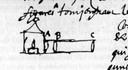
Although this private correspondence of Huygens is the earliest written evidence for the existence of a simple magic lantern, the lantern turns up in several other reports from the 1660s. In the same letter from Petit to Huygens in which he asked for advice on constructing a lantern, Petit noted that he had examined a magic lantern belonging to a Dane, and that the lantern he was making was modelled on it; this was most likely a lantern exhibited by Thomas Rasmussen Walgensten (or Walgenstein, 1627-1681) in Paris. Walgensten then also exhibited a magic lantern during a lecture in Lyon in 1665.10
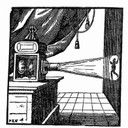
This elusive figure reappears in several contemporary texts as the earliest known lantern exhibitor, and he ultimately demonstrated his instrument for King Frederik III of Denmark and his court in 1670. Walgensten studied physics and architecture at the university in Leiden in 1657-1658 and could have crossed paths with Huygens at that time, if he did not do so two years later when both men lived in Paris, where Walgensten worked for a while as a glass grinder and Huygens was in residence as one of the founding members of the French Academy of Sciences. Walgensten next turned up in Italy, where, according to Athanasius Kircher in the second (1671) edition of Ars magna lucis et umbrae, “The Dane Thomas Walgensten, a well-known mathematician who, referring to my inventions [...] improved the lantern [and] later sold it with much profit to various Italian nobles, so that the object is already common in Rome.”11 By the time that Kircher wrote about Walgensten and his lantern, the Dane was indisputably in direct contact with Huygens, having written to him about his activities in Venice in 1667 and having returned to study again in Leiden in 1669.
Apart from Huygens’ private correspondence, which was not published until the 1890s and later, the first printed description of a magic lantern, without any illustration, came in Francesco Eschinardi’s Centuriae opticae, published in Rome in 1664. Eschinardi described an instrument which he called Laterna Magica and which is identical in all its essentials to Walgensten’s lantern. The year before this, a traveller and medical doctor from Lyon, Balthasar de Monconys (1611-1665), noted in his published travel diary that he had seen a magic lantern in London on 17 May 1663, in the shop of the optician and telescope maker Richard Reeve (or Reeves, or Rives).12 Perhaps coincidentally, Monconys was also an acquaintance of Christiaan Huygens: the two had met early in 1661. In London in 1666 Reeve’s son, also called Richard, demonstrated his lantern for Samuel Pepys, who mentioned in his diary a lantern demonstration by Reeve that took place on 19 August: “Comes by agreement Mr. Rives [...]. He did also bring a lanthorn with pictures in glasse, to make strange things to appear on a wall, very pretty”.13 A few days later Pepys bought two telescopes and “the lanthorn that shows tricks” from Reeve.
By the end of the 1660s, then, the lantern was gaining notice amongst scientists and optical instrument makers across Europe. The British scientist Robert Hooke gave a paper on an odd magic lantern at the Royal Society, a report published in 1668 in the Society’s Philosophical Transactions, a journal which circulated widely across the intelligentsia of Europe.14 Hooke considered that the purpose of this new device was principally to delight or frighten gullible spectators “not well versed in Opticks” with the presentation of apparitions of Angels and Devils. Again, there is a circumstantial link with Huygens, since the latter was elected to the Royal Society in 1663, two years after his visit to England when he met Reeve, while in 1662 Hooke was appointed the Society’s Curator of Experiments, with responsibilities to “furnish the Society every day they meet with three or four considerable experiments”. Although the two men did not get along well, they both also shared a commitment to the wave theory of light propagation, opposing the ideas of Isaac Newton, as proposed by the irascible Hooke in 1665 and later argued by Huygens in written texts from 1672.
The fact that a locus can be found in the circle of friends, colleagues, visitors and correspondents in contact with Christiaan Huygens that potentially intersects all of these earliest reports of the magic lantern in western Europe suggests that knowledge of the construction and use of the instrument was in the hands of a limited number of people in the 1660s. lt also reflects the interconnections between those few Enlightenment figures, including scientists, instrument makers, philosophers and educated amateurs, who exchanged knowledge, curiosities, and discoveries across Europe without regard to national or cultural boundaries. This was the small, limited circle of “new scientists” who believed in finding practical results through experimentation with specialist instruments, and who rejected the long tradition of basing their work on received knowledge from ancient authors. But with the appearance of the next published report of the magic lantern, all this would change, and knowledge of the instrument and its capabilities would find the widest possible circulation across all of literate Europe. This report, accompanied by the earliest published illustration of a magic lantern, appeared in the second edition of Athanasius Kircher’s Ars Magna Lucis et Umbrae, printed in Amsterdam in 1671.
Athanasius Kircher and Traditional Science
When the German Jesuit and Renaissance polymath Athanasius Kircher (1602-1680), author of more than 30 books covering astronomy, ancient civilizations, geography, the causes of the plague, magnetism, optics, music, logic, acoustics, the meaning of numbers and other topics, published both a description and an illustration of a magic lantern in 1671 in the second edition of his Ars Magna Lucis et Umbrae, knowledge of the new optical instrument was disseminated widely throughout educated Europe. 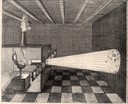
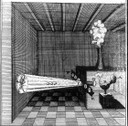
The projection apparatus that Kircher illustrated in Ars Magna was a curious partitioned room, a small portion of which acted as an enclosed lantern, with a chimney to evacuate the smoke from the oil lamp used as its source of illumination, a concave mirror behind the oil flame to concentrate the light onto a lens fitted in a long adjustable tube, and a series of circular hand-painted transparencies, later called a ‘long slide’, fixed on the front of the lantern wall to carry its images.15 Much has been made of the fact that Kircher’s illustration does not show the lantern slide placed properly in the front of the cabinet: it is not inverted, as is normally done and as is best suited to use the optical characteristics of the simple convex lens of the day. Experiments carried out by Willem Wagenaar16 contend that it is nonetheless possible to produce an upright projection image with Kircher’s arrangement, if at the cost of some magnification and brightness of the image, so perhaps in these earliest days Kircher had simply not fully grasped the optical principles involved that would make his magic lantern operate in the most efficient way. Kircher stated that this lantern was one of several new instruments that were demonstrated for visitors to the Collegium Romanum “to the astonishment of all,” and that it was particularly worthwhile since “entire satirical scenes, tragedies and similar things which are true to life can be shown this way.”17 He also suggested that the lantern was particularly useful, in the words of the German edition prepared in 1671 by Kaspar Schott, since “By this Art many Godless people could be kept from committing many sins, if a picture of the Devil was drawn on the mirror and thrown onto a dark place.”18
Kircher’s publication of a projecting optical lantern in a respected work with wide circulation had several consequences. Because of his standing in the scholarly world of the time, the new information in this second edition of Ars Magna was quickly disseminated by his students and associates. Several of Kircher’s experiments, including his description of the magic lantern, appeared in German in 1671 in the Magia Optica of Kaspar Schott,19 who had been Kircher’s disciple since 1630 in Würzburg and followed him to Mainz, ultimately editing many of Kircher’s unpublished papers in the 1670s. Another Kircher pupil, Johann Stephan Kestler, prepared a digest of Kircher’s experiments in 1680, published at Amsterdam as Physiologia Kircheriana Experimentalis, which again repeated Kircher’s lantern descriptions and which named Kircher as its inventor.20 Kircher’s engraving was also reprinted by Georgio de Sepi in 1678, in an account of the museum which Kircher founded at the Collegium Romanum; de Sepi added a complaint about the “vagrants” and “braggarts” who had recently claimed “the beautiful invention of the lantern”. 21 The imprimatur of Kircher also seems to have released some earlier knowledge of the lantern, since four years after the publication of the second edition of Ars Magna the Jesuit Professor of Mathematics in Lyon, Claude François Milliet Dechales published his detailed recollections of seeing Walgensten’s lantern in 1665. As Kestler wrote in the Physiologia, it was Kircher who “communicated to the world” the existence of the magic lantern.
Johann Franz Griendel and a Separate Lantern Tradition
By the time Kircher published his odd and uncertain description of the magic lantern, it was already an instrument being made for sale by a variety of instrument makers and opticians, such as Richard Reeve and Thomas Rasmussen Walgensten as noted above. The most interesting of these early lantern makers, and the first known in Germany, was Johann Franz Griendel von Ach (in some sources variously called Gründl, Gründler, or Grindl), an expert in the construction of military fortifications who made a living from the manufacture and sale of optical instruments and curiosities in Nürnberg between 1670 and 1677.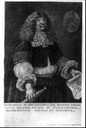
“16. An optical lantern which presents everything that one desires, figures, paintings, portraits, faces, hunts, even an entire comedy with all its lively colours, in a huge size in the darkness or in a room on a white wall or white fabric; it can be made so large that a clear picture occupies the wall of a high room from top to bottom, and is a curious and most highly astonishing apparatus.”22
This description clearly assumes that the recipient of Griendel’s list would know little or nothing of the uses or effects of projection by a magic lantern; it was a new optical device which needed explanation. Perhaps moreso, it was a new device that needed demonstration, and Griendel was ready from at least mid-1672 to provide an elaborate magic lantern show for visitors to his city, the first lantern exhibition for which an extensive description survives. The eyewitness to Griendel’s lantern show was a medical doctor from Paris named Charles Patin, who travelled widely in Germany and Italy in self-imposed exile from France after he was discovered to be the importer of some politically forbidden books from Amsterdam. In the account of his travels, published as Quatre Relations Historiques in Basel in 1673, Patin called Griendel “absolutely Master of the most abstruse Secrets in Opticks",23 and went on to describe the lantern exhibition, which he saw sometime in the first two weeks of July 1672, in considerable detail:
“For it seem’d to me as if I had a sight of Paradise, of Hell and of wand’ring Spirits and Phantoms, so that altho’ I know myself to be endu’d with some measure of Resoluteness, yet at that time I would willingly have given one half to save the other: All the Appiritions suddenly disappear’d and gave place to Shews of another nature: For in a moment I saw the Air fill’d with all sorts of Birds, almost after the same manner as they are usually painted round about Orpheus, and in the twinkling of an Eye, a Country-Wedding appear’d to my view, with so natural and lively a representation that I imagin’d myself to be one of the Guests at the Solemnity. Afterward the Horizon of my sight was taken up with a Palace so stately, that nothing like it can be produc’d, but in the Imagination; before which there were divers Personages running at the Ring: these Heroes seemed to be the Gods that were adored by Antiquity, and among them ’twas pleasant to observe Momus mounted upon a Barbary-Horse, and making Satyrical Reflections upon Jupiter, who had made a false step amidst so jolly a company.”24
Patin’s report is interesting in several respects. Firstly, it is clear that Griendel had a good stock of slides available to him to represent so many different scenes. Secondly, the slides must have been very well painted to generate such a strong reaction in his visitor, and to produce such a wide range of emotions — from fear to joy to surprise, and, with its classical allusions, even a certain respect. Thirdly, the show has a certain narrative progression, one that went well beyond the complaints about what Petit had called “the lantern of fear” and the simple tricks that were already beginning to become a disparaged refrain in the writings of scientists and gentlemen who carped that the lantern was only used to confuse and deceive the ignorant. Patin was impressed enough with Griendel’s show that three years later, when he was giving advice on what a Dr Meyer, the son of the mayor of Bremen, should see in Nürnberg, he included Griendel’s lantern show and optical instruments in a short list of recommended Nürnberg monuments such as the Neptune Well, the city library, and the house in which Albrecht Dürer’s pictures were exhibited.25
Griendel is also connected directly with some of the earliest and most important sources on the history of the lantern. He was a part of a social circle in Nürnberg that looked to new physical instruments and new experiences with great interest and curiosity, a circle led by Johann Georg Volckamer, Patin’s host. Volckamer, a prominent member and president from 1686 until his death of the Academia Naturae Curiosorum, a pan-German scientific academy later called the ‘Leopoldina’, kept a renowned salon for the exchange of scientific information. Along with Griendel, the engraver and astronomer Georg Christoph Eimmart and the Professor of Mathematics and Physics from Nürnberg’s university at nearby Altdorf, Johann Christoph Sturm, were part of Volckamer’s close circle.26 Eimmart engraved the only known portrait of Griendel, and in the Autumn of 1672 Sturm gave a series of lectures on physics to both students and the public at Altdorf, where in his last lecture he presented three “recent discoveries”,27 amongst them the magic lantern.
This lantern was Griendel’s, and when Sturm published his lectures four years later as Collegium Experimentale sive Curiosum, his accompanying engraving of Griendel’s magic lantern became what later historians called “for the first time a practical model of the [...] instrument.”28 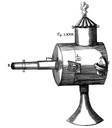
At a distance of “twelve paces”, this lantern would entirely fill a wall more than ten feet high. Unlike the room-sized apparatus of Kircher from 1671, or the lanterns of Huygens, Walgensten and Petit with their vertical cylindrical or square bodies and large diameter lens tubes, this efficient and portable instrument was horizontal in form, with two biconvex lenses spaced about eight inches apart and a four-inch diameter concave mirror at the back of the lamp housing; the oil lamp used a particularly thick wick to produce a broad flame. The lantern was made entirely of metal, and the slides were inserted through slots in the forward part of the main cylinder holding the lamp and mirror. Sturm also published the first image of a picture for the magic lantern, a head of Bacchus, which in a later publication he called “a most beautiful picture.”30 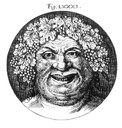
The surviving lanterns of Landgrave Carl of Hessen-Kassel
Sturm’s close connection to Volckamer and his friend Griendel, along with his apparent ignorance of either any report of Walgensten’s or Kircher’s lantern is a further indication that Griendel was the origin of this first “practical model” of the magic lantern, since he had been manufacturing the magic lantern for sale for over a year by the time of Sturm’s lecture. Four very early lanterns in Griendel’s form survive, in the former Kunstkabinett of the Landgrave of Hesse, now in the Astronomisch-Physikalische Kabinett at the Orangerie Museum in Kassel. The lanterns do not appear in an inventory of the Landgrave’s collection made in 1673, but they were certainly present by 1702 when they were represented in two drawings by Johann Oswald Harms for frescoes in a re-decoration of the Landgrave’s castle and galleries.31
The lanterns at Kassel have all of the characteristics of Griendel’s lantern: the horizontal cylindrical lamphouse, the angled chimney, and, particularly, the slide opening in the front part of the main cylinder itself. Surviving with the lanterns is a group of contemporary hand-painted slides with either three or four circular images in each long frame. The slides reflect a similar character to Griendel’s exhibition with its Roman gods, classical allusions, and palaces: the Kassel slides were clearly also meant for exhibition to an educated audience who would be entertained with pictures they could recognize and admire. At the same time, the Kassel slides mirror the Landgrave’s own preoccupations, specifically his interest in the continuing fight between the Catholic church and its reformers over the expulsion of the Protestants from France with the revocation of the Edict of Nantes in 1685. The Landgrave welcomed about 4,000 Huguenots and Waldensians over the next decade, and his slides include a set of satirical portraits of conservative Catholics involved in driving these new refugees out of the country, including the Jesuits François Lachaise d’Aix and Sir Edward Petre, an Archbishop of Paris, and others. These slides in Kassel were painted after a 1691 satirical series of prints by the Dutch painter Cornelis Dusart.
Other surviving slides in Kassel include representations of the Landgrave’s coat of arms and other heraldic imagery, plus a series of figures drawn after the work of Jacques Callot (1592-1635), who was fascinated by the portrayal of social types, including noblemen, paupers, entertainers, and the new bourgeoisie. Although by the time these slides were painted (probably contemporary with their lanterns, c.1690-1700) complaints were already beginning to appear in some books about the scurrilous and depraved nature of lantern shows that deceived an ignorant public, the survival of these slides, and the report of Griendel’s own exhibition of 1672, provides evidence for an ongoing high-art tradition of lantern exhibition.
Johann Zahn and the varieties of lantern design
Griendel was again involved with the remarkable array of lanterns illustrated and described by Johann (or Johannes) Zahn, a Canon of the Premonstrate Order in Würzburg, in his Oculus Artificialis Teledioptricus sive Telescopium published in 1685-1686. Zahn and Griendel were acquainted from the time when they were both monks in Würzburg, well before Griendel moved to Nürnberg, and at one point in his book Zahn calls Griendel his “former teacher of practical Teledioptrics.”32 Zahn also devotes an entire chapter of the work to Griendel’s microscope.33 The relationship between Zahn and Griendel, extending over many years and clearly one of mutual respect and exchange, leaves little doubt that Griendel is also a significant source of portions of the lantern information that Zahn collected for his Oculus Artificialis. Griendel is noted throughout Zahn’s work,34 while Sturm is not; perhaps Zahn thought either he had all of the necessary information from his friend and former teacher, or else took Griendel’s side of whatever argument lay between the practical optician and the academic Sturm.
Zahn illustrated a dozen different models and forms of the lantern, including lantern clocks and projecting wind direction indicators, and gave clear information about the lantern’s construction and use. Zahn, like his academic teacher Gaspar Schott, was not himself an instrument maker, but rather a collector of information and illustrations about optical instruments whose books used either previously published engravings (of the microscopes of Cosmus Conrad Cuno and Jan van Musschenbroek, or the astronomical tables of Georg Christoph Eimmart, for example)35 or new engravings of variant forms of instruments that he had either seen or been told about (such as Johann Wiesel’s portable camera obscura).36 Zahn’s material on the lantern demonstrates that there were already by 1685 several existing options for its design, use, and optical arrangement, with more development by 1702. His sketch of the principles of lantern projection from Vol. 2 of the Oculus Artificialis illustrates a vertical cylindrical lantern on a flared base with a candle illuminant, conical chimney and concave reflecting mirror. 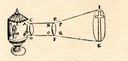
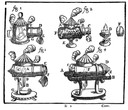
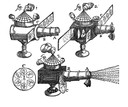
While most of Zahn’s lanterns are clearly built to use long slides painted with multiple circular images, one uses an image disk around which six different pictures are arranged in a circle. Considered by some historians a fanciful addition to Zahn’s range of lanterns, there is one existing lantern which is designed to project precisely this form of disk slide, in the instrument collection of the Landgrave of Hesse. This lantern, which sadly has no surviving slides, closely echoes the Zahn illustration, with the exception that it is equipped with a slide stage consisting of two thin wooden circular plates of a diameter that reaches the base on the lantern, clearly to support the entire breadth of a thin circular slide with the images painted around its outer rim. This slide support, again running through the forward part of the lantern’s main cylindrical lamphouse, is not precisely circular but slightly oval, or slightly teardrop-shaped, which means that a circular slide would project beyond its edges at the top and be easily and quickly turned to change the images during projection.
In his thorough treatment of lantern activities, Zahn also made an early suggestion that the lantern be used for instruction, with anatomical slides traced from the illustrations in books; his thoughts on this use of the lantern are very practical: “Because some illustrations in the anatomical books are often too finely drawn up, so that they are too difficult to draw on the chalkboard, or the teacher himself is unused to drawing, the enlarging lantern can then be of help if small illustrations are thrown onto a white screen and miraculously enlarged. It is nonetheless very easy to copy the illustrations onto glass or a sheet of mica.”37
That the optical arrangement and overall design of the magic lantern was still very much in flux at the end of the seventeenth century is well illustrated by the odd lanterns published by the pseudonymous Simon Witgeest in his Het Natuurlyk Tover-Boek, Oft Nieuw Speel-Toneel der Konsten.38 This handbook of magic tricks with cards, balls, numbers and coins also included a few experiments with magnetism, electricity, and other demonstrations emerging from new scientific work, amongst them the magic lantern. The book, now ascribed to the antiquarian bookdealer and art historian Willem Goeree, was immensely long-lived, appearing in over 70 editions in the Netherlands between 1679 and about 1830; another fifty editions of the fully anonymous German version of the book appeared between 1702 and 1798 under the title Natürliches Zauber-Buch Oder neuer Spiel-Platz der Künste.39 The magic lantern first appears in the Dutch edition of 1684,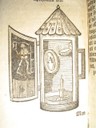
Throughout his book, Witgeest (or Goeree) was certainly drawing on a tradition of ‘knowledge’ that was far from the erudite concerns of Huygens, Deschales and Sturm, one that was even beneath the notice of Kircher’s fascination with Cabalistic science and arcane systems of thought. Witgeest’s lantern represents an underground tradition of popular (and deceptive) magic that may well have predated the ‘official’ recognition of the magic lantern as a new mathematical instrument in the 1660s; his 1684 Dutch text suggests that “skeletons, Knights on horseback, troops, animals, the sun, monsters, ghosts and the like”41 can be projected when one “goes [...] into a dark room / and lets the light shine through the glass [the lens] onto a wall or partition.”42
Interestingly, by the time of the 1702 German edition, which uses the same lantern illustration but taken from a different woodcut, the suggested subjects of pictures for the apparatus were “a skeleton / knight / rider / animal / sun / moon / star / trees / etc.”,43 indicating a slightly more respectable context for the lantern established by either the translator or the publisher. But by this time back in the Netherlands, Witgeest had already published his second lantern illustration in his Amsterdam edition of 1701.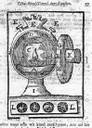
When Johann Zahn published Oculus Artificialis Teledioptricus sive Telescopium in 1685-1686, the magic lantern was being constructed by any number of opticians and instrument makers. A 1673 inventory of the mathematical instruments of Herzog Ernst I, der Fromme, of Sachsen-Gotha, included three magic lanterns:
“8) Three optical art-lanterns made of white sheet metal, to which belong
(1) the conical sheet-metal tubes, at the front of which a ground lens is fixed as well as
(2) 4 wooden sliders, in which are set in the two shortest 10 and in both of the longer ones 12 round glasses painted with pictures and perspectives. These are pushed into the lantern and one figure after the other can be presented very large by means of a light on a white wall or cloth; besides the 4 painted wooden sliders a further 4 are at hand wherein until now no glasses have been fixed.”44
The notice here that the lantern was supplied with empty slide frames without painted glasses suggests that the Herzog would find his own artists to paint slides after his own interests. Alternatively, when the young Sir Thomas Isham ordered a magic lantern and some slides from his London friend, the artist and dealer David Loggan, in December 1675, the painted glass slides were unbound and carefully packed behind a painting, because “I know you have a worckman to put them in wood.”45
The lantern spreads across Europe — and then Asia
In the latter part of the century, just around the time that Zahn published his Oculus Artificialis, the magic lantern was becoming available from an increasing number of sources. At Augsburg, the instrument maker Daniel Depiere offered magic lanterns of various sizes in his catalogue of August, 1674: “25. An optical lantern, which presents as one wishes any kind of image or writing with all of its colours on a white wall in a darkened room, over life-sized, at 12, 24, 30, and more Thaler.”46 Depiere, son-in-law of the distinguished Augsburg instrument maker Johann Wiesel (1583-1662), had a wide reputation for quality work. Cosmus Conrad Cuno, a goldsmith from Hamburg who became an important maker of microscopes and other optical instruments in Augsburg when he married the widow of Daniel Depiere and took over the running of Wiesel’s old workshop, also offered a magic lantern in the first edition of his catalogue of 1685, probably also in various sizes since he mentions the instrument in the plural: “Optical lanterns / to present the colours of their subjects on a wall [...].”47 A dissertation by Matth. Christian Müller from Jena, published in 1704, again described a lantern in Griendel’s form and carefully examined the optical characteristics of its twin lenses and reflecting mirror; intriguingly, the illustration of a long slide with five images that accompanies this lantern is reminiscent, in a very abbreviated sketch form, of the religious, royal, and heraldic subjects of the slides that survive with the Griendel-type lanterns in Kassel. By this time, a small industry was already beginning to appear in southern Germany, with a wider awareness of the magic lantern as an instrument for both education and amusement and the first hints of specialised manufacture of both the lantern and its pictures. The Leipzig instrument maker Jacob Leupold (1674-1727), who had a good reputation for his vacuum pumps, included only a few optical devices, along with the magic lantern, in his 1712 catalogue and did not make them himself.48 Leupold was not a maker of optical instruments, and it is not known from whom he obtained his lanterns, but his lantern slides were ordered from the Augsburg sculptor and modelmaker Daniel Volkert, who also made optical illusions like Anamorphoses.49 Leupold’s example indicates that by the early eighteenth century the magic lantern had to be included in the offerings of a well-rounded instrument maker even if his special skills lay outside optical manufacture; it also indicates a decisive shift in the profession of instrument making and its clientele that would characterise the period after 1750, driven no longer by telescopes, microscopes and optical apparatus but by electrical machines and physical measuring devices.50
In an indication of how quickly the magic lantern was in use around the world in the seventeenth century, news of the lantern’s use in China by Jesuit missionaries was published in Europe by 1688. In Das mächtige Kayser-Reich Sina und die Asiatische Tartarey, Johann Christoph Wagner reported that the Jesuits brought knowledge of God and Jesus to China, “which can then be made visible with an optical or artistic lantern, that greatly enlarges the light rays by means of a glass lens and so throws a bright light onto a round opening from which all the rays run towards the centre like a triangle, in order to suggest that Art is the light of reason to contemplate the wonders of nature and that this knowledge of the origins of all things leads to God.”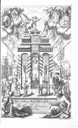

Towards the end of the seventeenth century, descriptions of the magic lantern began to proliferate across Europe, with individual makers trying out, step by step, practical variations on its construction that explored empirical alternatives to the still-undefined principles of optics that determined its capabilities. William Molyneux (1656-1698), a wealthy amateur scientist in Ireland and member of the Royal Society who dabbled in astronomy, natural history and philosophy, published in 1692 the first English description of a magic lantern in his Dioptrica Nova, a Treatise of Dioptricks of 1692, illustrating a tin lantern with a single convex lens. 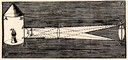
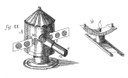
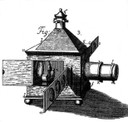
Parallel with these variations in the construction of the lantern, a number of popularising authors continued to describe the new instrument, including it among the general run of experimental or demonstration instruments used by scientists in their work, although frequently characterising it as a tool for idle diversion rather than as a significant experimental apparatus. The lantern began to appear in collected ‘dictionaries’ of new scientific materials and apparatus such as that of Edward Phillips57 or the Vollständiges Mathematisches Lexicon of the influential professor of mathematics at Halle and Marburg, Christian Friedrich Freiherr von Wolff.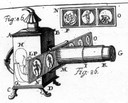
- ^ J.A. Bennett, “The Social History of the Microscope”, in The Journal of Microscopy, Vol. 155, Pt. 3, September 1989: 267.
- ^ Robert Hooke, ed. William Derham, Philosophical Experiences and Observations of the Late Eminent Dr Robert Hooke, and geom. prof Gresh and other eminent virtuoso’s in his time (London: W. Derham, 1726), 261. The passage continues: “... but for Diversion and Pastime, and by that reason it is become a portable Instrument, and easy to be carried in one’s Pocket.”
- ^ Peter de Clercq, At the Sign of the Oriental Lamp: The Musschenbroek Workshop in Leiden, 1660-1750 (Rotterdam: Erasmus Publishing, 1997), 137.
- ^ Christian Friedrich Freiherr von Wolff, Vollständiges Mathematisches Lexicon; Darinnen alle Kunst-Wörter und Sachen welche in der erwegenden und ausübenden Mathesi vorzukommen pflegen... (Leipzig: 1716), Col. 766.
- ^ Société Hollandaise des Sciences (eds), Oeuvres Complètes de Christiaan Huygens (Le Haye: Martinus Nijhoff, 1888-1950). Vol. 22, 197.
- ^ Ibid., Vol. 4, 109.
- ^ Ibid., Vol. 4, 102. Lodevijk Huygens was at this time acting as secretary to his father.
- ^ Ibid., letter of 25 March 1660 from Pierre Guisony to Christiaan Huygens, Vol. 3, 47.
- ^ Ibid., letter of 28 November 1664 from Pierre Petit to Christiaan Huygens, Vol. 4, 266. Note that in this volume the letter is incorrectly dated to 1662, a date used by several secondary sources; see correction in Vol. 13, 161.
- ^ Claude François Milliet Deschales, Cursus seu Mundus Mathematicus (Lyon: 1674), Vol. 2, 655.
- ^ Athanasius Kircher, Ars Magna Lucis et Umbrae (Amstelodami: Joannem Janssonium, 1671), 768.
- ^ Balthasar de Monconys, Journal des Voyages de Monsieur de Monconys (Lyon: 1665-1666), Vol .2, 17.
- ^ Henry B. Wheatley (ed.), The Diary of Samuel Pepys (London: 1895), Vol. 5, 406. The elder Reeves died early in 1664 and the workshop was taken over by his son Richard. See A.D.C. Simpson, “Richard Reeve – the ‘English Campani’ – and the Origins of the London Telescope-Making Tradition”, in: Vistas in Astronomy, Vol. 28 (1985), 357-365.
- ^ Robert Hooke, “A Contrivance to Make the Picture of Any Thing Appear on a Wall, Cup-Board, or Within a Picture-frame &c. ...”, in: Philosophical Transactions of the Royal Society of London (London: 1668), Vol. 3, No. 38, 741-744.
- ^ Kircher’s description of the lantern is at pp. 768-770 of the second edition of Ars Magna Lucis et Umbrae, op. cit.; the illustration is Taf. 1.
- ^ W.A. Wagenaar, “The Origins of the Lantern'”, in: The New Magic Lantern Journal, Vol. 1 No. 3 (March 1980), 10-12. Projection requires the first lens to have a very short focal length, turning the apparatus into a ‘point-lightsource’ projector, which uses upright images.
- ^ Kircher, op. cit., 769.
- ^ Kaspar Schott, Magia Optica (Bamberg: Johann Arnold Cholin, 1671), 407.
- ^ See Note 13.
- ^ Johann Stephan Kestler, Physiologia Kircheriana Experimentalis ... (Amsterdam: Ex Officiana Janssonio-Waesbergiana, 1680).
- ^ Georgio de Sepi, Romani Collegii Societas Musaeum Celeberium ... (Amsterdam: 1678), 40. This is quite likely a reference to Johann Franz Griendel von Ach, who was named as the inventor of the magic lantern in a work by Johann Christoph Kohlhans that appeared in 1677.
- ^ Johann Franz Griendel, Specificatio, Waß Johann Franz Griendl von Ach, Mathematicus und Opticus in Nurnberg von optischen Rariteten machen thut, enclosed in his letter of 30 December 1671 to Gottfried Wilhelm Leibniz. Niedersächische Landesbibliothek, Leibniz Archiv, Hannover. I am grateful to Inge Keil for a copy of this unpublished list, prepared by Prof. Dr. Albert Heinekamp.
- ^ Charles Patin, Quatre Relations Historiques, (Basle: 1673), 237-238. Rather than translating this work directly, the English citations are taken from the 1696 British edition of the book, which has an identical text: Charles Patin, Travels Thro' Germany, Swisserland, Bohemia, Holland and other parts of Europe (London: A. Swall & T. Child, 1696), 233.
- ^ Ibid., 238-239.
- ^ Letter from Charles Patin (Basle) to S.A. Fabricius (Nürnberg), 4 June 1675, Universitätsbibliothek Erlangen, cit. Pirson, op. cit. (Note 25), 281.
- ^ Inge Keil, Augustanus Opticus. Johann Wiesel (1583-1662) und 200 Jahre optisches Handwerk in Augsburg (Colloquia Augustana, Band 12; Berlin: Akademie Verlag, 2000), 163.
- ^ Johann Christoph Sturm, Collegium Experimentale, sive Curiosum, in quo Primaria Huius Seculi Inventa & Experimenta Physico-Mathematica ... (Nürnberg: Wolfgangi Mauritii Endteri & Johannis Andreas Endteri, 1676), 161.
- ^ John Barnes, Barnes Museum of Cinematography, Catalogue of the Collection, Part 2: Optical Projection (St Ives, Cornwall: Barnes Museum of Cinematography, 1970), 14.
- ^ Sturm, op. cit., (Note 32), Tentamen XVI, 163.
- ^ Johann Christoph Sturm, Mathesis Juvenilis ... Accessit Concilium de Mathesi ... (Nürnberg: B. Johannis Hoffmanni & Engelbertum Streckium, 1699/1701), II. Teil [1701], 148.
- ^ Karsten Gaulke and Bjoern Schirmeier, Optika. Optische Instrumente am Hof der Landgrafen von Hessen-Kassel. (Kassel: Museumslandschaft Hessen Kassel / Michael Imhof Verlag, 2011)
- ^ Johann Zahn, Oculus Artificialis Teledioptricus sive Telescopium ... (Würzburg [Herbipoli]: Sumptibus Quirini Heyl, 1685/1686), Vol. 3, 234.
- ^ Ibid.
- ^ See, for example, the comments and references at Band. 3, pp. 40, 134 and 200.
- ^ Keil, op. cit., 95 & 168.
- ^ Ibid., 353.
- ^ Zahn, op. cit., Vol. 3, 259.
- ^ Simon Witgeest, Het Natuurlyk Tover-Boek, Oft Nieuw Speel-Toneel der Konsten ... (Amsterdam: Jan ten Hoorn, 1679). My thanks to Thomas Weynants for first bringing Witgeest to my attention.
- ^ Anon. [Simon Witgeest], Natürliches Zauber-Buch, Oder neuer Spiel-Platz der Künste ... (Nürnberg: Verlegts Joh. Hoffmanns sel. Wittw. und Engelbert Streck, 1702).
- ^ Ibid., 86. In this passage, the Old Dutch text of the 1784 edition (pp. 253-4) seems to be identical.
- ^ Witgeest, op. cit., 254.
- ^ Anon. [Witgeest], op. cit., 87.
- ^ Ibid., 86.
- ^ Thüringisches Landesarchiv Gotha, Fürstliche Kammer YY VIII³ 3/3 Blatt 2: lnventrium über diejenigen Mathematischen lnstrumenta und lnventiones so aus Ihrer Frstl. Durchlaucht gemach in die Kunst Camer gebracht worden, angefangen den 2.[?] Januar 1673. I am indebted to Inge Keil for this reference from her research notes (letter to Georg Füsslin, 13 February 2001).
- ^ Letter from David Loggan to Sir Thomas Isham, 29 December 1675. See Sir Gyles Isham, Bart., “The correspondence of David Loggan with Sir Thomas Isham: 2,” in: The Connoisseur, June 1963, 85. The lantern had been made by Christopher Cox (or Cocks, Coxe).
- ^ Keil, op. cit., 367 and 431. The entire catalogue is reproduced at pp. 429-433. This is the oldest surviving printed catalogue of a European instrument maker.
- ^ Cosmus Conrad Cuno, Bericht, An die Herren Liebhabere Optischer Kunst- / Wercken/ den Handgrif und Gebrauch seiner hierbey verzeichneten Microscopiorum, samt dene dazu nöthigen Instrument betreffend, n.d., n.p. On this catalogue in the British Library, see Keil, op. cit., 434.
- ^ Keil, op. cit., 208.
- ^ Ibid., 208 and 190-191.
- ^ See J.L. Heilbron, Elements of Early Modern Physics (Berkeley/Los Angeles/London: University of California Press, 1982), 70-75.
- ^ Johann Christoph Wagner, Das Mächtige Kayser-Reich Sina und die Asiatische Tartarey ... (Augsburg: Jacob Koppmeyer, 1688), foreword. I am indebted to Ivo Gilbert for bringing the illustration of the magic lantern in this book to my attention, and to Inge Keil for a copy of the pertinent texts.
- ^ On Grimaldi, see Laurent Mannoni, Le Grand Art de la Lumière et de l’Ombre: Archéologie du Cinéma (Paris: Nathan, 1994), 74-77. The English edition is Laurent Mannoni, The Great Art of Light and Shadow: Archaeology of the Cinema (Exeter: University of Exeter Press, 2000), 71-73. Mannoni’s source is Jean-Baptiste du Halde, Description Géographique, Historique, Chronologique, Politique et Physique de l’Empire de la Chine (Paris: 1735).
- ^ William Molyneux, Dioptrica Nova, a Treatise of Dioptricks (London: 1692), Prop. LIX, 183-184.
- ^ M.I.L. de Vallemont, La Physique Occulte (Amsterdam: 1693), 301.
- ^ Johann Michael Conradi, Der Dreyfach Geartete Sehe-Strahl (Coburg: 1710), 115.
- ^ Christian Gottlieb Hertel, Vollstandige Anweisung zum Glassschleifen ... (Halle im Magdeburgischen: 1716), Tafel XV, Fig. 3.
- ^ Edward Phillips, The New World of English Words: or, a General Dictionary (London: 3rd Edition, 1696).
- ^ von Wolff, op. cit.
- ^ Jacques Ozanam, Récréations Mathématiques et Physiques ... (Paris: 1694).
- ^ Jacques Ozanam, Récréations Mathématiques et Physiques ... Nouvelle edition, totalement réfondue & considerablement augmentée par M. de C.G.F. [i.e. J.E. Montluca] (Paris: Cl. Ant. Jombert, 1778).
- ^ Jacques Ozanam, Recreations Mathematical and Physical ... (London: R. Bonwick, W. Freeman [etc.], 1708), and Jacques Ozanam, Recreations in Mathematics and Natural Philosophy ... “Lately recomposed, and greatly enlarged, in a new edition by the celebrated M. Montluca. And now translated into English and improved with many additions and observations, by Charles Hutton...” (London: G. Kearsley, 1803).