Works
Works


The manufacturing of lantern slides was an area of activity connected to the dispositif of performances in the historical art of projection through the projection apparatus and the projected image on the screen. At the same time, the manufacturing of lantern slides in itself represents an independent dispositif that also belongs to the historical art of projection. These two dispositifs (performance and slide production) were separated both spatially and temporally and followed their own requirements and rules independently. The glass slides used for the projection of luminous images on the screen were mainly produced by the photographic industry around 1900. Building on the established technical process for manufacturing photographic lantern slides, British companies operated factories1 based on the division of labour since the 1850s. Photographers took pictures either on location or staged them on studio sets and made reproductions of graphics, prints, photographs, and paintings. The exposed glass negatives were developed in photographic laboratories where multiple copies could be produced in standardised formats. The resulting glass positives ('glass slides') were often hand-coloured and finally made ready for sale as parts of lantern slide sets with readings, presentation suggestions and, if necessary, musical scores. The relevant companies produced lantern slide sets on a variety of fictional subjects and non-fiction subject areas.
The 'social question' was frequently debated 'on screen', particularly in Great Britain.2 The photographic industry provided various works in the art of projection that illustrated the serious problem of widespread-poverty in moving tales. In the following, their production will be discussed as a combination of technical, artistic and economic actions which should, in their entirety, always be recognised as 'social actions'. “Action,” according to Max Weber, “is 'social' insofar as its subjective meaning takes account of the behaviour of others and is thereby oriented in its course.”3 These Weberian social actions structured the relations within the dispositif of the manufacturing of lantern slides. Their aim was, firstly, to provide the visual material for live performances on the screen and, secondly, to generate profits through the sale of lantern slide sets. And lastly, one aim of social action within the dispositif of the manufacturing of lantern slides was to earn a living working in the manufacturing of lantern slides.
Producers and distributors of lantern slide sets on ‘the social question’
The catalogues published by producers and distributors of lantern slides show companies which offered lantern slide sets that illustrated stories of poverty and hardship. The British companies York & Son and Bamforth produced a large share of the supply of lantern slide sets dealing with the 'social question'.4
The “Classified Index” of York & Son's catalogue, for example, shows a variety of subjects aimed at instructing and entertaining large crowds. Within this context, lantern slide sets on the 'social question' feature in several categories. Adaptations of George R. Sims's ballads such as The Magic Wand (1889) and A Bunch of Primroses (1889) may be found under “Pathetic Sets from Life Models” whereas “Religious & Moral Sets from Life Models” offer sets on stories such as Jessica's First Prayer (1884) and Billy's Rose (1887). In the same categories, slide sets of photographically reproduced drawings made up another section of York & Son's range (designated as “from Drawings”). Additionally, most of the sets used for social interventions are to be found within the “Temperance Sets” category, including Ten Nights in a Bar Room (ca. 1891) and Dan Dabberton‘s Dream (ca. 1885). Both of them are listed as “from Life Models”. While The Bottle (ca. 1888) and The Trial of Sir Jasper (ca. 1887) are reproduced “from Drawings”.5
Bamforth's catalogue on the other hand is organized by categories referring to the type of performance the sets will be used in. Narrative sets on the 'social question' include Ora Pro Nobis (1897) in the category “Illustrated Songs – Life Models”, In the Workhouse (1890) in the category “Recitations – Life Models” and Humpty Dumpty and His Silver Bells (1896) in the category “Services of Song – Life Models”.6
Some national educational and welfare organisations such as the United Kingdom Band of Hope Union and the Church Army (associated with the Church of England) also produced lantern slide sets. After it was founded in 1892, the Church Army's lantern department produced a weekly output of up to 1,000 slides and distributed an additional 1.5 million slides for hire every year.7 Bamforth's catalogue also shows lantern slide sets aimed at certain organisations with their names listed in the catalogue alongside the respective sets. Examples are For Harry's Sake (1897) listed for the Church of England Temperance Society and Christmas in Paradise (1893) listed for the Wesleyan Conference Office.8
Many of Bamforth's and York & Son's slide sets on the social question were also offered for sale or hire in the catalogues of commercial distributors of lantern slides such as Riley Brothers or by the lantern departments of organisations such as the United Kingdom Band of Hope Union.9
The production of Life Model Slides
Many of the lantern slide sets telling stories of the lives of the poor were photographic Life Model Slides for which real persons portrayed events from stories in dramatic scenes.10 Their production illustrates the interrelations between the dispositif of performances in the historical art of projection and the dispositif of the manufacturing of lantern slides. Based on the comparatively large body of source material available on the production of Life Model Slides at Bamforth's, their company will serve as the exemplary object of study in this article.
In a richly illustrated article published in the popular Harmsworth Magazine in October 1900, Life Model Slides are praised as “an enormous advance in the preparation of lantern slides which has been made by the employment of life models to illustrate tales or poems, and this has been due to the genius and extraordinary versatility of Mr. James Bamforth, of Holmfirth, Yorkshire.”11 The article's title highlights the essential characteristics of these types of slides: “We have called this article ‘Sentiment to Order,’ and it is no exaggeration to say that Mr. Bamforth will produce to order, and at the shortest notice, a series of slides illustrating any imaginable subject and calling forth emotions of pleasure, horror, wonder, or alarm on the part of the audience to whom they are exhibited.”12
This take on the impact of Life Model Slides on the audience suggests that not only are the slides themselves a commodity, able to elicit any desired emotional response, but rather that the emotions themselves have become commodities that can be made to order.
Life Model Slides were primarily popular in Great Britain, the British colonies and the US. There are however also a few known examples from the Netherlands and France. Other important British producers besides Bamforth and York & Son include Riley Brothers of Bradford and Mason from Southampton.13 To date, none of these companies have been the subject of a historical or scholarly monograph.14 Bamforth have described themselves in multiple advertisements as “The Largest Producer of Life Model Slides in the World”.15 Both the comparison of producers' catalogues and the large number of surviving glass slide sets seem to support Bamforth's immodest claim. At least their documented output of Life Model Slides around 1900 points to a success challenged only by fellow competitors York & Son. Bamforth’s 1908 catalogue, for instance, lists 10.032 Life Model Slides in 640 sets, according to Richard Crangle. In comparison, York & Son catalogue, published around 1902, lists 2,714 Life Model Slides in 204 sets.16
The slide producer Bamforth
James Bamforth established his photographic studio in Holmfirth (WestYorkshire) in 1870.17 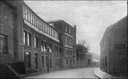
The company's constant growth lead to several extensions of the factory buildings, among them multiple photographic studios as well as buildings designed specifically for the purpose of processing and distribution. What had become a confusing complex of buildings was replaced by a single new and efficient production facility in 1905.The trade paper Caxton Magazine and British Stationer described Bamforth’s new premises in an illustrated article:
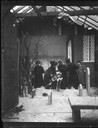
They constitute a solid and striking block of masonry – as shown in No. 1 illustration [...], the whole making a very imposing frontage, as shown in illustration No. 2. Attention is specially drawn to the double row of studio windows in this view, above and on the left of the rockery. The total area of floor space is 10,000-ft., of which 5,600-ft. represents studio space, some idea of the extent and equipment of which may be gathered from the interior views Nos. 3 and 4.24
How many employees worked at the Bamforth facility cannot be determined. However, contemporary accounts mention numerous assistants.25 In 1967, Edith Baker, former child model, recalls the company's unequalled job opportunities for women:
I think I did tell you that many people were concerned in the photographs. In this district at the beginning of the century there were only three jobs available for young women; The mills, domestic service or Bamforths, and Bamforths was considered a ‘lady’s’ job, it was clean and not heavy work, but it was also not very well paid work, but then who did get very much money before 1930?26
There are also no accounts describing operational procedures of the individual production facilities. No business records or studio equipment have been passed on. It is, however, possible to reconstruct the dispositif of the manufacturing of Life Model Slides by Bamforth based on surviving lantern slide sets, glass negatives, catalogues and articles in trade papers. The dispositif is composed of photography and production, processing and sales and distribution.
Production studio and Locations: Set design
As key elements, both the staging of real life persons as models and the set design factor highly in the artistic composition of Life Model Slides and their representation of narrative. Usually, the photographs were shot in studio settings but on occasion real environments were used as well.27 Production of the photographs started in April, making use of the natural light of the summer months all through September. During the winter months, Bamforth devised new material and scheduled production for the coming season while further processing, boxing and distribution were not subject to seasonal changes.28
Contemporary accounts describe Bamforth’s studio as a place where a multitude of distinct worlds were conceived: “This room in its time has played many parts. One day it may be a church, another a sumptuous ballroom, then a prison cell, and next a wretched, poverty-stricken garret. Again, it will serve as the quarter-deck of a ship, the interior of a signal-box, or the bar of a flaming gin-palace.”29
In a photographic illustration in Caxton Magazine, Bamforth’s studio exhibits all the characteristics of a typical modern photographic studio at the beginning of the 20th century.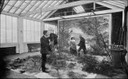
The company’s founder, James Bamforth, himself painted the backdrops for his sets. The employment of theatrical compositions was a common practice in photographic portrait studios; albeit to a lesser extent than the elaborate set designs of Bamforth’s productions. It is likely that James Bamforth received a solid training in his father’s establishment, who worked as a master painter and stage painter. Reports in trade papers also point out the variety of occupations in which Bamforth utilized his skills in the production studio:
He is truly a man of many parts, for besides being, in actual life, a scene-painter, stage-carpenter, stage-manager, photographer, plumber, glazier and gasfitter, and a host of other trades too varied to specify, he poses in his own creations in roles which range from bishop to congregation, from magistrate to mendicant, from temperance orator to drunken loafer.30
Bamforth obviously enjoyed impressing visitors to the studio by demonstrating his skill and swiftness in executing a background and set.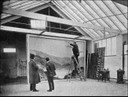
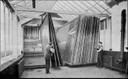
Studio production afforded Bamforth artistic freedom in creating his settings. This made shooting on location unnecessary for the most part.34 It also guaranteed reliable production conditions. Lighting conditions, for instance, were easily manageable. “The fact is, that the controllable lightning of the studio is so very convenient for the figures, that Mr. Bamforth finds his use of open-air surroundings steadily decreasing.”35 Whenever a setting could not be built for the set, Bamforth resorted to shooting on location.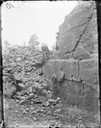
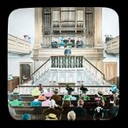
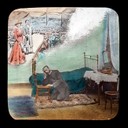
While contemporary accounts of Bamforth’s production focus on the company’s proprietor and only mention a “large staff of assistants” 38 in passing, interviews with former models, conducted in the 1960s, and census records attest to the involvement of members of the Bamforth family in the company’s productions.39 Bamforth’s wife Martha and their daughter Janie often worked as models; their son Frank worked behind the camera and also recruited new models. 40
Capturing Life Models
In an 1899 article titled “Life Model Studies”, trade paper The Photogram reports on the production in Bamforth’s studio:
It seems scarcely possible, but it is nevertheless a fact, that the sitters for the varied scenes of lantern-slide life can all be drawn from the inhabitants of a small West Yorkshire manufacturing town, almost a village. [...] a great deal of James Bamforth’s success depends upon his skill in adapting himself to untrained material. The very personality of his sitters forced him to choose homely stories as his themes, and the very nature of the stories with the unaffected naturalness of the figures in the illustrations has endeared his life model sets to millions of children and of ‘the masses’. These critics are strong realists with no great amount of ‘art’ prejudice, hence they at once recognise a ‘real’ policeman, and like him much better than the policeman of the opera stage or the artist’s studio.”41
The article puts emphasis on the strangely realistic impression that the fictional portrayals of Life Models made on the screen. It was apparently common practice to photograph the models in familiar surroundings – or to recreate these surroundings on set: “[...] as when a grocer’s shop is in question. In such case, as soon as the shop interior with its counter and shelving has been erected in the studio, a local grocer will lend a set of scales, flour scoops, etc., stock to fill the shelves, and himself or his assistants for models [...].”42 Further, The Village Blacksmith (1891) is an example of a real life blacksmith acting as the principle actor in a fictional story.43 The actors’ everyday looks and demeanour were an integral feature, purposely employed as a creative means to achieve the most realistic impact possible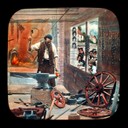
As one of a large family living [...] next door to Bamforth’s studio we were often used as models. I remember one occasion when Mr. Frank Bamforth came into our kitchen immediately we had finished a meal and took us up to the studio, seated us round a ‘set’ table for photographs connected with a film. My mother was most annoyed that she was not even allowed to wipe our faces or remove the feeding bibs we wore. Mr. Bamforth said he wanted us just as we were.44
In another letter, Edith Baker answers an enquiry concerning the motif of neglected children:
You mention ‘waifs’ in the snow. I think these children were from one or two families, Mrs. Fleming, and Mrs. Ludlam. Both of them had large families and if they do look like ‘waifs’ it was probably because both families were very poor, as were most of us in this valley between 1900 and the middle forties.45
Bamforth produced many lantern slide sets for events held by the temperance movement. The choice to use drunkards as actors in stories concerned with alcohol abuse shows a common sense approach to the realisation of sets in line with the movement’s aims.
A public-house interior is, perhaps, the easiest possible scene to fill with realistic sitters, for though Holmfirth is a busy little town there are always some idlers in the nearest ‘pub’ and they know that whatever else in the studio may be a fraud the beer is real. These good folk see no possible objection to posing as a room-full of ‘awful examples’ for a temperance reading; and curiously enough, there are some of the neighbours, harmless enough in real life, who make beautiful models as ‘leading drunkards,’ wife-beaters, etc., and who are quite willing to oblige by doing so.46
Such subjects naturally called for the costumed models to pose in ways they were not necessarily capable of in real life. James Bamforth and his family members themselves appeared as Life Models in a variety of roles and guises.47 The sixth image of Ora Pro Nobis, for example, shows James Bamforth (in a top hat) posing with his son Edwin (in a bowler hat) and his daughter Janie (turning towards the orphan girl).
During the photography sessions on set, the Life Models acted within a distinct microcosm of social relations: they faced the production team, not the audience. James Bamforth himself remarked:
I can generally get them to pose properly and to wear suitable expressions by not giving them much time to think about the matter themselves.
I generally pose them very quickly if much action is to be shown. For instance, in the picture called ‘The Man Hunt,’ I took the part of the baker myself. The man who represented the thief was a very poor actor, but I gave him a sudden shake and had the photograph taken before he had time to alter the position.
Very often I have to excite the models by shouting, or in other ways startling them into the position I require. With children it is quite different – I can usually train them to do whatever I want.48
As elements in a narrative’s course of action, the models’ poses locate a narrated present on the glass slide. In the studio, however, the present experience of the photographic production process was prevalent. Bamforth or another director had to direct the models in such a way as to ensure that their vision could come to life. Creative producers were responsible for either making use of the models’ authentic appearances as a means of design or for making them embody a variety of characters. These creative producers did not only select models, but also chose costumes and props, posed the models in action, looked after the models throughout the entirety of the production and finally maintained relations for future productions. While models were certainly able to discern their individual scenes as part of a narrative structure, the sequence of its events was of no great importance to them since scenes were shot individually.
In order for the creative producers to design convincing lantern slide sets, their knowledge of the potential use and impact of the glass slides’ in a live performance was paramount. Thus, creative designers were also aware of the complex relations within performances in the art of projection as well as in the manufacturing of lantern slides. Models’ actions, on the other hand, were limited to their respective parts within the dispositif of the manufacturing of lantern slides.
There is varying information on the matter of Bamforth’s payment for Life Models. Contemporary press reports on the company’s productions do not mention it and even create the impression that over all, the production process was great fun for all involved. In an interview with former models Annie Colling and Marion Barrowchlough, the models mention payments to the amount of two to four pence but are quick to stress that “It was done for the fun, not the money, and it was something they looked forward to”.49 Keeping in mind that most Holmfirth families lived in poverty at that time the significance of these payments should not be underestimated. To put this in perspective: at that time, two pence would buy over a pound of plaice or codfish – or from a child’s perspective: a whole pound of sour sweets.50 A number of models were also employed at Bamforth in other capacities such as colourist.51
Further Processing of negatives into glass slide sets
Further processing of the photographs was focused on delivering glass slide sets ready to order. The corresponding term in today’s media practice would be ‘post production’. This process started with the photochemical development of the exposed negative plates. Unfortunately, there are no detailed accounts of the operational sequence and layout of the manufacturing facilities. However, the role of this area of operation within the dispositif of the production of lantern slides can be inferred from the surviving glass negatives and positives as well as accounts in trade publications. A group of specialized journalists from the Optical Magic Lantern Journal and Photographic Enlarger, for instance, were impressed by the number of rooms they were shown during a 1902 tour of the facilities. They reported on the exposing rooms, where laboratory aids exposed the photographed scenes on the negatives onto glass plates. The darkroom’s well thought out system of running water, supplied by Bamforth's proper spring on the premises to save expenses, further drew the attention of the experts. Large stocks of collodion in opaque laboratory bottles, which was used as a photosensitive coating for the glass plates, attest to a considerable production activity.52
After their photochemical development, glass negatives were treated in a variety of ways before their exposure to produce the glass positives. Firstly, the field of view was determined with regard to the image’s appearance on the screen during projection. This section was scratched into the glass plate along with a title and a serial number. The negative of picture 18 in The Old Actor's Story (1899), for example, shows a scene, which had been constructed in the studio on a level plane, but its field of view was later rotated to be slanted, thusly simulating the rolling and pitching of the vessel. The angle at which the scene’s drop light had been painted on the background, as documented in the glass negative, shows that the rotation of the field of view for the glass positive had been considered during the design process of the background. In this glass positive, the drop light hangs perpendicular to the floor of the bunk in the belly of a ship seemingly in heavy swell.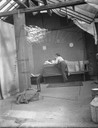
As another example, the glass negatives of Our Father’s Care (ca. 1885) were treated in a different manner. They show snow, illuminated by a street light, falling on a poor girl in a scene built in the studio. The snowflakes are visible on the glass negative as black painted spots.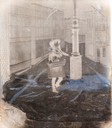

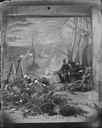
All glass slides were produced in a standard format of 3 ¼ by 3 ¼ inches, common in Great Britain.53 The range of dimensions of the square fields of view marked on different negative plates shows that the positive plates were not exposed in a contact process, but with optical enlargers and repro cameras.54
The greater part of the black and white glass positives was coloured manually. The applied colour had a considerable influence on the image's impact. No research on the colours or painting techniques used by Bamforth has been undertaken as of yet. It is also unknown at this point in time, whether the images were coloured by one person alone, or whether labour was divided based on the use of a certain colour or a certain degree of difficulty. To complete the production process, the finished glass positives were prepared for their use in a projection apparatus and made ready for despatch. Firstly, a format mask was applied. Secondly, little paper labels with the series title, serial image number and copyright notice were added. Then, a cover glass was affixed to the glass positive utilizing a paper binding strip around the edges of the slide. Lastly, a line from the suggested reading was provided on the margin of the slide to indicate at what point during the performance the respective slide should be projected onto the screen. All slides to a set were then packaged together in a sturdy cardboard box.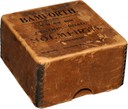
Supply and Distribution
Bamforth offered a catalogue for all their lantern slide sets which was first published in 1888 and updated with annual supplements. A backlist of all listed lantern slide sets allowed for continual reorders.55 Media historian Richard Crangle found a total of 14,728 glass slides in 1,105 lantern slide sets in the 1908 catalogue; the titles of the individual glass slides were also listed.56 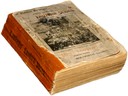
List: Bamforth, A Detailed Catalogue of Photographic Lantern Slides, Holmfirth, issue 1908
| Categories | Sets | Glass Slides |
| Illustrated Songs – Life Models | 336 | 3.495 |
| Services of Song – Life Models | 86 | 3.114 |
| Recitations – Life Models | 139 | 1.934 |
| Comics – from Drawings | 305 | 1.667 |
| Tales | 43 | 1.267 |
| Lecture and other General Sets |
18 | 912 |
| Hymns – Words Only | 13 | 593 |
| Religious Subjects | 14 | 388 |
| Miscellaneous | 20 | 345 |
| Illustrated Hymns | 64 | 331 |
| Effect Sets | 31 | 319 |
| Comics – Life Models | 23 | 264 |
| Nursery Stories | 6 | 56 |
| Old-fashioned Stories | 7 | 43 |
| Total |
1105 | 14.728 |
All creative decisions regarding the products made at Bamforth’s were naturally motivated by market expectations. The prime incentive was, accordingly, which lantern slide sets could be circulated in massive numbers. Thus, the company’s selection of texts and songs adapted for non-commercial performances was geared towards the demand of religious, charitable, socio-political and educational organisations. Whatever Bamforth expected these organisations would need for their propaganda or social intervention events was produced for the screen. Professional entertainment companies placed their orders according to what pleased their audience and what was demanded by the performers.
Lantern slide sets of biblical stories and narrative testimonies of faith were listed under “Religious Subjects”. These were aimed at customers from the different organisations of the Church of England and non-conformist denominations. The category “Hymn-Slides” contains glass slides intended for practical use in churches: they illustrated hymns and were foremost used to project the hymns’ words on the screen for joint singing. A large part of Bamforth's range geared at this clientele is found in the category “Services of Song – Life Models”. The category offers 86 comprehensive lantern slide sets which provided enough content for a whole performance on their own and consisted of a total of 3,114 glass slides. The sets were a compilation of popular tales for recitation in church services, interspersed with songs and hymns sung by the congregation or the choir. All texts and scores were available from the publishing trade. Bamforth also produced specific glass slide sets used to visually accentuate the stories told in Services of Song on the screen.58
Many of these Services of Song, Recitations, Tales or Illustrated Songs combine religious issues with the 'social question'. A Peep Behind the Scenes (ca. 1888) proves that the link of religious and social issues is a common one in Bamforth's range of products starting from the early beginnings of the company, as documented in their first catalogue from 1888. Bamforth also frequently adapted publications by the interconfessional Religious Tract Society, who published the children's stories of Mrs O.F. Walton. Other adaptations of publications by the Religious Tract Society include Hesba Stretton's Jessica’s first prayer and Humpty Dumpty's silver bells: a story illustrating the Lord's Prayer by Mrs M.S. Haycraft.59 A prime example for Bamforth's lantern slide sets concerned with the 'social question' beyond a religious context are adaptations of George R. Sims's ballads such as In the Workhouse, A Bunch of Primroses or The Magic Wand. Bamforth adapted a total of 21 of Sims's texts – more than of any other author. These productions were used and performed by secular philanthropic organisations and Christian charities alike.
Another target audience for Bamforth's slides were organisations and lecturers of the temperance movement. Bamforth's catalogue lists the category “Temperance Stories in Verse. Life Models”60 as early as its first issue in 1888. In the first issue's temperance category there are seven lantern slide sets, among them I Have Drunk my Last Glass (ca. 1888) and The Fool’s Pence (ca. 1888). Bamforth's last known set on temperance issues is listed on the 1912/13 season's Supplementary List. It is a Service of Song titled A Prodigal’s Return (1912).61 Organisers of temperance events were looking for ways to provide pleasurable alternatives to a visit to the local pub for their audiences. Bamforth supplied them with a wide range of comic slides, entertaining stories and romantic songs.62
The first two Illustrated Songs published by Bamforth were Nazareth (1895) and Deep in the Mine (1895).63 By 1908 this category’s 336 lantern slide sets make up a quarter of the products advertised in their catalogue and contains the largest number of individual slides of any category (3,495).64 Up until the First World War, Illustrated Songs are also first on the list of the latest lantern slide sets in the Supplements. Bamforth understood the potential growth of this particular segment of the lantern slide market and accordingly tried to occupy the largest share of the high-selling segment. They write: “If the Song you want is not included in this list, do not delay in acquainting us of the fact. We are pleased at all times to illustrate good up-to-date Songs.”65 By the early 20th century romantic songs and folk songs had replaced the social and religious issues as the prevalent content of Illustrated Songs in Bamforth’s range. Additionally, the 1914/15 season mirrored current politics. War became a central issue with songs such as Bravo Territorials! and Your King and Country Need You. 66
As manufacturers, Bamforth supplied their lantern slide sets to slide retailers and hirers as well as large organisations. Glass slides, ready for use, were produced on demand from the glass negatives on the back list. “We have a large staff of Slide Painters on the premises. Orders entrusted to us are executed on the day of receipt,”67 stated Bamforth in their catalogue emphasizing the speed with which these transactions were carried out. The company maintained a large warehouse to handle shipping. James Bamforth showed the building to a group of trade journalists from the Optical Magic Lantern Journal and Photographic Enlarger during their tour of the premises in 1902.
The room we were seated in was lined with shelves filled with slides ready to be sent off to the dealers, the cupboards were packed to their full extent. Then Mr. Bamforth began to go into figures, and we got bewildered, there were some hundreds of thousands there, and in an inner room we saw three or four assistants hard at work on pile after pile of slides, masking and binding, – we forget how many thousands, – then into another store room fitted with shelves from floor to ceiling, with just sufficient space between each shelf to accommodate the slides, on edge. This room has four tiers of shelves 52 feet long 8 feet high, with capacity for another 1,500,000 slides.68
In addition, Reynolds also mentions two million images in Bamforth’s depot.69 These numbers illustrate the considerable output of works in the historical art of projection manufactured in industrial mass production. And, in conclusion, they also suggest a widespread practice of performing magic lantern shows. Especially when keeping in mind that every single one of the 1,105 lantern slide sets advertised solely by Bamforth could be used in performances any number of times.
- ^ Cf. on the history of photographic lantern slides: G. S Dicker, „Who Introduced Photographic Magic Lantern Slides?“, The Optical Magic Lantern Journal and Photographic Enlarger, vol. 6, no. 68, 1895, p. 6-7; Jürgen Berger, „Foto-Geschichten. Fotografische Laternenbilder im viktorianischen England“, Fotogeschichte, 3. Jg., Heft 8, 1983, p. 13-28; Jens Ruchatz, Licht and Wahrheit. Eine Mediumgeschichte der fotografischen Projektion, Wilhelm Fink, München 2003, p. 69-101.
- ^ Cf. Ludwig Vogl-Bienek, Richard Crangle (eds): Screen Culture and the Social Question 1880-1914. KINtop Studies in Early Cinema, vol. 3. John Libbey Publishing: New Barnet (GB) 2014.
- ^ Max Weber, Economy and Society. An outline of interpretive Sociology. Guenther Roth and Claus Wittich (eds.). Bedminster Press: New York 1968, Vol. 1 p. 4.
- ^ Cf. Bamforth, A Detailed Catalogue of Photographic Lantern Slides, Holmfirth, Issue 1908 (Index not included in the 1910 publication); cf. The Dutch distribution catalogue of British manufacturers York & Son: Ivens, Lijst van Lantaarnplaatjes, Nijmegen, Amsterdam, Groningen, Den Haag o. J. [ca. 1912].
- ^ Cf. Ivens, Lijst (Note 3), p. i-ix.
- ^ Cf. Bamforth, Catalogue (Note 4), p. i-xv.
- ^ Cf. Ann Hecht, “Church Army”, in: David Robinson et al. (Hg.), Encyclopaedia of the Magic Lantern, The Magic Lantern Society, London 2001, p. 68-69.
- ^ Cf. entries on these organisations on the DVD-ROM The Illustrated Bamforth Slide Catalogue, The Magic Lantern Society, London 2009.
- ^ Cf. Riley Brothers, Catalogue of optical lantern slides, Bradford o. J. [1904/5]. Nine consecutively numbered Supplements Season 1906-07-Season 1914-15; United Kingdom Band of Hope Union, Illustrated Catalogue of Magic Lanterns, Dissolving Views, Slides etc., Season 1891-92, London 1891 [York & Son: Section B, p. 1-160; Bamforth: Section C, p. 3-61].
- ^ Nine lantern slide sets produced with this method are available on DVD: cf. Martin Loiperdinger, Ludwig Vogl-Bienek (curators), Lichtspiele and Soziale Frage. Screening the Poor 1888-1914, Edition Filmmuseum 64, film & kunst, München 2011.
- ^ Philip Reynolds, “Sentiment To Order”, The Harmsworth Magazine, vol. 5, no. 28 (October 1900), p. 337-343, available as facsimile on the DVD-ROM Bamforth Slide Catalogue (Note 8).
- ^ ibidem, p. 338.
- ^ Cf. David Henry: “York & Son, Part 1”, “York & Son, Part 2”, New Magic Lantern Journal, vol. 3, 1984, Nr. 1, p. 13-16, no. 2, p. 13-18; Riley Brothers, Catalogue (Note 8); Mason, Catalogue of Photographic Slides for the Optical Lantern, Southampton o. J. [ca. 1919].
- ^ Cf. Richard Crangle, „Zweidimensionales Leben. Die britischen Life model-Dias“, Fotogeschichte, 19. Jg., Heft 74, 1999, p. 25-34.
- ^ Cf. for instance the advertisement in the Optical Magic Lantern Journal and Photographic Enlarger, vol. 8, no. 101, 1897, p. XI.
- ^ Cf. Crangle (Note 14), p. 26.
- ^ Cf. Richard Crangle, “Bamforth”, in: Robinson et al. (Note 7), p. 26-27.
- ^ Cf. »Life Model Studies, I. A peep behind some scenes«, The Photogram, no. 6 (February 1899), p. 46 -48; »No. II. – The Models Themselves«, The Photogram, no. 7 (March 1899), p. 76-78; [Alfred Henry Saunders], »Prominent Men in the Lantern World: New Series. No. 1. Mr. James Bamforth, of Holmfirth, Yorks«, The Optical Magic Lantern Journal and Photographic Enlarger, vol. 13, no. 151, 1902, p. 7-9.
- ^ National Archives, COPY 1/377/228-230, 276-279.
- ^ Cf. Bamforth Slide Catalogue (Note 8), Booklet, p. 17-21.
- ^ Frederick Alderson, The Comic Postcard in English Life, David & Charles, Newton Abbot 1970, p. 11.
- ^ Saunders (Note 18), p. 7.
- ^ Life Model Studies I (Note 18), p. 46.
- ^ Cf. Bamforth’s ‘Life Model’ Picture Postcards, Bamforth’s ‘Life Model’ Pantomime Songs, Bamforth’s New Premises and Studios, 1905-6, in: Reprint from The Caxton Magazine and British Stationer, Bamforth, Holmfirth 1906, p. 1-11, in this case p. 3. This graphics and printing industry trade paper was interested in Bamforth's practice to re-use the glass negatives of Life Model Slides for the production of picture postcards. For the most part, the Caxton Magazine article echoes Reynolds (Note 11).
- ^ Cf. Life Model Studies I (Note 18), p. 48; Reynolds (Note 11), p. 343.
- ^ Edith Baker, letter, 21.6.1967, Historic Library, Kirklees Metropolitan Council, Huddersfield. Mrs. Goshawk and R. K. B. Aldridge compiled oral history-documents on the history of the Bamforth company in the 1960s. Letters and interview transcripts from this collection were examined by the author on site.
- ^ Cf. Reynolds (Note 11), p. 338-340.
- ^ Cf. Reynolds, p. 343; cf. also Reprint from The Caxton Magazine (Note 23), p. 8.
- ^ Reprint from The Caxton Magazine (Note 24), p. 6; identical: Reynolds (Note 10), p. 339.
- ^ Reprint from The Caxton Magazine (Note 24), p. 46.
- ^ Saunders (Note 18), S.8.
- ^ Cf. Reprint from The Caxton Magazine (Note 24), S.3 and p. 6, Abb. 5.
- ^ Reynolds (Note 11), p. 343.
- ^ Cf. ibidem, p. 342.
- ^ Life Model Studies I (Note 18), p. 48.
- ^ Cf. Reynolds (Note 11), p. 342.
- ^ Ibidem, p. 340.
- ^ Ibidem, p. 343.
- ^ Cf. Bamforth Slide Catalogue (Note 8): Information on persons with the surname Bamforth. On the interviews with former models, see Note 26.
- ^ Cf. Edith Baker, letter, 15.5.1967, Historic Library, Kirklees Metropolitan Council, Huddersfield, and thereat Interview with „Mrs. G. Lewis (nee Gertrude Ellen Middleton)“, September 1977, Typoskript.
- ^ Life Model Studies, No. II. (Note 18), p. 76.
- ^ Ibidem.
- ^ Cf. ibidem.
- ^ Edith Baker, letter, 15.5.1967 (Note 40).
- ^ Edith Baker, letter, 21.6.1967, (Note 26).
- ^ Ibidem.
- ^ Cf. Bamforth Slide Catalogue (Note 8): Information on persons with the surname Bamforth.
- ^ Reynolds (Note 11), p. 341.
- ^ Interview with Mrs. Annie Cooling and Mrs. Barrowclough, September 1975, Typoskript, Historic Library, Kirklees Metropolitan Council, Huddersfield.
- ^ Cf. Harold Priestley, The what it cost the day before yesterday book, Kenneth Mason, Homewell 1979. p. 35.
- ^ Cf. Edith Baker, Brief, 15.5.1967 (Note 40).
- ^ Cf. Saunders (Note 18), p. 7.
- ^ Cf. Lester Smith, Stephen Herbert, “formats, slide”, in: Robinson et al., (Note 7), p. 116-117.
- ^ Cf. relevant glass negatives in the Bamforth Collection of the Kirklees Museums and Galleries and the illuminago Collection.
- ^ Bamforth, Catalogue (Note 4).
- ^ Richard Crangle, Hybrid Texts. Modes of Representation in the Early Moving Picture and Some Related Media in Britain, unpublished dissertation, Exeter University, Exeter 1996, p. 246-295.
- ^ Bamforth, Catalogue (Note 4), 1908 issue, p. i-xv. The index on these pages is not present in the 1910 version, nummerical data on the respective categories according to Crangle (Note 56), p. 295.
- ^ Cf. Illustrated Bamforth Slide Catalogue (Note 8): “Services of song” in the category “Readings and songs listed by type of text”.
- ^ Hesba Stretton, Jessica's first prayer, Penny Books for the People, vol. 45, Religious Tract Society, London 1867; Mrs M. S. Haycraft, Humpty Dumpty's silver bells: a story illustrating the Lord's Prayer, Religious Tract Society, London 1888.
- ^ Bamforth, Catalogue (Note 4), p. 14.
- ^ Cf. ibidem, Supplementary List, Season 1912-13, p. 510.
- ^ Cf. for instance “The Lantern versus the Tap-Room”, Help. A Journal of Social Service, vol. 1, no. 2, 1891, p. 42-43.
- ^ Cf. Bamforth, Catalogue (Note 4), p. 111; Crangle (Note 56), p. 159.
- ^ Cf. Crangle, (Note 56), p. 295.
- ^ Bamforth, Catalogue (Note 4): Supplementary Lists, respectively on the other side of the cover: Season 1907-1908; Season 1912-13, Season 1914-15.
- ^ Ibidem, Supplementary List, Season 1914-15, p. 566-567.
- ^ Cf. ibidem, Supplementary Lists, Season 1912-13, Season 1914-1915.
- ^ Saunders (Note 18), p. 7.
- ^ Cf. Reynolds (Note 11), p. 343.
 Gefühle auf Bestellung_01.pdf